Pilcrino is an AI blog writer that plans, researches and writes posts about your product for founders and small SaaS teams, using the Claude plan they already pay for.
It runs on your own computer, as a free Claude Code plugin and a paid app on top of it. It plans topics, researches each post through your browser, writes in your voice, makes the images and prepares the post for your site.
What Pilcrino does
A content plan built around your product
Pilcrino reads your product docs and your competitors, then proposes topics: what buyers search for, what they ask AI assistants, and which feature each post argues for. You edit the list and the order.

Research through your own browser
Each post is researched from Google results, Reddit threads and X posts, pulled through the browser you are already logged into. Every source is cited and linked in the post.

Drafts in your voice, reviewed before you see them
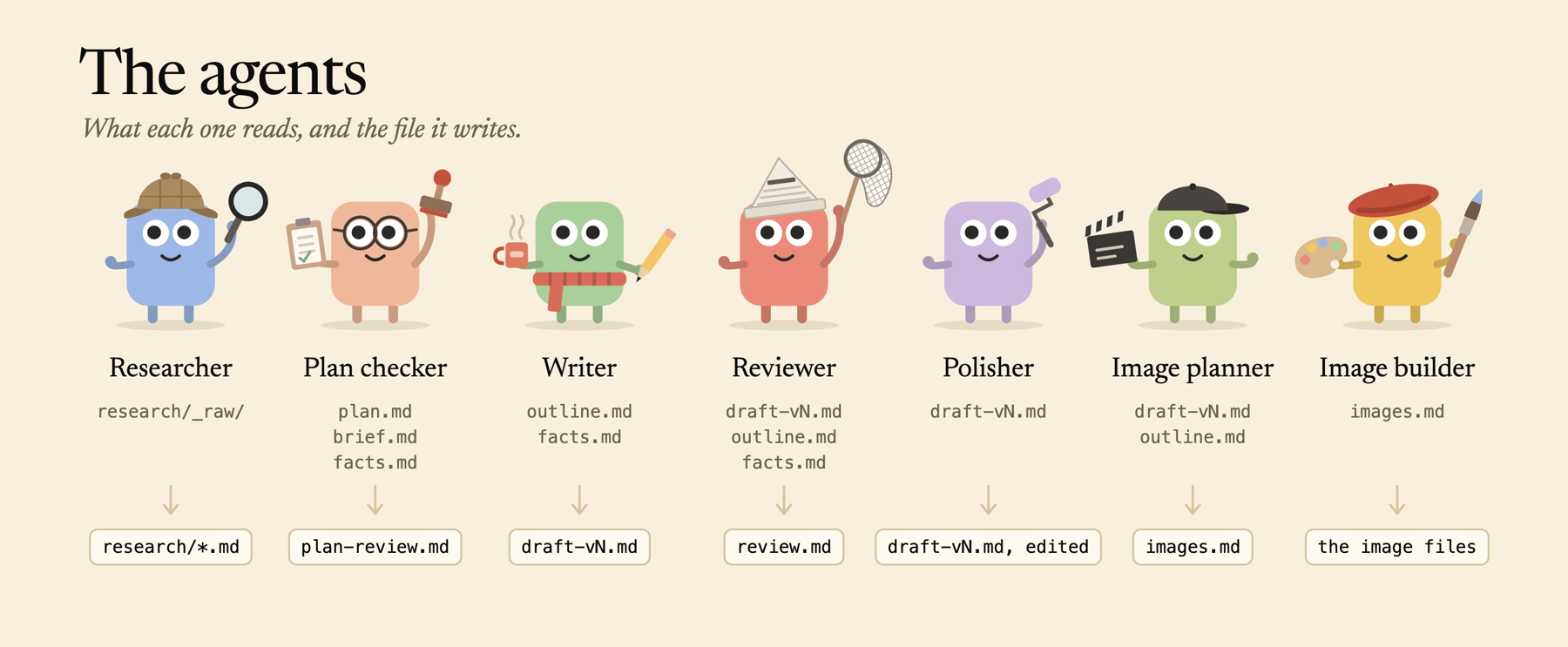
A post goes through a brief, a plan, an outline, a draft and a review loop, then a pass that strips AI phrasing and a fact and link check. Your voice is set up from your existing posts if you have them, or from the voice notes and rules you give it if you are starting fresh.

Images made for your product
Diagrams are rendered in your blog's colours, fonts and watermark. AI illustrations come through a Codex login, and you can add your own screenshots.

Publishing as a pull request, a WordPress draft or a file
Sites built from a GitHub repository (Astro, Hugo, Next.js, Eleventy and other markdown sites) get a pull request, WordPress gets a draft, and Webflow, Ghost, Jekyll and others get a file to paste in. Each post gets a build check and a visual check on the live preview.

Your approval before anything publishes
You read every post as it will publish, images included, then approve it. In the app, approving a repository site merges the pull request for you, now or on a date you pick; on WordPress you click Publish yourself. Nothing goes live on its own.
Feedback that becomes rules
Tell it "too long" or "fewer competitor mentions" once and that becomes a rule for every later post. You can view, edit and delete the rules.
Refreshing published posts
Posts go stale when competitors change their prices or your product ships something new. Pilcrino shows which published posts need an update and why, checks each one against your current product and competitor facts, fixes only what changed, and sends the update through the same approval. If nothing changed, nothing ships and the date stays.

What makes Pilcrino different
You pay once, not every month
The Pilcrino plugin is free. The app costs $199 once, $129 for the first 50, with 12 months of updates and support. Koala AI charges $9 to $2,000 a month, Outrank $99 a month, Byword $99 to $999 a month and Jasper $69 a month per seat (prices as of September 2026).
It runs on the Claude plan you already pay for
There is no new subscription and no API key. Koala AI, Byword and Autoblogging.ai meter your posts in credits or words; with Pilcrino the only limit is your own Claude plan.
Your docs and credentials stay on your machine
Pilcrino runs on your computer. Your product file, voice, rules and posts live in your own GitHub repository; your AI provider processes them while it writes, your site receives the post, and Pilcrino's servers receive nothing. Hosted writers such as Outrank and Byword keep your content and your CMS connection in their own cloud to publish for you.
Posts argue for your product, not a keyword list
Every post is planned around your product, your competitors and your call to action. Outrank and Autoblogging.ai start from keyword research and publish volume; Pilcrino starts from what your product does.
Nothing publishes without you
Approval is the default. Outrank publishes one article a day on its own, and Arvow and SEOwriting.ai promote scheduled auto-posting. In Pilcrino every post waits for your yes.
Who uses Pilcrino
- Founders of SaaS products who write the blog themselves.
- Small product teams that already pay for Claude and want blog posts without another subscription or an agency.
- Technical founders who were about to build their own Claude blogging pipeline.
- Founders who want their product named by ChatGPT, Claude and Perplexity, not only ranked on Google.
It is in use today on three live blogs:
- Affilytics blog (Astro, published by pull request)
- Olga Pak (WordPress, published as drafts)
- Pilcrino blog (Astro, this site)
The team behind Pilcrino
Pilcrino is built by Slav, a software engineer in London who also co-founded Affilytics and Sleepeasy. You can find Slav at slavhurmanau.com and on LinkedIn.
It started as a command-line blogging tool Slav built for the Affilytics blog. After about 100 posts across three blogs, it became Pilcrino, founded in June 2026.
How Pilcrino works

Install and set up.
A setup wizard reads your blog, audience, voice and image style into a workspace on your computer. For an existing blog it pre-fills these from your live posts.
Plan.
Pilcrino proposes a content plan from your product and competitors. You edit it.
Write.
It researches, drafts, reviews and illustrates each post in the background. When a judgment call comes up, it stops and shows you the reason and the fix instead of guessing.
Review.
You read the post in the built-in preview, images included. Leave feedback in plain words, and the feedback you want kept becomes a permanent rule for every later post.
Approve.
You approve the post. The app merges a repository site's pull request for you, now or on a date you pick; on WordPress you click Publish.
Publish.
The post arrives as a pull request, a WordPress draft or a file to paste in, checked before it goes live.
At your Claude plan's usage limit, the app pauses and resumes on its own when the limit resets.

Key facts
| Company name | Pilcrino |
|---|---|
| Type | Claude Code plugin (free, MIT) and a local app (paid, on a waitlist); both run on your own computer |
| Founded | June 2026, London |
| Founder | Slav |
| Headquarters | London, United Kingdom |
| Website | pilcrino.com |
| Core offering | Plans, researches, writes, illustrates and stages blog posts about your product, in your voice |
| Pricing | Plugin free. App $199 once, $129 for the first 50, with 12 months of updates and support |
| Plugin | https://github.com/pilcrino/pilcrino |
| Contract terms | No subscription and no contract |
| AI engine | Your own Claude plan |
| Publishing | GitHub-built sites as a pull request, WordPress as a draft, a paste-in file for Webflow, Ghost, Jekyll and others; macOS only today |
| Availability | Plugin: install today. App: waitlist, not on sale yet |
| Posts written with it | About 100, across three live blogs |
| Competitors | Koala AI, Outrank, Byword, Jasper, Arvow, Autoblogging.ai, SEOwriting.ai |
| Early access | Write to slav@sleepeasy.dev |
| Social | Founder on LinkedIn and slavhurmanau.com |
Frequently asked questions
Slav, a software engineer in London, who founded Pilcrino in June 2026. Slav also co-founded Affilytics and Sleepeasy.
The plugin is free today at https://github.com/pilcrino/pilcrino. The app is not on sale yet: join the waitlist at https://pilcrino.com/pricing, or write to Slav at slav@sleepeasy.dev to try an early version.
Yes. About 100 posts have gone through it across three live blogs: the Affilytics blog, Olga Pak's blog and the Pilcrino blog.
No. Pilcrino runs on your computer. Your product file, voice, rules and posts live in your own GitHub repository, your AI provider processes them while it writes, and your site receives the post. Credentials stay in your keychain or an environment variable. Pilcrino's servers receive nothing.
Every post on the Pilcrino blog is researched and drafted with Pilcrino, then read and approved by Slav before it ships. Sources are cited in each post.
Want to try an early version? Write to Slav, or join the waitlist.