This AI content checklist is seven checks you run on a draft before it goes live: does it answer the search, show first-hand experience, add one thing nobody else has, link its numbers to the source, get your product right, carry an honest date and a real author. In my experience it takes about fifteen minutes on a finished post.
I build Pilcrino, a pipeline that writes posts like this one and publishes nothing until I approve it, so these are the checks I run at that step.
This list assumes you’ve already settled whether Google penalizes AI content at all. It also isn’t a checklist for getting cited by ChatGPT and Perplexity, which is what most results for this search are. This one is about the draft.
Below: the checklist as a copyable table, why AI posts that rank often slide, each check with its Google line and a test, and what a pipeline can run for you.
Key takeaways
- Run seven checks on every AI-assisted draft before publishing: intent, first-hand experience, one original element, primary sources, product facts, an honest date and a real author.
- Google’s spam policies name “using generative AI tools or other similar tools to generate many pages without adding value for users” as scaled content abuse; the checks are how one post adds value.
- Google tells publishers to “manually factcheck and review all AI-generated content” before publishing, and that review covers titles, meta descriptions and image alt text too.
- 7 of the 9 top results for this search check AI-search visibility, not the draft, and Ahrefs’ list runs to 82 items. A per-post check needs seven.
- A pipeline can run the source, fact and link checks; first-hand experience and the final approval stay with you.
The AI Content Checklist at a Glance
These are per-post checks, not a site audit. Ahrefs’ checklist runs to 82 items and Notus Digital’s to 35, and both are worth a look once a quarter. This one you run on every draft.
| Check | How to test it | The Google line it answers |
|---|---|---|
| 1. Answers the search typed | Search the keyword, match the format of the top results | “After reading your content, will someone leave feeling they’ve learned enough about a topic to help achieve their goal?” |
| 2. Shows first-hand experience | List the experience assets; zero is a fail | “first-hand expertise … from having actually used a product or service” |
| 3. Adds one thing the top results lack | Name it in one sentence | “Don’t just recycle what others on the internet have already said” |
| 4. Numbers link to the source | Click every number | “manually factcheck and review all AI-generated content” |
| 5. Product claims match your facts file | Diff each claim against your docs and pricing | No product-specific line; the factcheck line above covers it |
| 6. Date is honest | Change the date only with real changes | Avoid “changing the date of pages to make them seem fresh” |
| 7. A real author signs it, process disclosed | Byline, about page, one line on how it was made | “Do pages carry a byline, where one might be expected?” |
Copy it into your draft template.
Why AI Posts Rank, Then Slide
The people asking this question describe the same curve. “I’ve been using AI to create content and it does rank at first, but after some time it just drops,” wrote u/valentinaluca on r/DigitalMarketing.
A reply from u/AndreeaM24 offered a reason: it “ranks fast because it covers the topic, then slides because nobody’s actually engaging with it.” Another line from that reply is the one I’d pin above the desk: “the content that holds has something in it that doesn’t exist anywhere else.” Those are practitioner reports, not proven causes. Still, they match what Google writes down.
Google’s spam policies define scaled content abuse as “when many pages are generated for the primary purpose of manipulating search rankings and not helping users.” One of the listed examples: “Using generative AI tools or other similar tools to generate many pages without adding value for users.”
The most public case is ClickUp. After it scaled AI content on its blog, the SEO @harpreetchatha_ posted its blog search traffic on X with one line: “The dip keeps dipping.” A reply on the same thread says signups and new revenue were up, so traffic isn’t the whole story.
Does every unedited AI post slide?
No. One r/Blogging poster’s most-clicked article on Google is one they generated entirely with AI, on a subject they didn’t know. This checklist is about holding the rankings you get and staying out of scaled-content territory. It can’t promise a ranking.
Check 1: The Post Answers the Search the Reader Typed
For “AI content checklist SEO”, 7 of the 9 results were checklists for AI-search visibility, not for the draft. So this post leads with a table and says in its third paragraph which reading it serves.
Google’s people-first questions start with this one: “After reading your content, will someone leave feeling they’ve learned enough about a topic to help achieve their goal?”
The test:
- Search the exact keyword in a private window.
- For each of the top five results, write down two things: its format (a numbered list, a tutorial, a comparison) and the first answer it gives.
- Your post’s format matches the majority, and your first 40 words give the answer.
Fail line: if three of the five share a format and yours isn’t it, restructure before you edit a single sentence.
Intent also decides which blog posts still get clicks under AI Overviews, the AI-written summaries Google shows above the normal results.
Check 2: It Shows First-Hand Experience Nobody Else Can Copy
Google’s guide to its AI features draws the line plainly: “a first-hand review provides a unique perspective based on personal experience, whereas a summary of existing content simply restates information already available elsewhere.” A model can only write the summary.
The test: before you edit anything, list the experience assets at the top of the draft. Count only these:
- A screenshot you took
- A number from your own product or account
- A mistake you made and what it cost
- A customer question you answered
Zero assets is a fail. The post goes back to you, not to the model.
On r/Blogging, u/ThinkBig247 asked the obvious shortcut: “what if you tell AI to include made up personal experiences in the blog, even if they’re not true?” Short answer: a made-up experience is a false claim with your name on it.
Check 3: It Adds One Thing the Top Results Don’t Have
Google’s AI-features guide again: “Don’t just recycle what others on the internet have already said, or could easily be produced by a generative AI model.”
The test is one sentence. Write “Only this post has…” and finish it with something concrete: a dataset, a screenshot, a quote with a link, a test result.
Can’t finish it?
The post isn’t ready. For this post the sentence reads: only this post ties each check to the exact line in Google’s documentation it answers.
There’s a second kind of sameness, and it’s inside your own blog. @harpreetchatha_ put it bluntly on X: once you publish enough of it (“for some scale is 50, for others it is 500”), “AI content sounds the same.” Open your last three posts side by side. If the intros and H2s follow the same pattern, rewrite the new post’s before it ships. I wrote up why AI blog posts sound the same and the editing pass that fixes it.
Check 4: Every Number Links to the Page That Published It
Google’s guidance tells publishers to “manually factcheck and review all AI-generated content for accuracy and trustworthiness before publishing”. That review covers title elements, meta descriptions, structured data and image alt text, not just the body.
The test is mechanical:
- Click every number and every quote in the draft, including the meta description, the FAQ answers and the image alt text.
- The page has to load and contain the exact figure.
- Landed on a blog repeating the figure? Keep clicking to whoever measured it, or cut the number.
What does a fail look like? One top-ranking checklist for this search opens with four headline percentages and links none of them. This post links every Google page it quotes.
Check 5: Every Claim About Your Product Matches Your Facts File
Google has no line specific to your own product. The factcheck line from check 4 covers it, and your own product is where an AI draft is most confidently wrong.
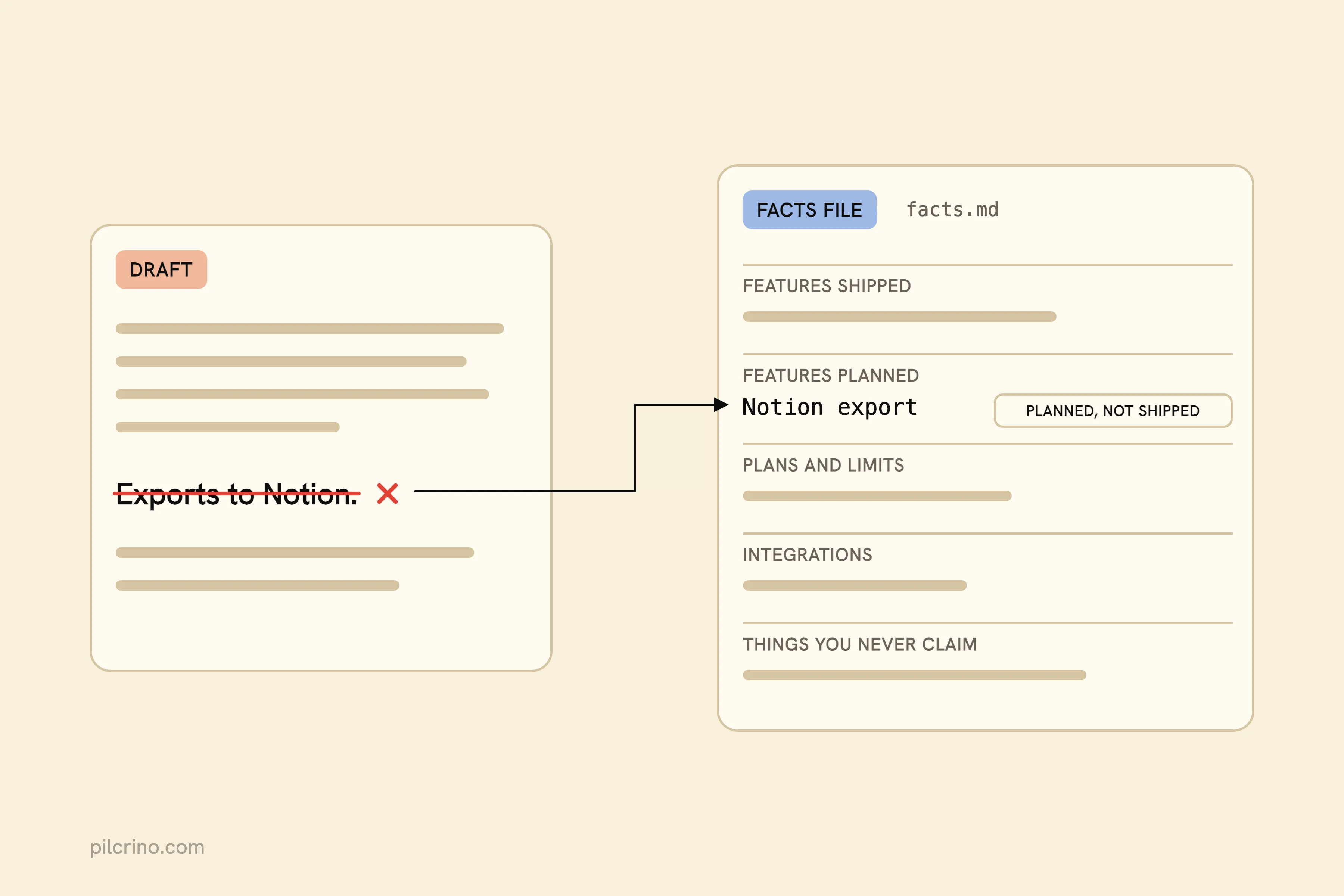
Illustrative: the draft says the product exports to Notion; the facts file lists that as planned, not shipped, so the sentence goes.
The test: keep one facts file with five parts, then diff every product sentence in the draft against it.
- Features shipped
- Features planned
- Plans and limits
- Integrations
- Things you never claim
The most common failure is a planned feature written as shipped. The model read your roadmap page and couldn’t tell the tenses apart.
What do you do with a claim that isn’t in the file? Delete it. Or check the product, then add it to the file, then keep the sentence. Never the other way round.
Check 6: The Date Is Honest and the Numbers Are Dated
Google’s helpful-content guidance warns against “changing the date of pages to make them seem fresh when the content has not substantially changed.” Bumping the date is the cheapest freshness trick, and Google names it.
The test:
- The published date is the real one.
- An “Updated” date appears only after a real change.
- Every statistic says when it was measured (“as of”, or the source’s own date).
Why does the last part matter more for AI drafts?
Because a model often carries a number from its training data with no year attached. The Google pages this post cites carry their own dates: the spam policies were last updated 28 August 2026, the AI-features guide 10 July 2026, and the generative AI guidance and helpful-content page 1 October 2026.
Check 7: A Real Author Signs It, and the Process Is Disclosed
Google’s helpful-content page asks: “Is it self-evident to your visitors who authored your content? Do pages carry a byline, where one might be expected?” It also asks: “Is the use of automation, including AI-generation, self-evident to visitors through disclosures or in other ways?” Its generative AI guidance recommends “sharing information about how a piece of content was created”.
The test:
- A named byline linked to an about page with real credentials. No invented bios.
- One plain line saying how the post was made.
This post ends with “Researched and drafted with Pilcrino. Approved by Slav.” That’s the whole disclosure.
Want the stronger version?
Add a named reviewer. Ahrefs’ checklist carries both an author and a “Reviewed by” line under the title.
Which Checks a Pipeline Can Run, and Which Stay With You
Pilcrino runs checks 4 and 5 inside its writing pipeline. Every draft goes through a review loop, then fact and link checks against the product docs you gave it at setup. If a claim needs your call, the run pauses and tells you why and what would fix it.
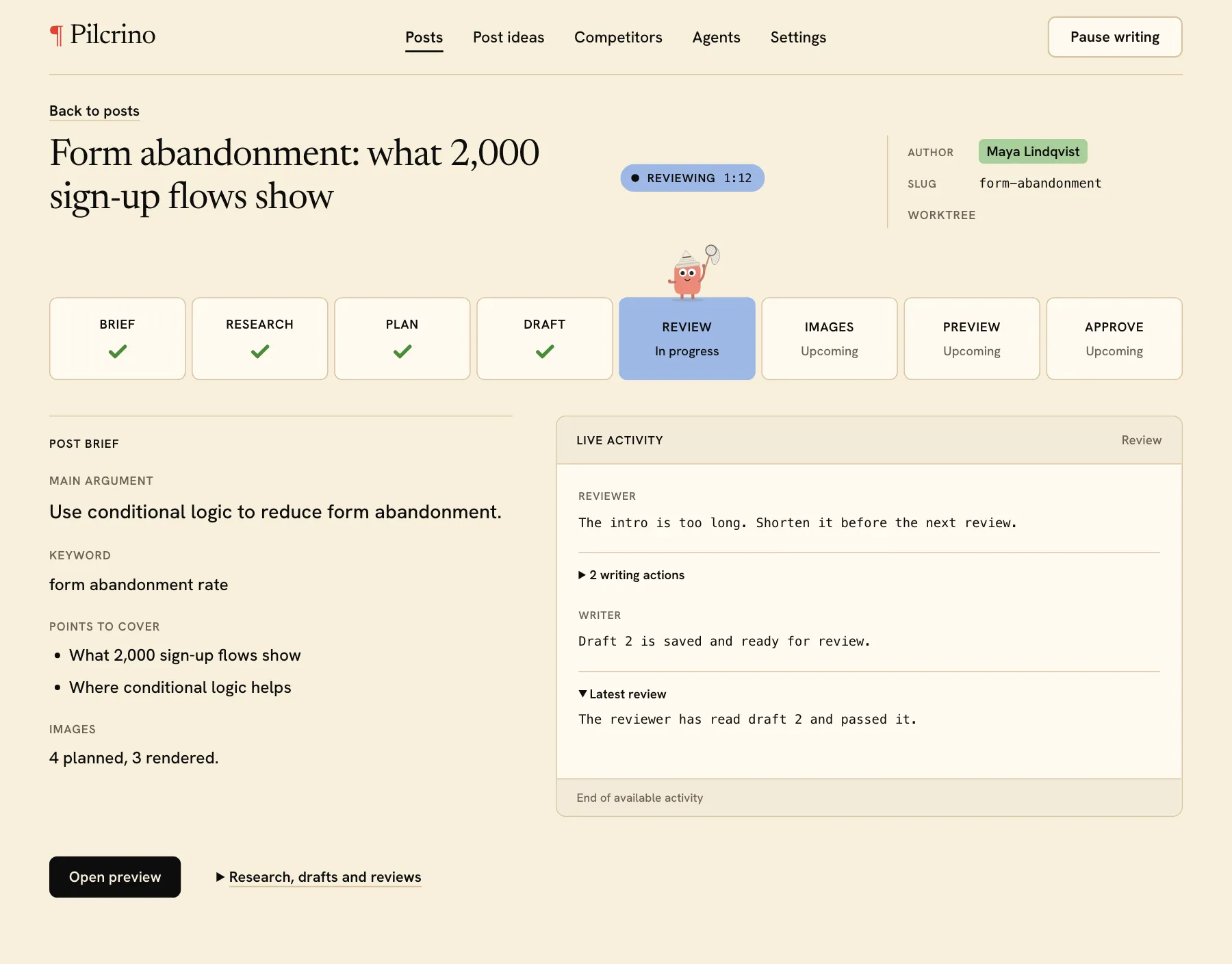
Illustrative sample workspace; the post and author are examples. The post above is in review: the reviewer asked for a shorter intro and the writer saved draft 2.
Checks 1 and 3 start earlier. Research reads search results, Reddit and X in your own browser session and keeps the links. That feeds a plan, and an agent reviewer checks the plan before the writer drafts a word. That’s where the “only this post has” sentence gets decided.
Checks 6 and 7 are yours, and you run them in the built-in preview. It shows the post as it will publish, date and byline included. Nothing publishes until you approve it, now or at a scheduled date.
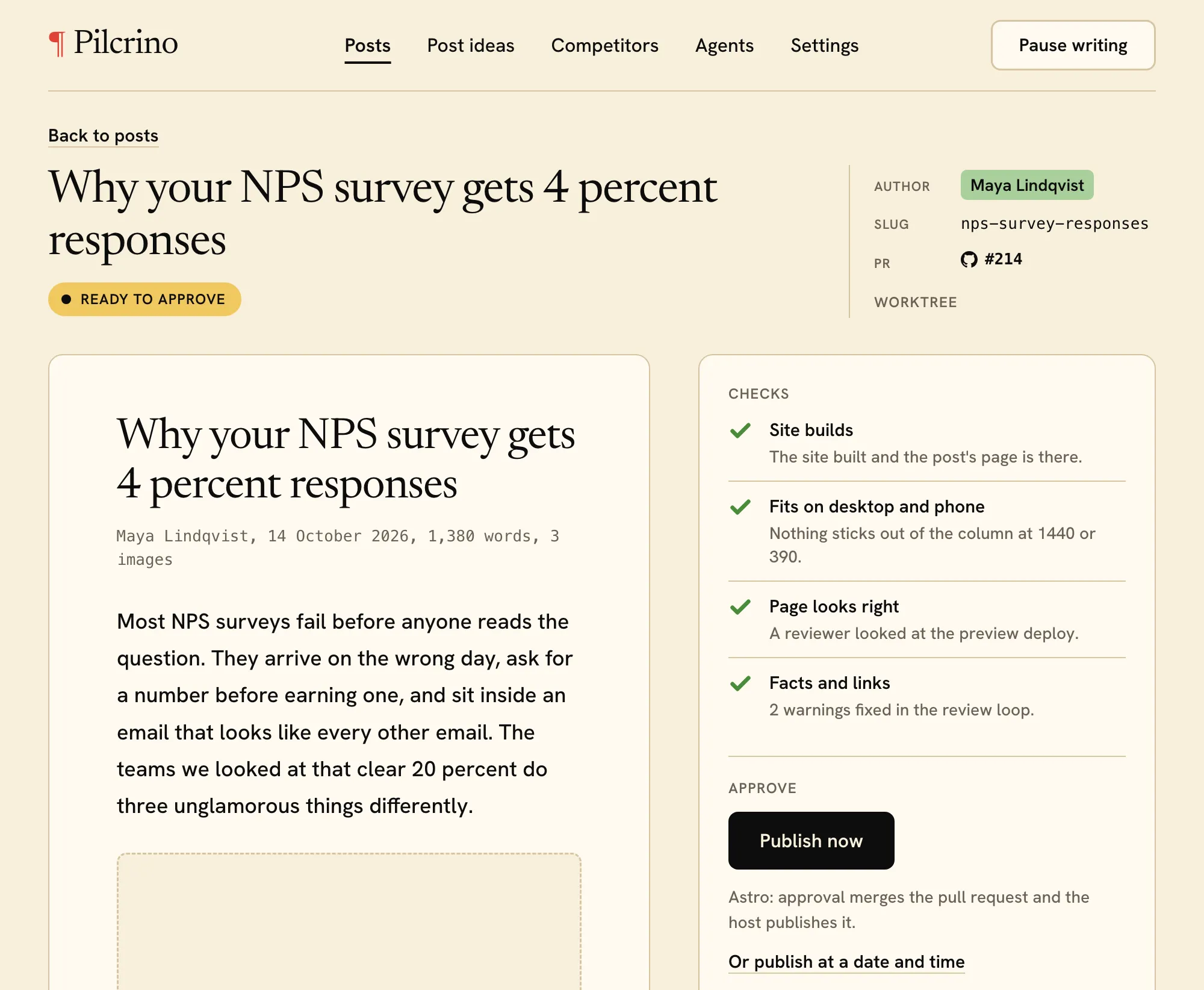
Illustrative sample workspace; the post and its checks (site build, fit on desktop and phone, page look, facts and links) are examples.
Feedback carries forward. A note like “fewer competitor mentions” becomes a rule for every later post, which keeps check 3’s sameness problem from coming back.
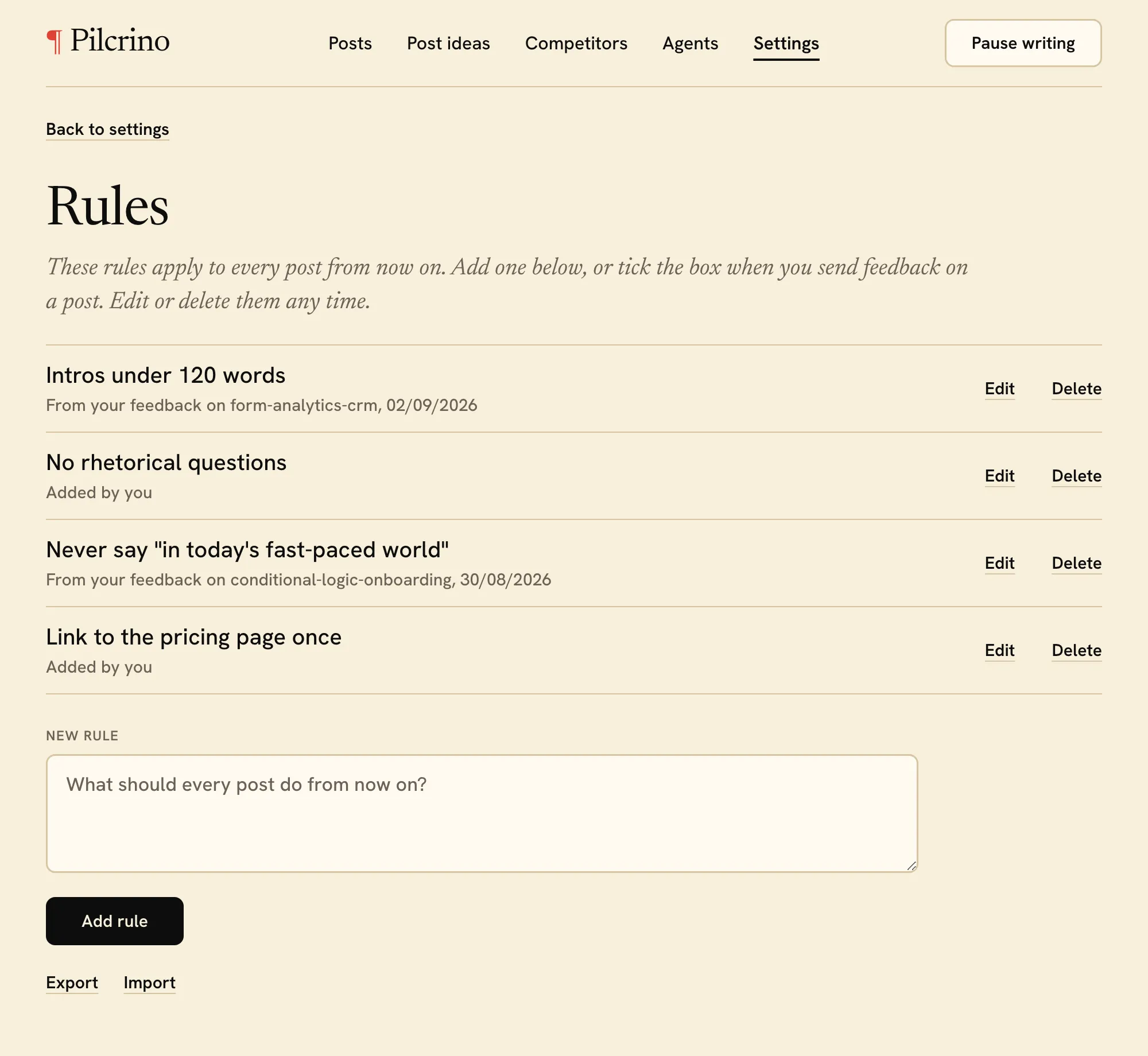
Illustrative example rules: “Intros under 120 words” was kept from feedback on an earlier post, “No rhetorical questions” was added by hand.
Checks 2, 6 and 7 stay with you, and so does the final yes. If you publish a post or two a month, a plain Claude chat plus this checklist is enough.
If you’d rather have these checks run on every draft, join the Pilcrino waitlist. It will sell for a one-time price with no subscription and run on the Claude plan you already pay for.
Researched and drafted with Pilcrino. Approved by Slav.
FAQ
Is AI-written content scaled content abuse?
Not by itself. Google’s spam policy targets scaled content abuse: many pages generated without adding value for readers, whoever or whatever wrote them. The seven checks above are how one post adds that value.
How long does it take to run this checklist on one post?
In my experience about fifteen minutes on a finished draft. Checks 4 and 5 take the longest, because you click every number and diff every product sentence against your facts file. The others are a few minutes each.
Should I disclose that a post was written with AI?
Yes. Google recommends sharing information about how a piece of content was created, and its helpful-content questions ask whether the use of automation is clear to visitors. One plain line at the end of the post is enough.
Can I make up a personal story to add experience?
No. A made-up story is a false claim under your name, and it fails check 2 by definition. If the post has no real experience in it, add a screenshot, a number from your own account or a customer question you answered.
Do I need an 82-point SEO checklist too?
Those are site and AI-visibility audits you run once in a while for the whole site. This seven-check list is the one you run on every post before it publishes.