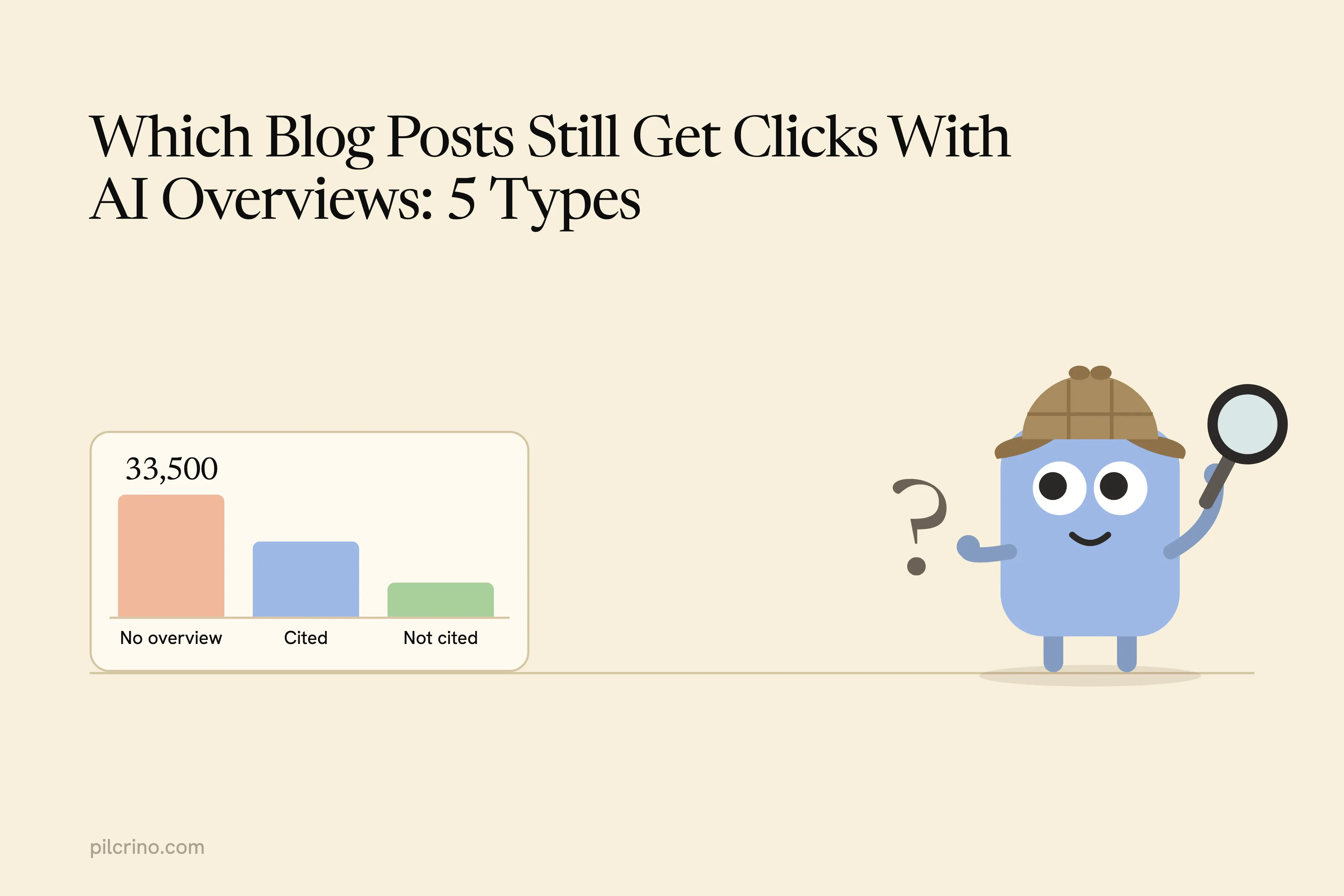
Which blog posts still get clicks with AI Overviews? An AI Overview is the AI-written summary Google shows above the normal results. On informational searches (people looking something up, not shopping), Seer Interactive counted about 33,500 clicks per million impressions (times a page was shown) with no Overview, about 20,700 when one cited your site, and about 9,400 when it didn’t.
So the clicks go to posts Google can’t sum up in a paragraph, and to the sites it cites when it tries. I plan this blog’s posts off numbers like these, so I read Seer’s April 2026 report, caveats included, instead of the headline cards that get passed around.
I covered whether a SaaS blog is still worth it in an earlier post. This one assumes you’re writing and asks which post to write next, with the data.
Below: how often each kind of query gets an Overview, what that does to your clicks, five post types with a worked example of each, and a check to run before you write the next one.
How Often Each Kind of Search Gets an AI Overview
Seer Interactive’s April 2026 study covers 53 client accounts, 5.47 million queries and 2.43 billion organic impressions from January 2025 to February 2026. It measures Overview exposure two different ways, and the two don’t belong in one table.
By query wording, within informational queries:
| Query wording | Showed an AI Overview |
|---|---|
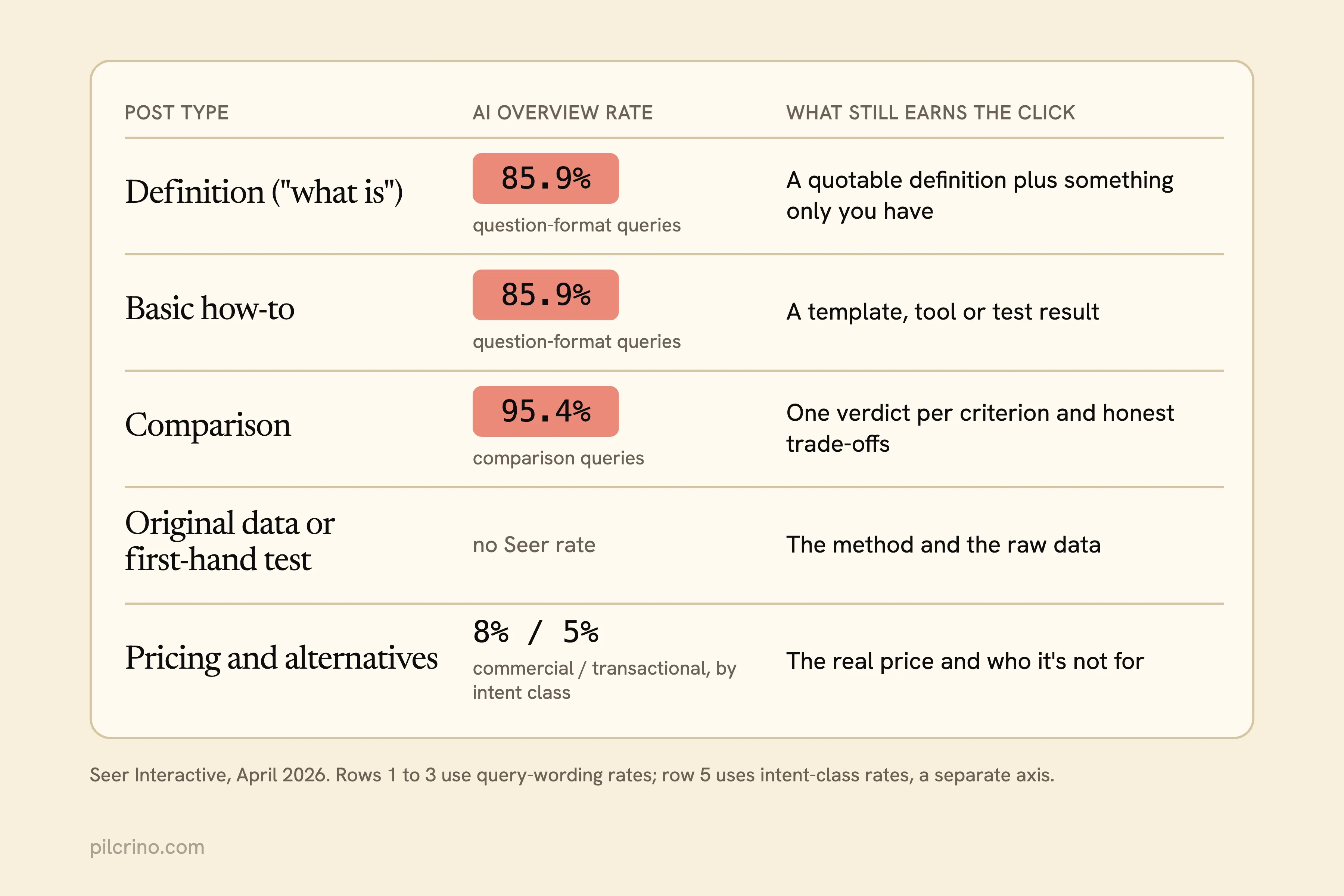
| Comparison (“X vs Y”) | 95.4% (267 of 280) |
| Question format | 85.9% (1,214 of 1,413) |
| Contains “near me” | 76.9% |
| Single word | 27.3% |
By intent class, which Seer assigned from the features on each results page: informational queries showed an Overview 36% of the time, commercial 8%, and transactional 5%, “just under 1 in 20.”
Keep those apart. The 36% covers every informational query, while the wording rates describe slices of it.
Now look at the top row of the table. The standard advice right now is to stop writing how-tos and write comparisons. But comparison queries are the most likely of all to get an Overview.
Which posts escape the Overview?
Hardly any of the ones you’d want to write. The useful question is which posts still get clicked when it shows up.
What an AI Overview Does to Your Clicks: None, Cited, Not Cited
On informational queries, Seer counted about 33,500 organic clicks per million impressions with no Overview, about 20,743 when the Overview cited the brand, and about 9,445 when an Overview appeared without citing it. Cited beats not cited. Nothing beats no Overview.
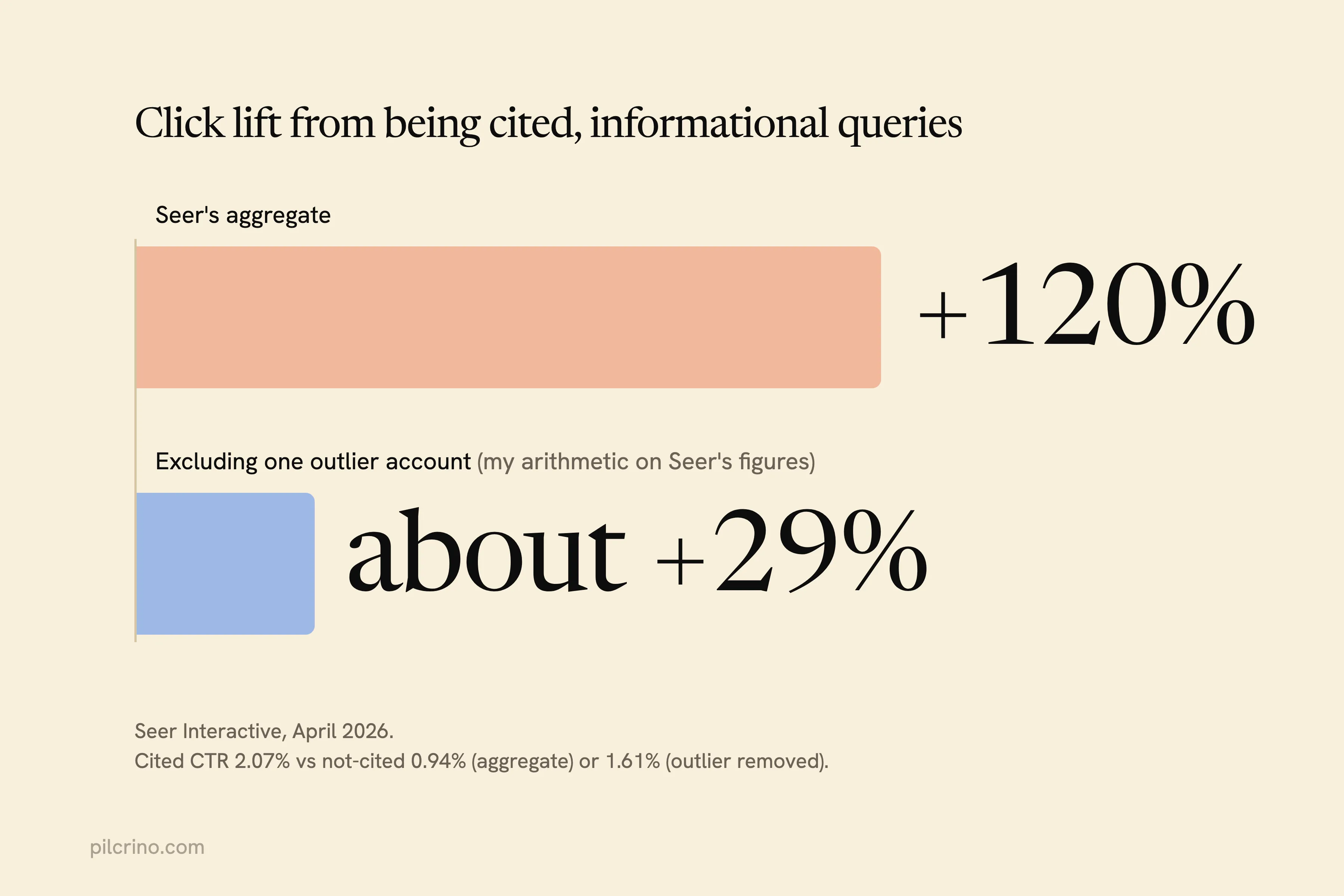
Seer’s headline puts it this way: “Being cited in the AIO delivers +120% more organic clicks per impression versus when you are not cited. But it still underperforms No AIO [no AI Overview] by -38% in informational queries.”
Is a citation worth chasing?
Yes, but read the caveat right under that headline, the one most summaries skip. One account makes up 47% of the not-cited impressions at a 0.20% clickthrough rate (CTR). Without it, Seer puts the not-cited rate at about 1.61%.
Against the cited rate of 2.07%, that’s about +29% by my arithmetic on Seer’s figures, not +120%. Citation still wins, by less than the headline says.
Seer’s own summary is the line I’d keep: “A citation is an advantage relative to everyone else on the same AIO-present SERP [a results page that shows an Overview]. It’s not a return to the pre-AIO baseline.”
Two other studies point the same way:
- Pew Research Center found that people who saw an AI summary clicked a traditional result on 8% of visits, against 15% without one, and clicked a link inside the summary on 1% (900 U.S. adults, March 2025).
- Ahrefs found an Overview goes with a 58% lower average clickthrough rate for the top-ranking page.
On Reddit, u/urbangardeningcanada doesn’t want to be in the Overview “UNLESS it has a high CTR”, and u/dashosh worries that “the better my content is, the more likely it gets used”. The numbers answer both.
Being used without credit is the worst tier on the page, and being cited is the best tier left on it. Cited still isn’t recommended, which is why I treat cited, named and recommended as three separate outcomes.
One number moved the other way. Informational queries with no Overview went from 2.93% to 3.97% CTR over 2025, across 901 million impressions. Seer’s read: “Non-AIO queries represent topics Google isn’t choosing to easily summarize yet”. Note the “yet.”
Five Blog Post Types and What Still Gets the Click
Google’s head of Search, Liz Reid, wrote in August 2025 that people are more likely to click into “an in-depth review, an original post, a unique perspective or a thoughtful first-person analysis.” For a quick answer like “when is the next full moon,” she wrote, people “may be satisfied with the initial response and not click further.”
That’s Google describing the split.
Which side of it is your next post on?
The five types below sit on either side. Every worked example uses a hypothetical scheduling app I’ll call Acme Booking. The app, the titles and any numbers in them are made up to show the shape of a post, not results.
Definition and “What Is” Posts
Definitions are Reid’s full-moon case. Question-format queries got an Overview 85.9% of the time, and a definition fits in the Overview whole, so these land in the not-cited tier by default.
Hypothetical example: Acme Booking’s “What Is a Booking Buffer?” usually opens with preamble. The version worth publishing opens like this: “A booking buffer is blocked time before or after an appointment that nobody can book. It stops back-to-back meetings and leaves room for travel or prep.” Then it moves to what only Acme could add, such as how its own customers set their buffers.
The page must contain:
- a one-to-two-sentence definition Google can quote whole
- a reason to click right after it
Don’t lead a content plan with these.
Basic How-To Posts
How-to searches are usually phrased as questions (“how do I…”), and question-format queries got an Overview 85.9% of the time. One r/Blogging member said their how-to site took a 40% traffic hit on basic tutorials “where the answer fits in one or two sentences.”
Hypothetical example: “How to Reduce No-Shows” becomes “How We Cut No-Shows With Two Reminder Rules (Test Results).” The first sentence names both rules. The body gives the steps, the result, and a reminder template you can download.
The page must contain:
- steps compact enough to be quoted, so you’re the cited source
- a template, tool or test result the summary can’t carry
u/PixelOMedia calls that optimizing for “reasons to leave Google.”
Comparison and “X vs Y” Posts
Comparison queries got an Overview 95.4% of the time, the highest rate in Seer’s study. You won’t dodge it. Write to be the page it cites.
Hypothetical example: “Acme Booking vs Tool B for Solo Consultants.” First sentence: “For a solo consultant who needs one booking link, Tool B is simpler; for a team that needs round-robin scheduling, Acme Booking fits better.” Then a table with a one-line verdict per criterion.
The page must contain:
- one attributable verdict per criterion, one sentence each
- claims you actually tested
- the trade-off stated against yourself, not only against the other tool
A verdict that stands alone in one sentence is easy to quote and easy to credit.
Original Data or a First-Hand Test
Seer doesn’t publish a rate for this type. Reid’s list does name it, though: “an original post,” “a thoughtful first-person analysis.” A commenter in the same r/Blogging thread put it plainly: “adding original data or personal experiments helps a ton, even small case studies or test results make your content harder to summarize.”
Hypothetical example: “We Checked 500 Booking Pages: 61% Hide the Cancellation Policy.” I made up both numbers for this example. The first sentence states the finding and the sample together.
The page must contain the number, the sample, the method, and the raw table or a download. The Overview can quote your finding. The reader clicks for the method and the data.
I went further into what makes an AI-assisted post hold up in its own post.
Pricing, Alternatives and “Buy” Pages
By Seer’s intent classes, transactional queries showed an Overview 5% of the time and commercial queries 8%, against 36% for informational ones. Those are intent classes, not wording, so this doesn’t mean every “how much does X cost” search skips the Overview.
The low rate isn’t a shield. Transactional queries that did get an Overview without citing the brand saw CTR fall from 4.17% to 2.15% in 2025. Commercial CTR with no Overview “declined meaningfully in 2025 without any significant AIO exposure. AIO is not the only force compressing organic CTR.”
Hypothetical examples: “Acme Booking Pricing: What Each Plan Includes” and “Acme Booking Alternatives for Solo Consultants,” both written for someone about to choose.
The page must contain:
- the real price and what it buys
- who the product is not for
- an alternatives page that admits trade-offs
Check the Results Page Before You Write the Post
The table above tells you the odds. Only the results page tells you which blog posts still get clicks with AI Overviews on your own queries. Run this before you commit to a post:
- Search the exact query logged out or in a clean browser. Is there an Overview? Which pages does it cite?
- Decide the job. No Overview: write for the click, since that’s the pool that grew from 2.93% to 3.97% CTR. Overview present: write the paragraph it would quote, then the reason to click past it. Overview that is the whole answer, a quick fact: skip the post or fold it into another one.
- Read clicks and impressions separately after you publish.
Why separately?
Seer’s October 2025 example shows it. Cited clicks stayed flat, 398,798 to 400,271, while cited impressions doubled from 15.8 million to 33.1 million, so cited CTR halved from 2.52% to 1.21%. A falling CTR can mean more citations, not fewer clicks.
If you’re starting from zero, I showed how to score a new blog on one sheet with clicks and impressions in their own columns.
How Pilcrino Plans Posts Around the Clicks That Remain
Pilcrino’s content plan proposes topics from your product docs and competitors: what buyers search for, what AI assistants get asked, and which feature each post argues for. You edit the list and the order.
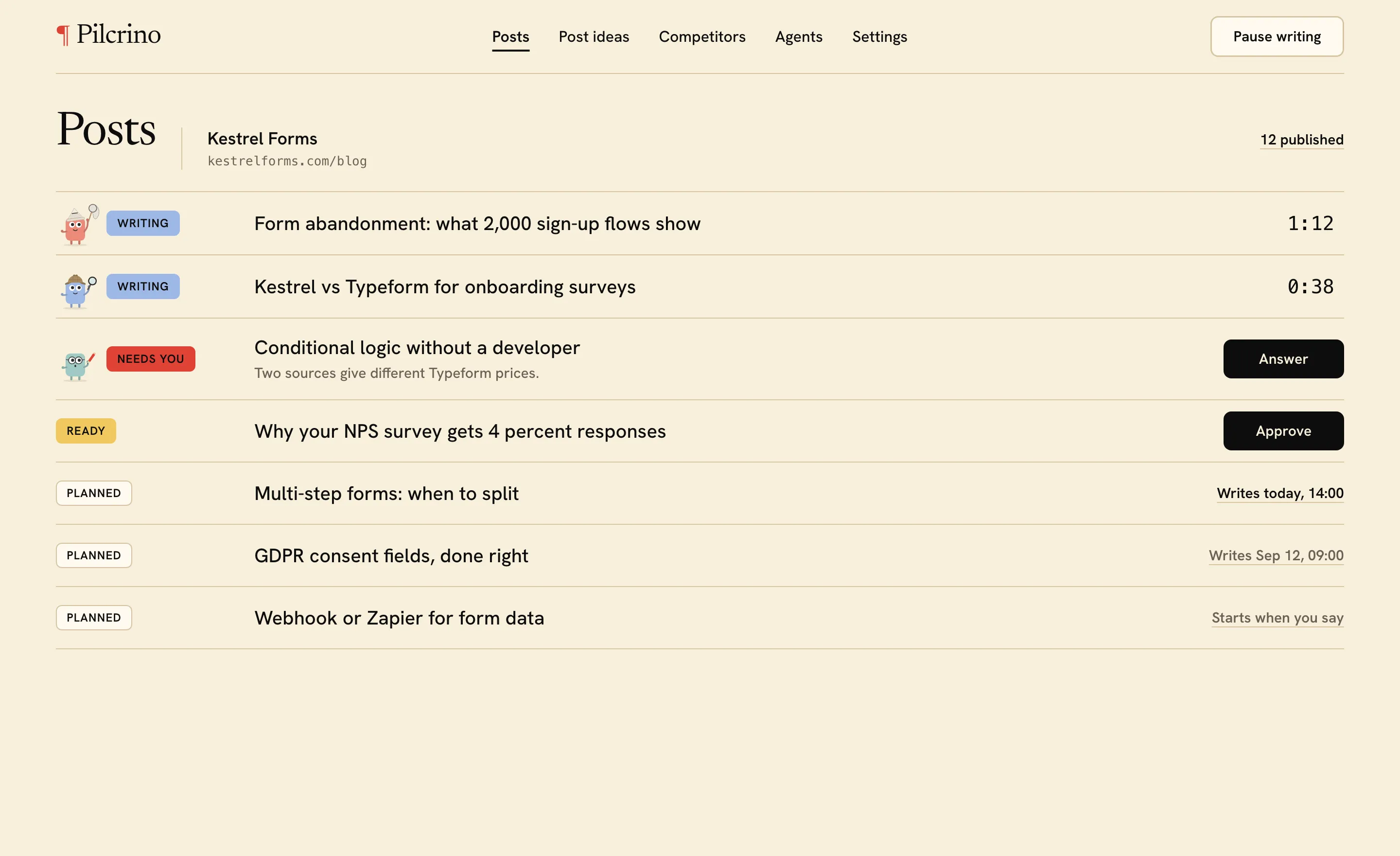
Illustrative sample workspace; Kestrel Forms is a fictional brand.
So what goes to the top?
That order is where this post’s data goes to work. I’d move comparison, first-hand and pricing posts up the queue and cut definitions a paragraph can replace. Research pulls the Google results, Reddit threads and X posts for each topic through your logged-in browser and cites them in the post. Nothing publishes until you approve it.
What This Data Can’t Tell You
How far should you trust all this?
Seer says it straight: “As with other studies of this nature, the data is directional”. Here’s what that means for you:
- It’s one study. 53 agency client accounts is not a random sample of the web.
- It shows correlation. Cited brands earned more clicks. Calling that a pattern rather than a cause is my framing, not Seer’s wording.
- Studies disagree because they count different things. Ahrefs measured a 58% lower CTR at position one across 300,000 keywords. Seer blends CTR across its clients’ accounts. Pew counts a share of browsing visits. As @liamviseo2026 put it on X: “That does not make the lowest figure wrong. It makes it narrow.”
- Cited is not recommended. An Overview citation doesn’t mean an AI assistant names your product.
- None of it predicts your site. Run the check above on your own queries.
Write the Posts That Still Get the Click
If you want posts planned around the queries that still send clicks, in your voice and argued around your product, Pilcrino drafts them on the Claude plan you already pay for.
The Pilcrino plugin is free; the app is $199 once, $129 for the first 50, and on a waitlist for now: join the Pilcrino waitlist.
Researched and drafted with Pilcrino. Approved by Slav.
FAQ
Do AI Overviews reduce clicks to blog posts?
Yes, on informational queries. Seer Interactive counted about 33,500 organic clicks per million impressions with no AI Overview, about 20,700 when the Overview cited the brand, and about 9,400 when it didn’t. Pew found people clicked a traditional result on 8% of visits with an AI summary, against 15% without one.
Is it worth being cited in an AI Overview?
Yes, compared with not being cited on the same page. In Seer’s aggregate, brands cited in the Overview earned about 120% more clicks per impression than brands that weren’t, and about 29% more once one outlier account is removed. It still doesn’t bring clicks back to the level of a search with no Overview at all.
Which queries don’t trigger AI Overviews?
By Seer’s intent classes, transactional queries showed an Overview 5% of the time and commercial queries 8%, against 36% for informational ones. Within informational queries, comparisons (95.4%) and question-format searches (85.9%) almost always get one, while single-word searches got one 27.3% of the time.
Should I stop writing how-to posts?
Stop writing the ones a paragraph can replace. Write how-tos that carry a test result, a template or a tool a summary can’t include, and keep the steps compact enough that the Overview can quote and cite you.
How can I tell if AI Overviews are costing my blog clicks?
Search your top queries logged out and note which ones show an Overview and whether it cites you. Then read clicks and impressions separately in Search Console. A falling CTR with flat clicks can mean you’re being cited more, not losing traffic.