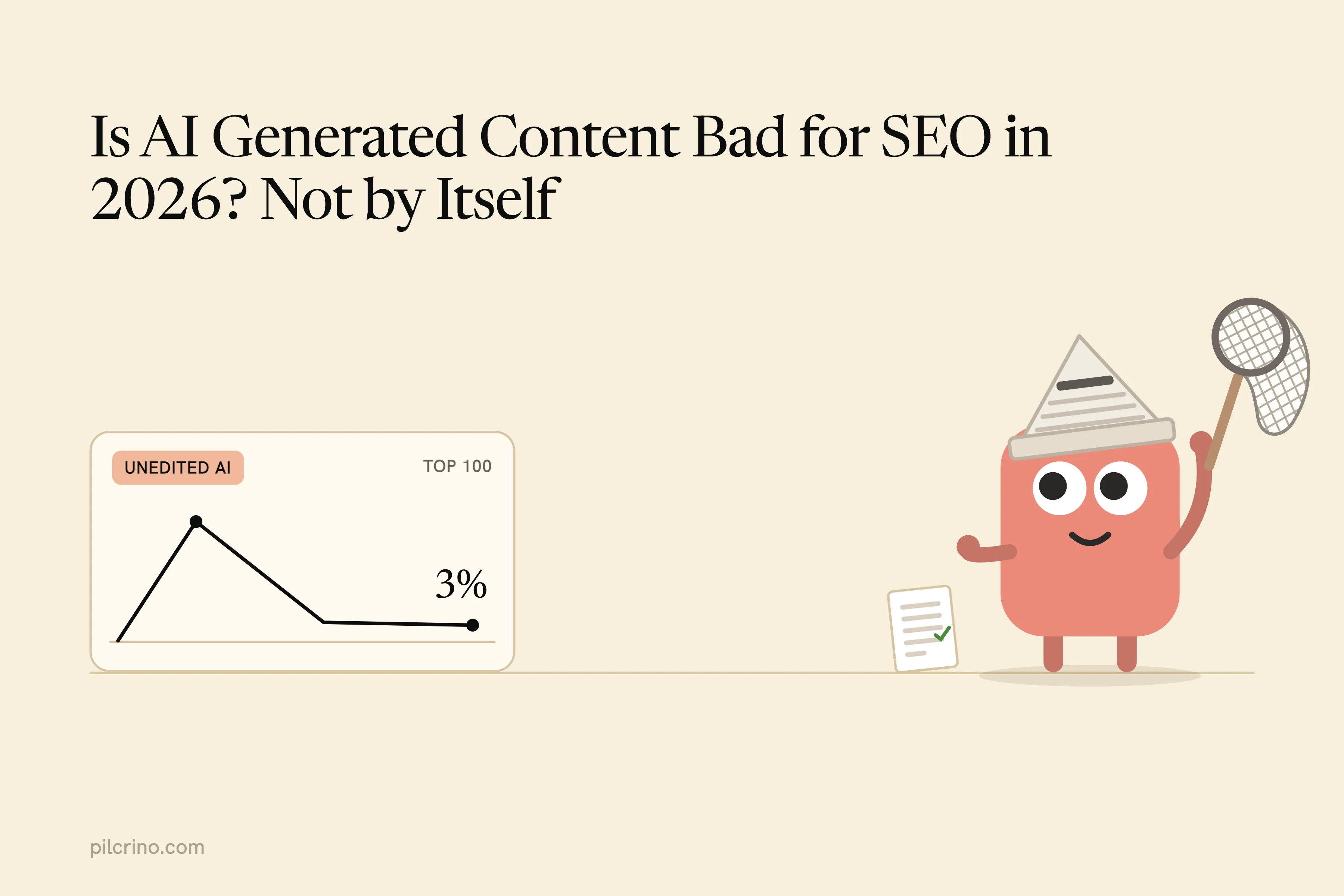
No. AI generated content isn’t bad for SEO by itself: Google says appropriate use of AI isn’t against its guidelines. What sinks pages is publishing lots of them that add nothing, and SE Ranking watched that happen to 2,000 unedited AI articles.
I’ve run about 100 posts through an AI pipeline on two live blogs, one on Astro and one on WordPress, so whether AI output can rank isn’t an abstract question for me. The pipeline itself is in how to write blog posts with Claude, step by step. This post is about whether the result can rank.
Below: what Google’s policy actually says, what happened to SE Ranking’s AI sites over 16 months, what 131 SEOs rate above who wrote a page, and the four things that decide whether an AI-assisted post holds up.
What Google Says About AI-Generated Content
Does Google penalize AI content?
Not for being AI.
In February 2023, Google’s Search team wrote that appropriate use of AI isn’t against Google’s guidelines. The exact line is “Appropriate use of AI or automation is not against our guidelines,” and it sits under a heading that sums up the whole position: “Rewarding high-quality content, however it is produced.”
The same post says Google’s “focus on the quality of content, rather than how content is produced” has guided its results for years. It also says, plainly, that “not all use of automation, including AI generation, is spam.”
It draws the other half of the line too. Using automation, AI included, “to generate content with the primary purpose of manipulating ranking in search results is a violation of our spam policies.”
So which pages cross it? Google spells that out in its spam policies, under scaled content abuse:
“Scaled content abuse is when many pages are generated for the primary purpose of manipulating search rankings and not helping users.”
One of the examples Google lists is “Using generative AI tools or other similar tools to generate many pages without adding value for users.” And the policy covers unoriginal content “no matter how it’s created.”
Read that definition again. It targets:
- Many pages
- Made mainly to move rankings
- With no added value for the person reading them
Who typed the words isn’t on that list.
Google’s guidance on helpful content turns the same idea into a question you can ask yourself: “Is the content primarily made to attract visits from search engines?” If the honest answer is yes, the page has a problem no matter which tool wrote it.
Google made the point again when it announced the policy in March 2024. Elizabeth Tucker, a director of product management at Google, wrote that it covers content produced in bulk to boost search ranking “whether automation, humans or a combination are involved.” A human content farm breaks the same rule a bot does.
When Google finished rolling out that March 2024 update, it reported 45% less low-quality, unoriginal content in search results, against the 40% it had expected.
What Happened to 2,000 Unedited AI Articles Over 16 Months
Google’s policy tells you what it intends. SE Ranking, an SEO software company, ran an experiment that shows what happened to 2,000 unedited AI articles on 20 new domains once they went live, and it reads like a timeline.
The setup:
- 20 brand-new domains, 100 articles per niche, 2,000 articles in total
- Launched November 5-6, 2024
- Every article generated “in one click using SE Ranking’s AI Writer” and “used as-is”
- No link building: the sites ran “no link-building campaigns,” so nobody tried to get other sites to link to them
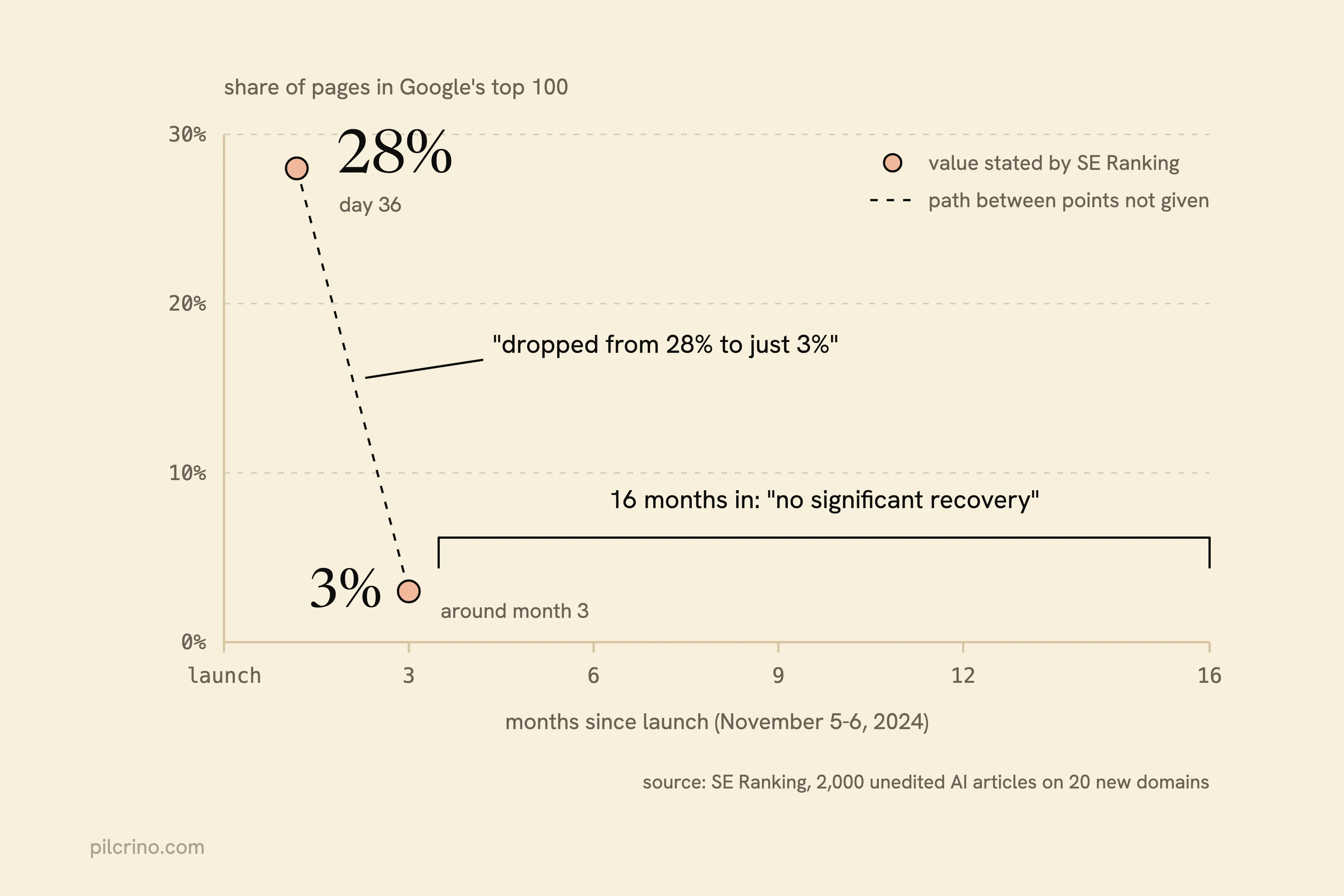
The first month looked fine. Google indexed 70.95% of the pages, and together they drew 122,102 impressions and 244 clicks. At day 36, 28% of the pages ranked somewhere in Google’s top 100 results.
Indexed means Google stored the page and can show it. An impression is one appearance in someone’s search results, click or no click. Judged at day 36, the experiment looked like it was working.
Then, in SE Ranking’s words, “around the 3-month mark, the trend reversed sharply.” The share of pages in the top 100 “dropped from 28% to just 3%.”
It didn’t come back. Sixteen months in, “Most sites settled into a pattern of low visibility and limited traffic, with no significant recovery.”
SE Ranking also ran a contrast case on its own established blog. Six AI-assisted articles went through “thorough revisions, editing, and fact-checking,” and between June 2024 and July 2025 they earned 555K impressions and 2,300+ clicks.
That’s six posts against 2,000, and the editing and the domain changed at the same time. It’s a contrast, not a controlled comparison.
So did Google punish the AI, or the emptiness?
This test can’t settle that by itself. Four things stacked against the 2,000 articles at once: new domains, zero editing, zero links and one-click generation. It shows what unedited bulk content on a new site does, not what an edited post on an established site does.
SE Ranking doesn’t say why the drop happened, either. Any explanation, including mine below, is a reading of the data.
Why Bulk AI Content Collapses: Sameness, Not Authorship
Here’s my read.
Google’s policy describes unoriginal content that adds little value, “no matter how it’s created.” A hundred articles per site, each made in one click by the same tool, sit very close to that description.
Nothing in them came from the site owner: no test, no opinion, no source the tool didn’t already have. Anyone else clicking the same button could get something very similar.
A commenter on r/SEO named the mechanism better than any policy page. u/Jaded-Passenger-8072 wrote: “the risk isnt that a model wrote it. its sameness. 5000 products through one prompt gets you 5000 pages with the same rhythm and the same three headings.”
That’s also what makes a single post read flat. One prompt settles on one rhythm, which is why AI blog posts sound generic, and across a hundred pages that rhythm hardens into a template.
How do you know if your own posts have the problem?
The same commenter offered a test: “pull 20 outputs and read them next to each other. if you cant tell them apart, nothing else can either.” Applied to a blog, it looks like this:
- Pick 20 posts made with the same prompt or tool.
- Read them two at a time, side by side.
- Count the ones you can’t tell apart without looking at the title.
If most of the 20 end up on that count, the tool isn’t your problem. The prompt is, and so is what you fed it.
What SEOs Rate Above Who Wrote It
Zyppy’s 2026 ranking factors survey is expert opinion, not measured ranking data: 131 SEOs rated more than 100 possible ranking factors on a scale from -3 to +3.
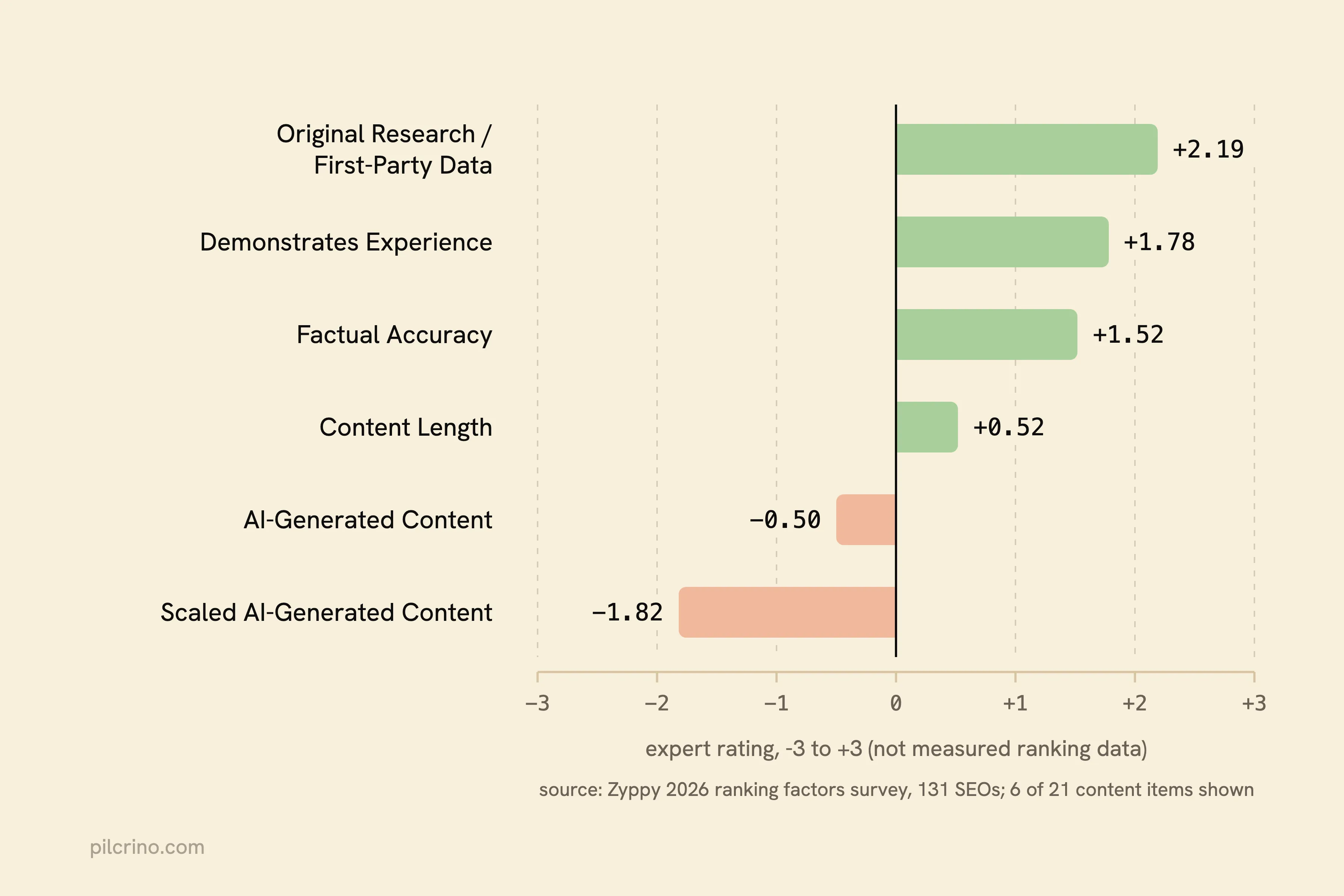
Cyrus Shepard and Dawn Shepard published it on September 9, 2026, built from 13,665 data points. “Search Intent Match” got the highest rating of any single factor. The content quality chart is the part that answers this post’s question:
- Original Research / First-Party Data: +2.19
- Demonstrates Experience: +1.78
- Factual Accuracy: +1.52
- Content Length: +0.52
- AI-Generated Content: -0.50
- Scaled AI-Generated Content: -1.82
Put plainly, 131 SEOs rated AI-generated content slightly negative, put scaled AI content at the very bottom of the chart, and gave length very little weight. Original research sat at the top.
Second in that chart, “Information Gain” scored +1.93: information other pages don’t already have. That’s the sameness problem seen from the other side. Zyppy’s written summary is softer than its own chart: it calls the reception to AI content mixed, and negative when it’s “scaled with little added value.”
One respondent summed up the gap: “Using AI to help you publish ten times the amount of the same quality content in half the time is not as good as using AI to help you publish the same amount of content, but ten times the quality.”
Does that mean AI-assisted pages can’t rank?
No.
Ahrefs checked the top 20 ranking pages for 100,000 random keywords with its own AI content detector: 81.9% “included some form of AI assistance,” 4.6% were “fully AI-generated,” and 13.5% were “pure human.” A detector’s verdict is an estimate, so read those shares as rough.
Still, AI-assisted pages already rank. The question is what else is on the page.
What Makes an AI-Assisted Post Hold Up
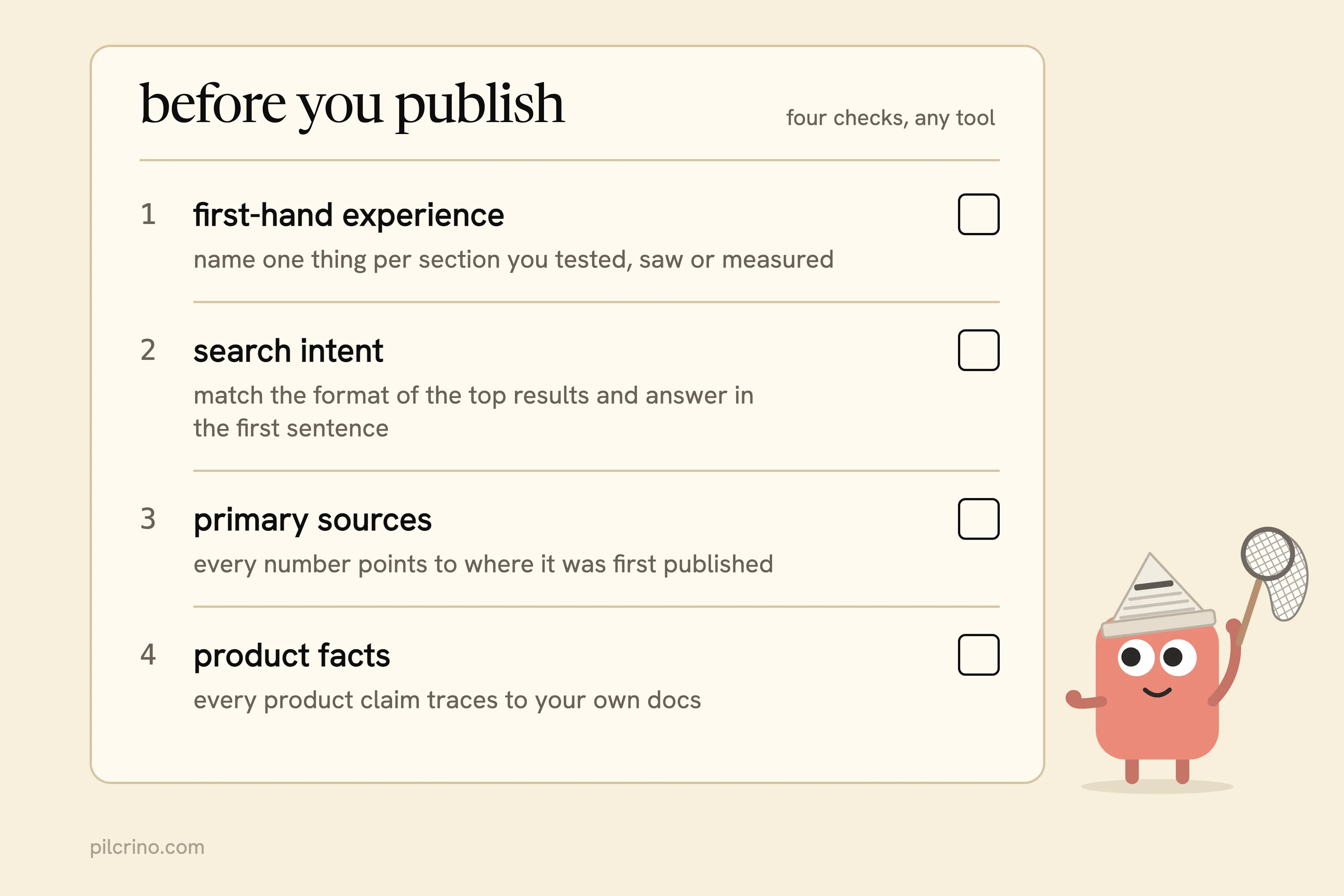
Four things decide whether an AI-assisted post holds up, and none of them care who typed the draft. Each one below comes with the reason it matters and a check you can run before you publish.
First-Hand Experience
Google’s guidance on helpful content asks: “Does your content clearly demonstrate first-hand expertise and a depth of knowledge (for example, expertise that comes from having actually used a product or service, or visiting a place)?”
A model can’t answer yes on your behalf. It never used your product, never sat in on your customer calls, never hit your bug. The SEOs in Zyppy’s survey rated “Demonstrates Experience” at +1.78.
The check: go through the draft section by section and name one thing in each that you tested, saw or measured yourself. A section with nothing gets a real example or gets cut.
What if you can’t find one?
Then that section is the same section every other post on the topic already has.
A Match to Search Intent
Search intent is what the person typing the query actually wants: a quick explainer, a list, a product page, a how-to. “Search Intent Match” was the highest-rated single factor in the survey.
An AI draft can be accurate and still be the wrong shape. A long essay is the wrong answer to a query where every top result is a short list.
The check:
- Search your keyword and note what the top results are: explainers, lists, product pages or how-tos.
- Match that format.
- Make sure your first paragraph answers the query in its first sentence.
For this post’s keyword, the top results are yes-or-no explainers built on Google’s policy. So this is an explainer with a direct answer, not a tool roundup. Its first word is “No.”
Primary Sources
A model writing from memory fills gaps with plausible numbers. A number traced to where it was first published is one your reader can check in a click. The survey points the same way: Original Research / First-Party Data at +2.19, Factual Accuracy at +1.52.
The check: every number in the post links or points to the page that first published it, not to an article repeating it.
This post’s SE Ranking figures come from SE Ranking’s own page. Some write-ups of that test quote 16-month totals that aren’t on SE Ranking’s page, and some give the drop an exact date when the page only says “around the 3-month mark.” Neither made it into this post.
In Pilcrino this starts at research: it pulls Google results, Reddit threads and X posts through your logged-in browser and cites them in the post.
Correct Facts About Your Own Product
If you write about your own product, an invented feature is the fastest way to lose a reader. They go looking for it, and it isn’t there. Google’s guidance on generative AI content says to “focus on accuracy, quality, and relevance, especially when automatically generating the content.”
The check: every claim about your product traces to your own docs or pricing page. Anything that doesn’t gets removed, not softened. The same goes for every stat and quote, and here’s how to fact-check AI blog posts before publishing step by step.
Why not soften it? Because softening is where AI drafts hide the problem. “Supports most platforms” is still wrong when your docs name two, and “may support” is still a claim about a feature you don’t have.
Pilcrino locks the claims a post may make before drafting starts and runs fact and link checks on the draft, and when a claim needs a judgment call, it pauses the post and shows you why instead of guessing.
When AI Content Is Still Risky
AI content isn’t bad for SEO by itself, but it isn’t safe by default either. Here are the cases I’d take seriously, and one argument I wouldn’t:
- Bulk publishing on a new domain. That’s the pattern SE Ranking’s test captured: lots of unedited pages, no history, no links, and a drop around month three with no significant recovery.
- First-hand spam reports. A forum owner in an r/DigitalMarketing thread wrote, “In my experience AI content usually gets flagged as spam. I was using AI bot in my forum and Google flagged my forum as spam.” It’s one report with few details, but it’s first-hand, and it belongs in the picture.
- The detector argument. SearchLogistics argues that AI content gets penalized, and its evidence is AI-detector scores. A detector score isn’t a ranking penalty.
The risk nobody sees is quieter. A paper at The Web Conference 2026, “Retrieval Collapses When AI Pollutes the Web,” mixed SEO-style AI content into a lab pool of documents.
When 67% of the pool was AI content, over 80% of what got retrieved was AI-written, and answer accuracy stayed stable. That’s a lab result about retrieval systems, not a Google ranking result. What it points to is “good” AI content crowding out real sources without anyone noticing.
So what keeps your own blog out of the bulk pattern?
A person who reads every post before it goes out. With Pilcrino, nothing publishes until you approve it. My bet: twenty posts that answer better than the top results beat two hundred nobody reads.
Pilcrino is built around the four checks above. It reads the live Google results and the Reddit threads and X posts for each post through your logged-in browser, cites its sources, takes product claims from your own docs and runs fact and link checks on the draft. The first-hand parts and the final sign-off stay with you. Why join the waitlist now:
- Joining is free. Nothing is charged, and waitlist members hear first when there’s something to try.
- The plugin is free and the app is $199 once with 12 months of updates and support, not another monthly subscription.
- It runs on the Claude plan you already pay for, with no API key.
If that’s how you want AI-assisted posts made for your blog, join the Pilcrino waitlist.
Researched and drafted with Pilcrino. Approved by Slav.
FAQ
Does Google penalize AI-generated content?
Not for using AI. Google’s February 2023 guidance says appropriate use of AI or automation isn’t against its guidelines. What its spam policy targets is scaled content abuse: many pages made mainly to manipulate rankings without adding value for readers, however they were produced. Where volume starts to look like that is covered in how many posts a week is too many.
Can Google tell if a blog post was written with AI?
Google says it focuses on the quality of content rather than how it was produced, so its policy doesn’t hinge on detection. Separately, Anthropic says Claude models launched on or after August 2, 2026 embed an imperceptible watermark in the text they generate, but its help article doesn’t say search engines read it. Either way, the quality test is the one to plan for.
Should I disclose that I used AI to write a post?
Google’s guidance on generative AI content says that sharing how a piece of content was created “can help give your readers more context.” That’s a suggestion, not a requirement. I do it anyway: every post on this blog ends with a line saying it was researched and drafted with Pilcrino and approved by me.
How many AI-assisted posts can I publish without getting flagged?
Google’s policy doesn’t give a safe number. The SE Ranking sites that collapsed each published 100 unedited articles, but that doesn’t make 99 safe. The useful test is whether each page adds something a reader can’t get elsewhere, not how many pages you ship.