To get ChatGPT to recommend your SaaS, stop counting how often it cites you: make your category obvious, get named on pages you don’t own, publish plain pages it can read and honest alternatives pages, then check every week whether it names you. Being cited and being recommended are different results. In Semrush’s study, ChatGPT linked the domains it used as sources 87% of the time but named the brand in the answer only 20.7% of the time.
This post draws on six published studies and datasets on AI answers, each checked on its own page, plus founder threads on Reddit and X where people report what they see when they ask.
If your posts read like everyone else’s (I wrote about why AI blog posts sound generic), an assistant has nothing to name you for.
Below: what cited, named and recommended mean, six steps that move you from the first to the last, and what nobody can control.
Cited, Named, Recommended: Three Different Results
An assistant can use your page and still send the buyer somewhere else. Semrush found that 62% of AI citations never name the brand: the page is linked as a source, and the answer text never says whose it is. They call these ghost citations.
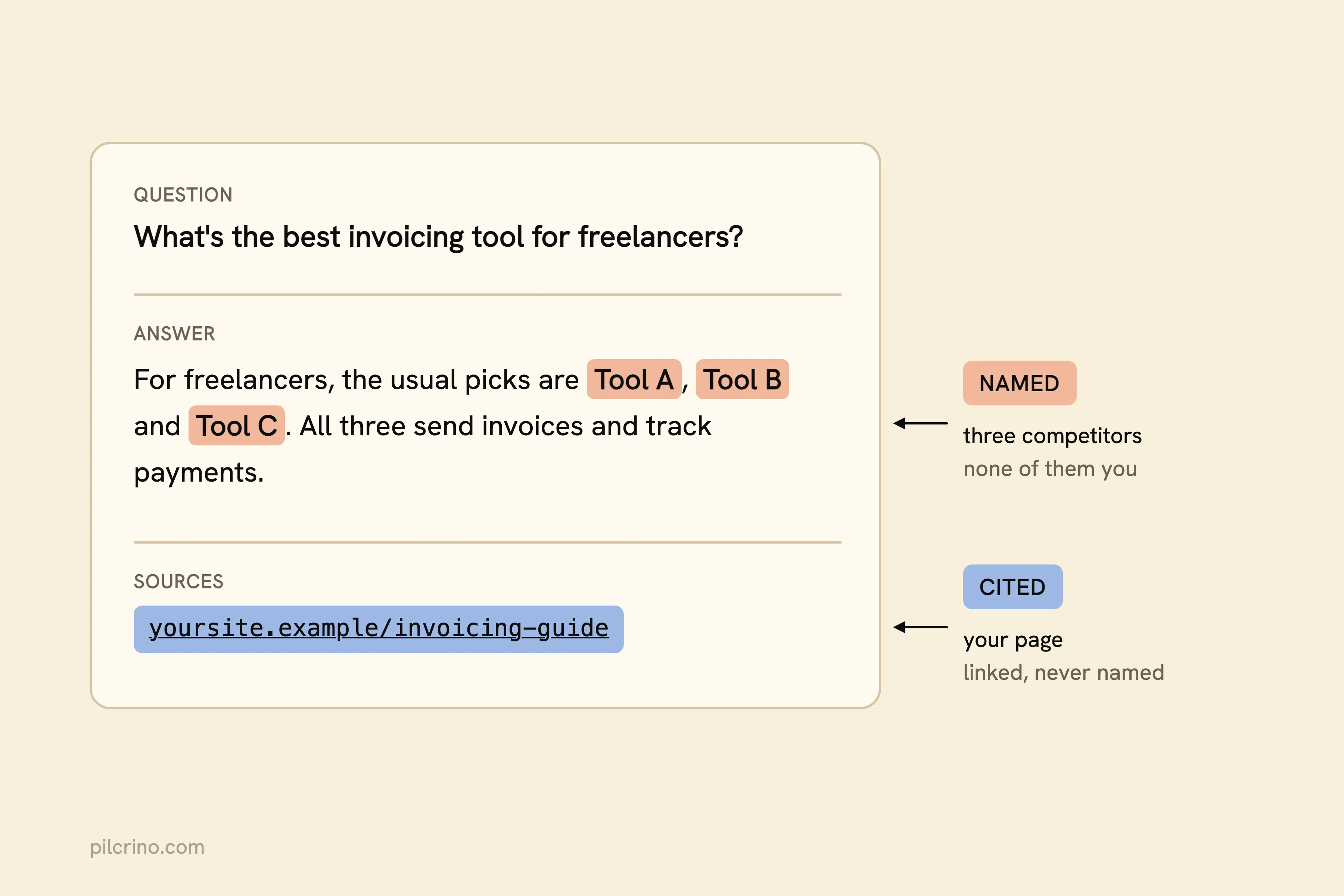
So there are three results, from weakest to strongest:
- Cited: your page is linked as a source for the answer. In SEO terms, a citation.
- Named: your product appears in the answer text itself. A mention.
- Recommended: the answer presents your product as a fit for what the buyer asked for.
@research_actvox put the first gap plainly on X: “If ChatGPT, Google AI Mode, or Copilot cites your article, it means your page helped answer a question. It does not necessarily mean your company was the answer a buyer should choose.”
The second gap is just as real. u/Appropriate-End-6328 on r/SaaS described a product the assistants clearly knew existed, with a “0% recommendation rate.” Their summary: “You’re ‘visible’ but not actually selected.”
So which one should you chase?
Recommended. But log all three, because the one that’s missing tells you where you’re stuck.
Step 1: Run a Baseline Probe Before You Change Anything
A probe query is a buyer question you type into ChatGPT on a schedule to see whether your product shows up. Run a set of them before you touch a single page, or you’ll never know what moved.
Why not ask once and take a screenshot?
Because one answer tells you almost nothing. SparkToro had 600 volunteers run 12 prompts 2,961 times through ChatGPT, Claude and Google AI Overviews (the AI-written summary Google shows above the normal results). They found under a 1 in 100 chance of the same list of brands in any two responses, and about 1 in 1,000 for the same list in the same order.
SparkToro suggests 60 to 100 runs per prompt for research, and calls the right number an open question. You don’t need that. Run each question a few times per assistant and record the share of runs you’re named in.
Start with ChatGPT. Add Perplexity, Claude or Google’s AI Overviews if your buyers use them, and save the full answer every time.
Write 10 to 15 Buyer Questions
Write them the way a buyer would type them, and leave your product name out of all but one:
- Category: “best [category] for [segment]”
- Use case: “how do I [job your product does]”
- Alternatives: “alternatives to [competitor]”
- Comparison: “[competitor A] vs [competitor B]”
- Branded: “is [your product] good for [use case]”
One practitioner on X, @veeeeking, uses a similar spread: 6 to 12 neutral questions across discovery, comparison, use-case, trust and branded prompts.
Log Cited, Named and Recommended Separately
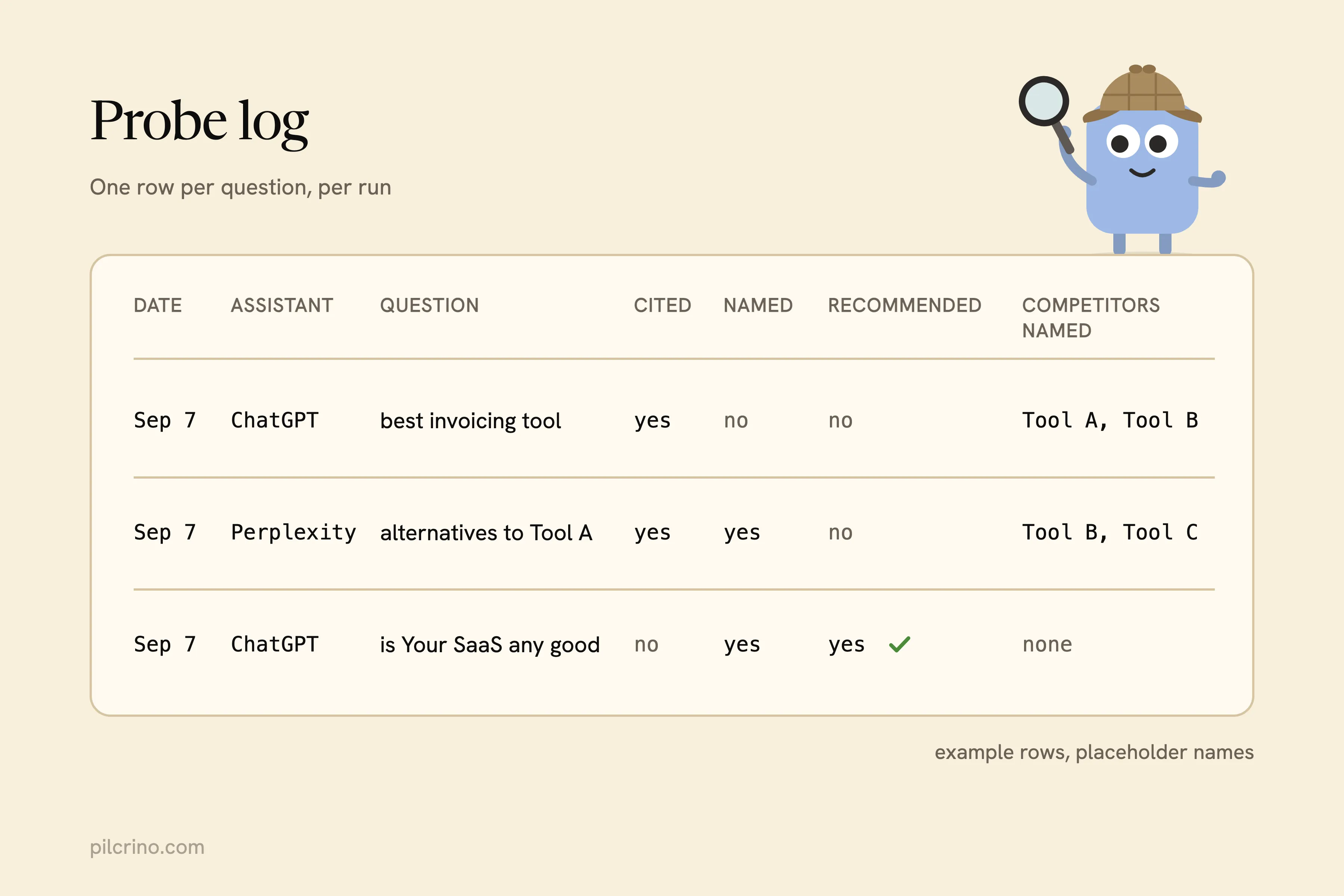
One row per question, per assistant, per run:
- Date
- Assistant
- Question
- Cited (yes or no, and which URL)
- Named (yes or no)
- Recommended (yes or no)
- Competitors named
@veeeeking’s labels add two more: absent, and inaccurate. Keep the second. An answer that names you and gets you wrong needs a different fix than one that leaves you out.
Step 2: Make Your Category Impossible to Miss
In a “best tool for X” answer, the assistant mostly names what it already believes belongs in the category. BuzzStream’s study of 12,000 AI responses shows how little a linked page has to do with that: on unbranded prompts, only 7.2% of brand mentions were backed by a citation, against 39% on prompts about a single brand.
Unbranded means “best project management tool.” Single-brand means “Is Asana good?” When a buyer asks for the best tool in your category, the names come mostly from what the model already thinks.
Can an assistant finish the sentence “[your product] is a ___ for ___”?
If you can’t finish it in one line, it can’t either. Write that sentence, then repeat it word for word in:
- Your homepage, in the headline or the line under it
- Your about page
- The first paragraph of your docs
- Your pricing page
- Every profile you control: GitHub, directories, social bios
That’s half of the top reply on an r/SideProject thread about exactly this problem. u/ellensrooney listed two things that “usually move the needle,” and one was “Repeated positioning language across multiple trusted sites.”
Small products have the most to gain. Ahrefs, testing its own promotional pages, found that self-promotional content “seems most useful when AI has a gap in its understanding.” A product nobody has pinned to a category is that gap.
Step 3: Get Named on Pages You Don’t Own
Your own site says what you are. Other sites decide whether anyone believes it.
Ahrefs studied 75,000 brands and compared their visibility in ChatGPT against common signals. Branded web mentions correlated at 0.664. Domain Rating, Ahrefs’ score for a site’s backlink strength, correlated at 0.266. YouTube mentions correlated even higher, at about 0.737.
Ahrefs itself says correlation isn’t causation. The gap between web mentions and Domain Rating is still wide enough to set your priorities.
Third-party mentions come from four places:
- Review sites. G2’s published methodology requires at least 10 reviews in a category before a product appears on that category’s Grid. Ask real customers, one at a time, until you cross it.
- “Best X” lists written by other people. Pitch the author with facts: what you do, who it’s for, and where you’re weaker than the tools already on the list.
- Integration partners’ directories. If a tool you connect to lists its integrations, get on that list.
- Community discussion. Answer questions in the forums your buyers read, as yourself, and bring up the product only when it’s the honest answer.
What about seeding Reddit threads yourself?
A founder on r/SaaSMarketing described dropping links to their own posts into Reddit comments. u/SHIFTcommunications replied: “most channels ban posting owned links like that (and communities typically value non-promotional info/answers, anyway).”
On X, an agency claimed the model “scans Reddit threads first.” @arberx_ answered: “Thats a really bold claim on a black box LLM web search process.”
Both replies hold. Seeding breaks the rules of most communities, and the theory behind it is a guess about a system nobody outside OpenAI can see. Take part honestly or stay out.
Step 4: Publish the Boring Pages Assistants Read
Assistants can only repeat what they can read. The pages that answer a buyer’s plain questions are usually the ones a founder puts off longest.
Publish each of these as text on a public page, not only as an image or a gated PDF:
- Pricing: what it costs to start, or how pricing works (a plain pricing.md at your site root helps too)
- Docs: what the product does, step by step
- About: who makes it and who it’s for
- Integrations: what it connects to
- Changelog: what shipped and when
- What it does: one plain page saying what the product is, who it’s for, and what it doesn’t do
u/Pervasivepeach asked ChatGPT, Perplexity and Claude about tools across SaaS categories and posted on r/SaaS that “the brands showing up weren’t necessarily the best ones or most funded, they were just the ones with the most structured citable content written about them.”
On r/SideProject, one founder’s informal read was that Claude “seems to favor products with good documentation.” u/dwkeith replied: “documentation is now cheap to generate. Seems like low hanging fruit for a lot of niche SaaS companies.”
Is your site even allowed in?
Check your robots.txt, the file that tells crawlers what they may read, for OAI-SearchBot. OpenAI’s crawler docs say sites that block OAI-SearchBot are not shown in ChatGPT search answers. GPTBot is a separate crawler that collects training content, so you can block GPTBot and stay in search.
Don’t go hunting for special files instead. Google says there are no additional requirements for AI Overviews or AI Mode (Google’s chat-style search), and “You don’t need to create new machine readable files, AI text files, or markup to appear in these features.” Write the pages.
Step 5: Write Alternatives Pages That Admit Trade-Offs
Go back to your probe log. Every question where a competitor gets named and you don’t is a page you haven’t written yet.
Usually that page is “[competitor] alternatives” or “[your product] vs [competitor]”. It’s the other lever from that r/SideProject reply: “Clear comparison pages (you vs alternatives).”
Does a page on your own site actually help?
Ahrefs tested it on itself, with 34 self-promotional pages and 9,886 responses from ChatGPT, Gemini, Perplexity and Copilot. For its new conference, 43% of answers that cited its pages never named the conference.
Yet those same pages produced 82% of the conference’s new mentions. For an established Ahrefs product, they produced 6%.
Two lessons. Your own page can get you cited without getting you named. And it helps most when the assistant doesn’t know you yet. Getting cited is still the first step, and I wrote up the checklist for getting cited in the first place.
Honesty is what makes the page worth quoting. Each one needs:
- Who each option fits, one sentence per option
- A plain comparison table
- The cases where the competitor is the better pick
- The date you checked the competitor’s features and pricing
If you’re writing these with the AI plan you already pay for, how to write blog posts with Claude walks through the brief, research, plan and review.
Picking which alternatives and comparison pages to write, from your competitors and the questions buyers ask AI assistants, is a step Pilcrino’s content plan runs, and its research quotes real Reddit and X threads with links.
Step 6: Repeat the Probe Weekly and Read the Share
Same questions, same assistants, same number of runs, same day each week. Change the probe itself and you’re measuring your edits to the test, not to your site. The 10 questions I track for this blog are listed in my day-90 bet for starting a SaaS blog in 2026.
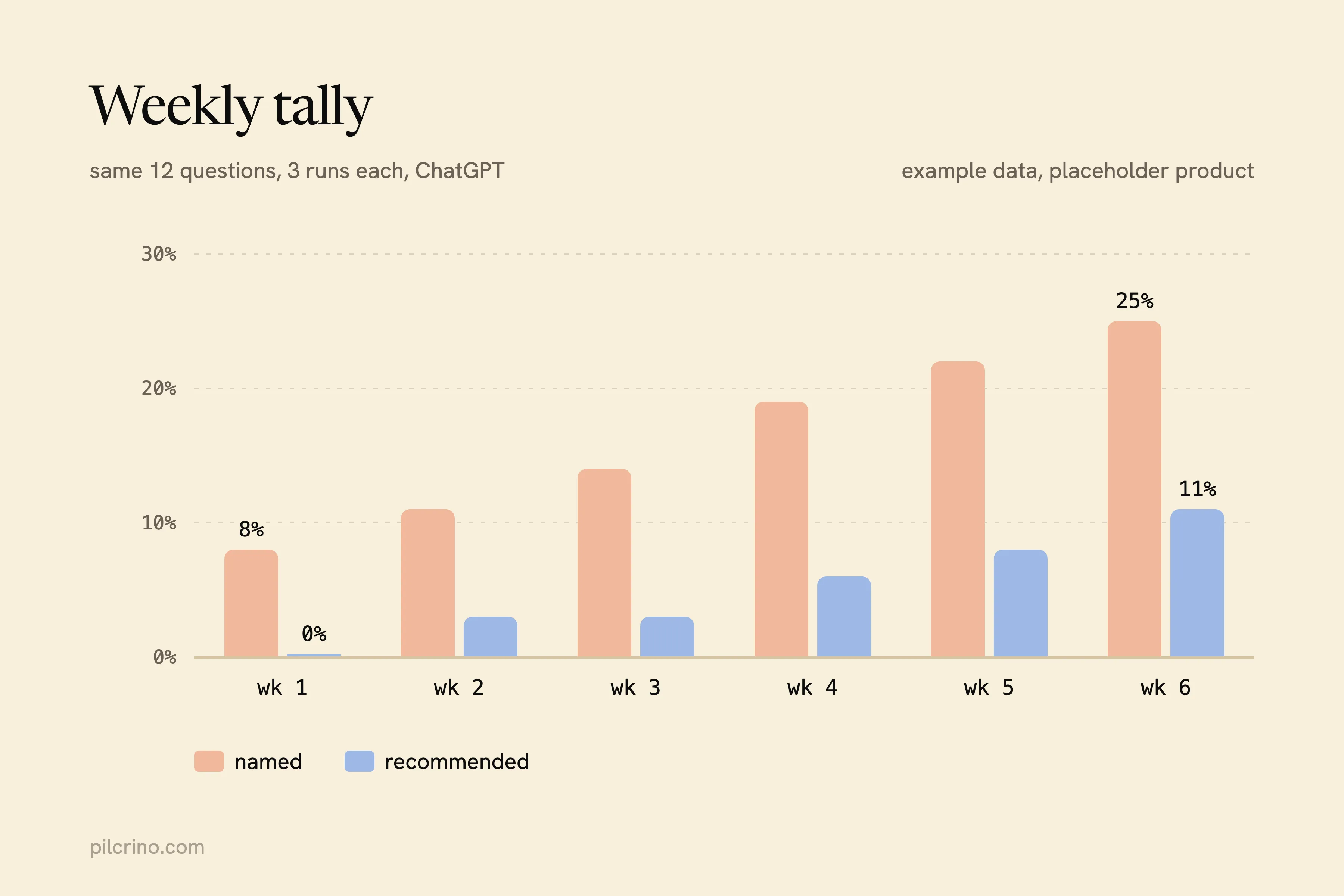
Rand Fishkin’s conclusion from the SparkToro data is why this works: “Visibility % across dozens to hundreds of prompts run multiple times is a reasonable metric.” A share over weeks is readable. A single answer isn’t.
Citations also come and go on their own. In Ahrefs’ experiment, cited pages showed up on only about a third of eligible days between their first and last citation.
What counts as progress?
The share of runs where you’re named, then recommended, rising across several weeks on the same questions. Not one good answer on a Tuesday.
Keep a change log next to the probe log:
- What you changed: a new alternatives page, a rewritten about page, new reviews
- The date it went live
- Which questions it should affect
Change one thing at a time. And take @veeeeking’s warning: “Do not publish a new page after one absent result. Treat the check as a hypothesis generator.”
What You Can’t Control
Some of this is out of your hands, and it helps to know which parts.
- You can’t buy a place in product results. OpenAI’s help page on shopping in ChatGPT says product results “are not ads, nor influenced by any OpenAI partnerships.” That covers product results, not every answer ChatGPT gives.
- Answers change from run to run. SparkToro’s under 1 in 100 finding applies to your questions too.
- Sources shift under you. In Promptwatch’s data, Reddit’s share of ChatGPT citations fell from 3.83% to 0.52% within days in mid-August 2026. Promptwatch itself calls the size of the drop provisional. I wrote up what that drop means for quoting threads in your own posts.
- Nobody can promise a date. Anyone who guarantees ChatGPT will recommend your SaaS by a deadline is guessing.
So what’s left?
The six steps. They make you easier to name. They don’t make naming you mandatory.
Every step above works by hand, with a spreadsheet and whichever AI assistant you already use. If you want posts in your voice planned around the questions buyers ask assistants, researched from real threads and approved by you before anything publishes, join the Pilcrino waitlist.
The plugin is free; the app is $199 once, $129 for the first 50, with 12 months of updates and support. Both run on the Claude plan you already pay for.
Researched and drafted with Pilcrino. Approved by Slav.
FAQ
Can you pay to get your SaaS recommended by ChatGPT?
Not in product results. OpenAI’s help page on shopping in ChatGPT says ChatGPT selects product results independently, and they’re not ads or influenced by OpenAI partnerships. That statement covers product results, not every answer, so the dependable route is the work above: a clear category, mentions on other sites, plain pages and honest alternatives pages.
How long does it take for ChatGPT to start recommending a product?
Nobody has a reliable number. Citations come and go on their own: in Ahrefs’ experiment, cited pages showed up on only about a third of eligible days between their first and last citation. Watch the weekly share of runs where you’re named instead of waiting for a date, and give each change several weeks before you judge it.
Do I need llms.txt or special schema to show up in AI answers?
Not for Google: Google says you don’t need new machine-readable files, AI text files or markup to appear in AI Overviews or AI Mode. llms.txt is a plain-text file at your site root that tells AI crawlers what your site is and which pages matter. For ChatGPT search, what matters is that your robots.txt doesn’t block OAI-SearchBot, the crawler OpenAI uses to surface sites in search answers. I added both files to this site anyway; here’s what I shipped and why.
How many questions should I track?
A small fixed set you can run every week. Start with 10 to 15 buyer questions covering category, use case, alternatives, comparison and one branded question. One practitioner on X uses 6 to 12. The exact number matters less than keeping the questions identical from week to week.
What’s the difference between being cited and being recommended by ChatGPT?
Cited means your page is linked as a source for the answer. Recommended means the answer presents your product as the right fit for what the buyer asked. The two sit far apart: in Semrush’s study, ChatGPT linked the domains it used 87% of the time but named the brand only 20.7% of the time, and a named brand still isn’t necessarily a recommended one.