Starting a SaaS blog in 2026 means planning for fewer clicks than the old playbooks promised. Pick topics from your product and your buyers’ questions, publish a first batch fast, keep a human approval step, and score the blog on more than traffic for at least 90 days before you judge it.
I started this blog on September 14, 2026, and I’ve run about 100 posts through the same pipeline on two other live blogs, one on Astro and one on WordPress. This post ends with what I expect from this blog by day 90, written down before any of those numbers exist.
If you’re still deciding whether to blog at all, I covered whether blogging is still worth it for SaaS separately; this post assumes you’ve decided.
Below: five steps, the one-sheet scoreboard I use instead of a traffic chart, and my day-90 bet for this blog with the method behind each number.
Step 1: Set Day-90 Expectations Before the First Post
A new blog’s first quarter is mostly quiet. Decide that before the first post goes out, so a flat month reads as normal instead of as failure. Two things make it quiet: fewer clicks per search, and new pages that rank slowly.
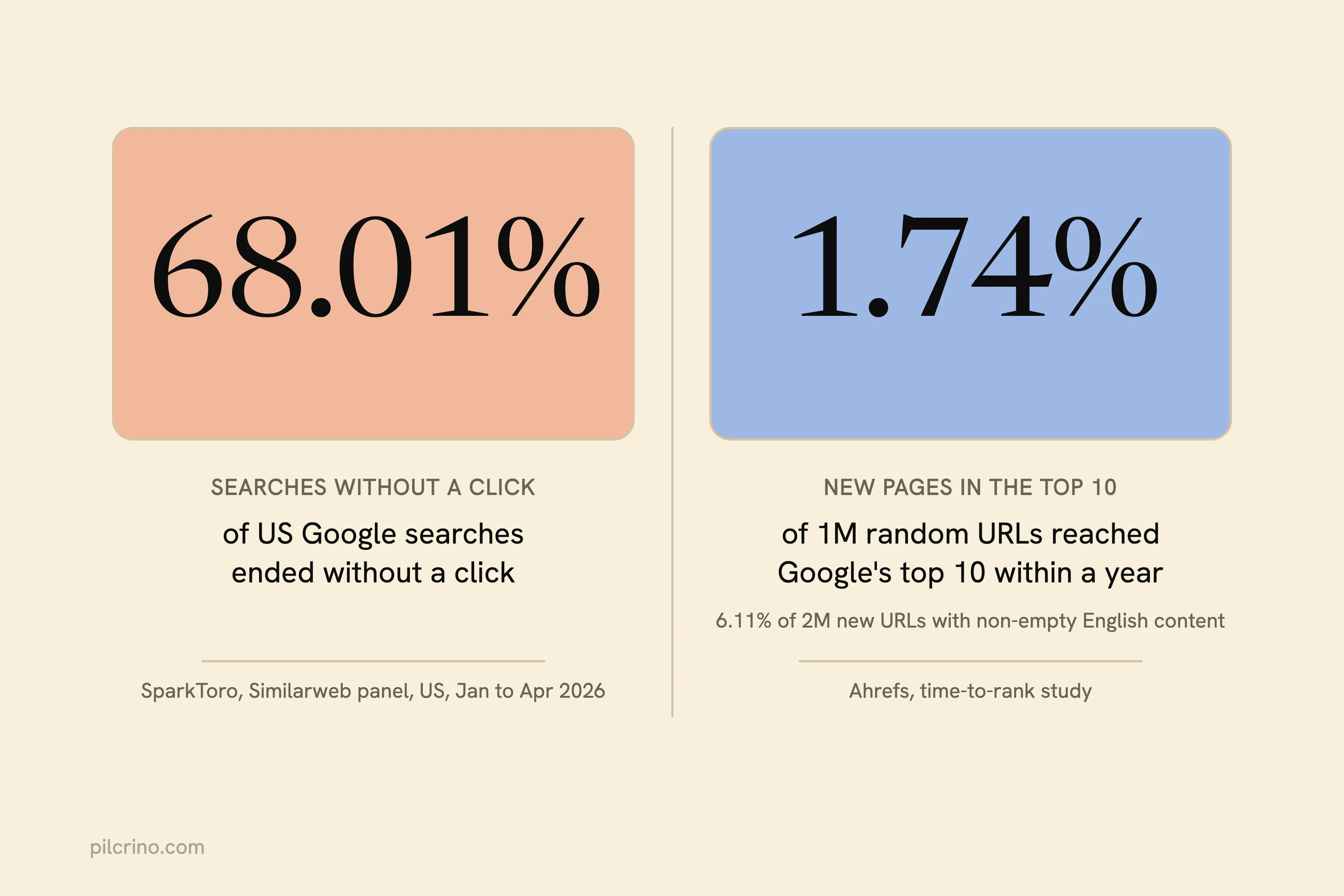
Clicks first. SparkToro’s Rand Fishkin found that 68.01% of US Google searches ended without a click from January to April 2026, based on Similarweb’s panel. So about a third still send someone to a website. I made the full argument about what that means for blogging in the post linked above.
Then ranking. Of 1 million random URLs Ahrefs’ crawler saw in September 2023, only 1.74% reached Google’s top 10 within a year. With a different filter, 2 million random URLs created in October 2023 with non-empty English content, 6.11% did. Of the pages that made it, 40.82% got there within a month.
A new domain also competes against old pages. In the same Ahrefs study, the average #1 page is 5 years old, and 72.9% of top-10 pages are more than 3 years old. Google Search Central’s starter guide says some changes take effect in a few hours while “others could take several months,” and that you likely want to “wait a few weeks to assess” your work.
What does an honest early number look like?
On r/SaaS, u/LordVein05 reported 30 clicks and about 3,000 impressions 35 days after buying the domain, plus 25 clicks from Bing, with zero paid ads. One reply in the same thread, from u/grand-yojimbo, pushed back: “SEO discussions should always be had in years.” Both are right. So here’s what I’d write down before post one:
- Expect impressions before clicks.
- Expect clicks in the tens, not the thousands.
- Expect most posts to sit outside the top 10 at day 90.
- Put the review date in your calendar now.
Step 2: Pick Topics From Your Product and Your Buyers’ Questions
Where should the first batch come from?
From the questions buyers ask right before they choose a tool like yours, and from the feature each post argues for. A keyword export gives you search volume. It doesn’t tell you which questions end in a signup.
A post that answers one specific question gives an AI answer something to quote, and gives Google a clear reason to send the person who asked. Here’s how I’d build the list:
- Collect the questions from sales calls, support tickets and demo notes, in the buyer’s own words.
- Google each one. Where an AI Overview (the AI-written summary Google shows above the normal results) answers it, write the post so a single paragraph can be quoted whole, and check which blog posts still get clicks with AI Overviews before you pick the format.
- Tie every post to one feature or one decision. If you can’t name which, the topic is too loose.
- Order the list so decision-stage posts come first: comparisons, “is it worth it” questions, “how do I do this with that tool.”
For this blog, I did that research on September 13, 2026: 22 Google searches through a logged-in browser, 28 Reddit threads, 35 Hacker News stories, and 14 competitor homepages and pricing pages. That became the first 30 topics.
It’s also the job Pilcrino’s content plan does: it proposes topics from your product docs and competitor pages, and you edit the list and reorder it. This blog’s own topic list is the worked example.
Step 3: Front-Load a First Batch, Then Review at Week 6
A new blog has nothing to optimize yet. No page is sitting on page two waiting for a better title, because no page exists. So the first weeks build the base, and the review comes after.
Here’s this blog’s plan:
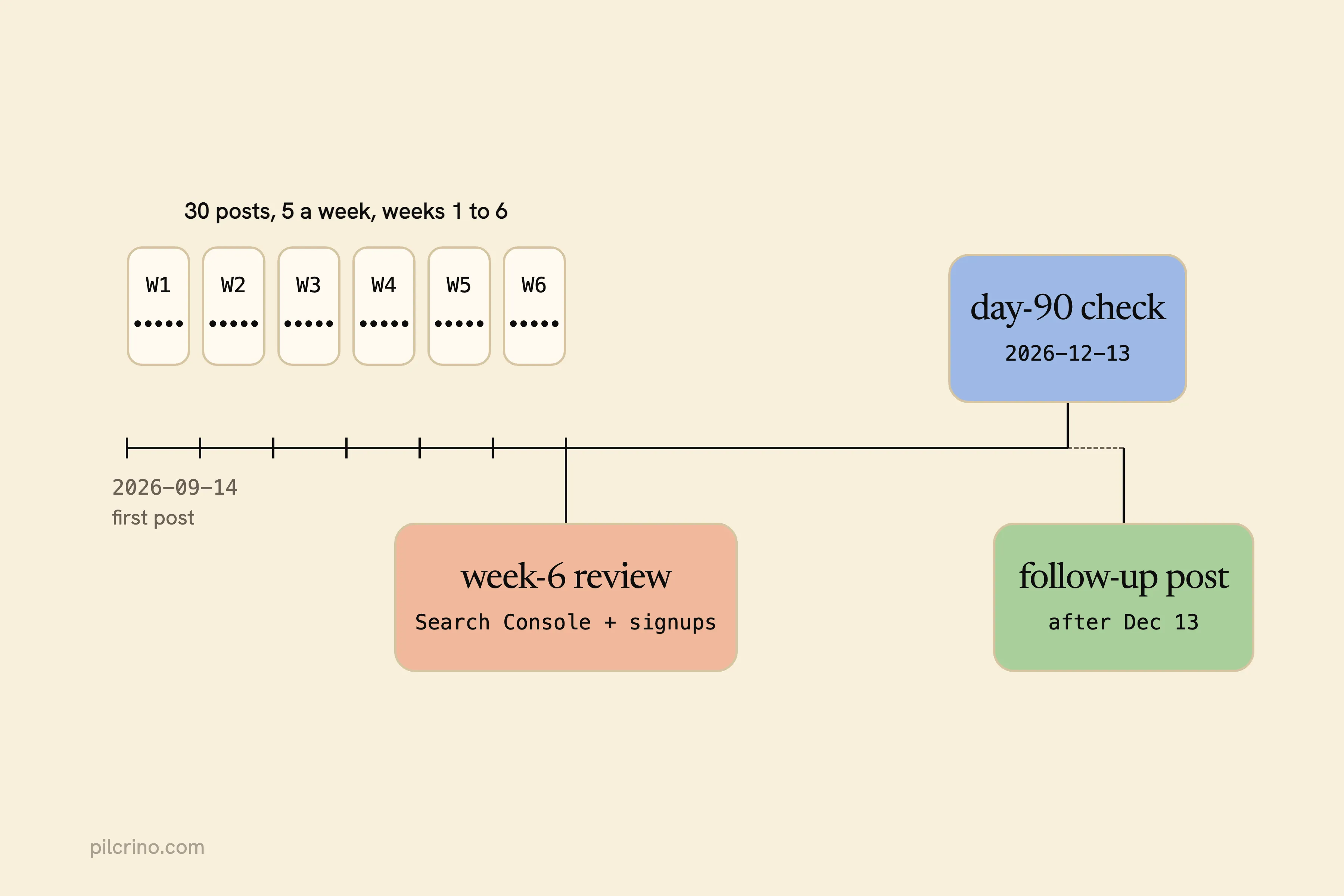
- 5 posts a week for the first 6 weeks, 30 posts in total.
- First post on September 14, 2026, and six posts live by September 17.
- At week 6, a review against Search Console and waitlist signups.
The strongest counterpoint I found is Jake Ward’s post on X: “Stop publishing new SEO content.” He continues: “I see too many websites with 100s of pages that get no traffic, yet they’re still publishing 4+ new posts per month.” His fix is to pull the Search Console queries sitting in positions 4 to 20 and improve the pages behind them.
Is he wrong?
Not for the sites he’s describing. His advice is for sites that already have pages to improve, and a new blog has none.
At week 6 his rule applies here too: posts sitting in positions 4 to 20 get refreshed before new ones get written. Ahrefs gives a longer checkpoint in the same time-to-rank study: if a page is still outside the top 10 after about 6 months, look at updating it.
A batch only helps if the posts don’t read like filler. Thirty posts that sound like everyone else’s give Google thirty pages it has no reason to pick, which is the problem behind why AI blog posts sound generic.
Step 4: Keep a Human Approval Step in the Publishing Path
At five posts a week, the risk isn’t writing too little. It’s shipping a wrong number or a broken page that nobody read. The fix is one checkpoint where a person reads the rendered post before it goes live.
Every post on this blog ships as a pull request, which is a proposed change you review and then merge to publish. Each one gets:
- a build check, so a broken page fails before it ships
- a visual check on the live preview
- my merge, by hand
Nothing publishes on its own.
Can you build this yourself?
Yes. A hand-built pipeline can open the same pull request and wait for you; I wrote up a hand-built Claude Code blog workflow, including what breaks in one.
Pilcrino stages each post this way and waits for my approval, and it runs on the Claude plan you already pay for, with no new subscription. Cost is part of starting a blog, so I covered writing blog posts with the Claude plan you already pay for in its own post.
Step 5: Score It on One Sheet, Not a Traffic Chart
Judged on clicks alone, a new blog looks like it’s failing even when it isn’t. A one-sheet scoreboard, updated weekly, shows whether the blog is working during a quarter when most searches end without a click.
There’s a reporting reason too. Google says AI Overviews and AI Mode are counted inside the “Web” search type of Search Console’s Performance report, not as a separate line. You can’t read AI traffic out of Search Console. So AI visibility needs its own column.
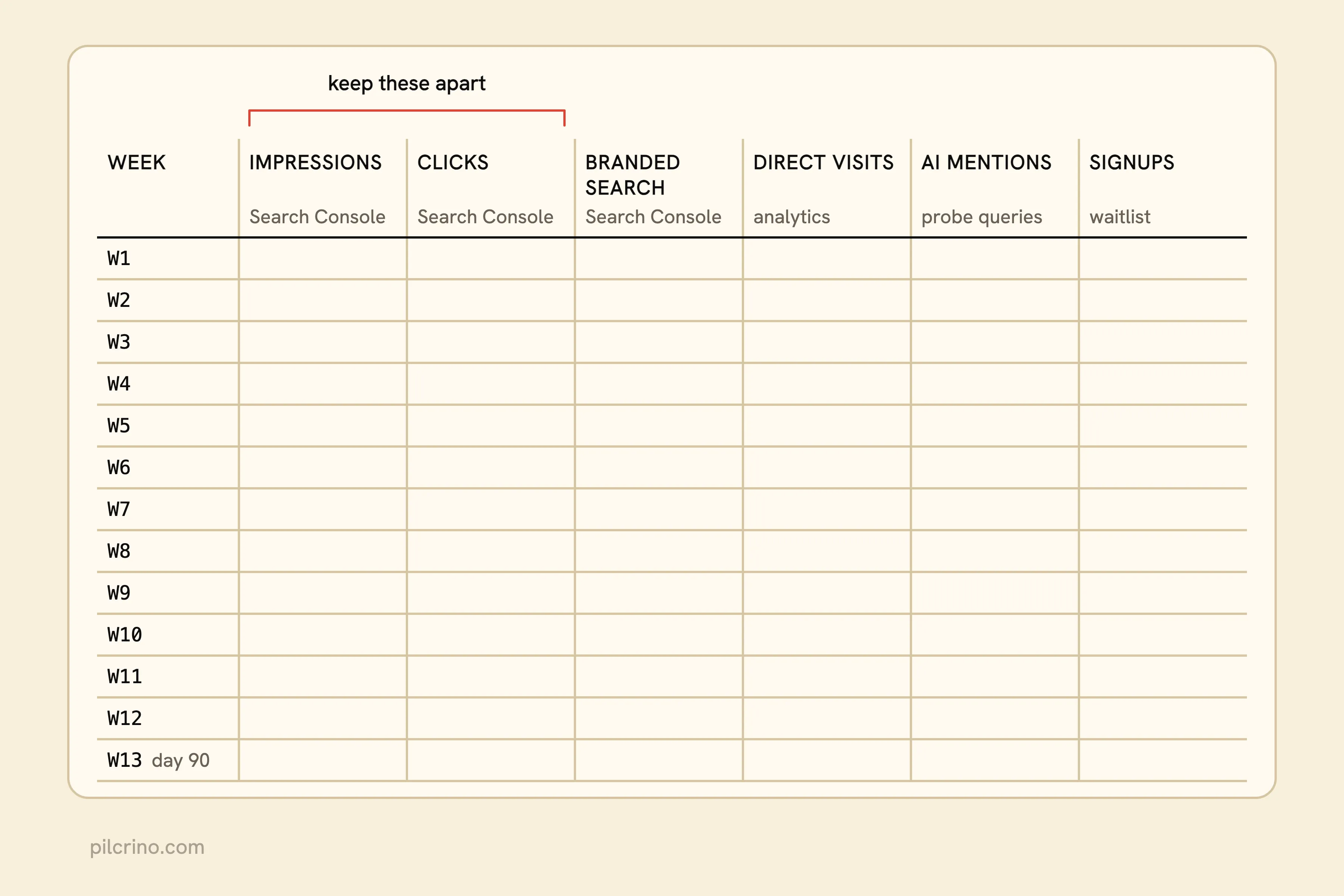
The sheet has six columns:
- Impressions (Search Console): how often your pages showed up. Keep this apart from clicks.
- Clicks (Search Console): how often someone came through to the page.
- Branded search: impressions for queries that contain your product name, so people looking for you by name.
- Direct visits (your analytics): people who typed the address or came back on their own.
- AI mentions: how many of your fixed probe queries name your product. A probe query is a buyer question you type into ChatGPT or Perplexity on a schedule; the full routine is in getting ChatGPT to recommend your SaaS.
- Signups, with a “how did you hear about us” answer where your form asks it.
Why keep impressions and clicks in separate columns?
Because they answer the question @ChhetryAdarsh posted on X: “why my impressions are increasing but getting fewer clicks ?” Side by side, rising impressions and flat clicks show a blog that’s being seen, even if the searcher got the answer on Google’s page.
One caveat on my own sheet. This blog’s waitlist form asks for an email only today, so my signup number is a total, not a count of people who came from the blog.
My Day-90 Bet for This Blog, in Public
Here’s the worked example. The window runs from the first post on September 14, 2026 to day 90 on December 13, 2026. I have no baseline for any of these four measures, so every range comes from public reports, with the method under the table.
| Measure (2026-09-14 to 2026-12-13) | My bet |
|---|---|
| Search Console impressions | 3,000 to 15,000 |
| Posts in Google’s top 10 | 0 to 2 |
| AI mentions | 0 to 2 of 10 |
| Waitlist signups | 20 to 100 |
How each measure is defined, and why that range:
- Search Console impressions, 2026-09-14 to 2026-12-13. u/LordVein05 reported about 3,000 in roughly the first 25 days of indexing, about 120 a day, which held flat would be about 10,800 over 90 days; u/MyDraftly (r/SEO) reported about 10k over a recent three-month window for a young SaaS site after its launch bump, not its first 90 days. The low end assumes a far slower start than both; the high end is their pace plus headroom for 30 posts.
- Posts in Google’s top 10 for their target keyword: average position 10 or better in Search Console, last 28 days ending 2026-12-13. 30 posts × Ahrefs’ 6.11% ≈ 1.8 within a year, and 40.82% of those arrive in the first month, so about one by day 90 at Ahrefs’ average. This domain is new and the last posts will be about 7 weeks old, so 0 is the likelier end.
- AI mentions: of 10 probe queries, how many name Pilcrino in a ChatGPT or Perplexity answer on 2026-12-13 (a query counts once if either assistant names it). A new domain with no third-party mentions yet; the measure most likely to read zero.
- Waitlist signups dated 2026-09-14 to 2026-12-13, all sources. No baseline at all, so the widest range; the form asks for an email only, so this is a total.
Why ranges instead of single numbers?
Because I don’t know how a new domain will do, and a range with its reasoning shown is something you can hold me to.
These are the 10 probe queries, fixed now so I can’t swap in easier ones later. Only the last one names the product:
- best AI blog writer for SaaS founders
- how do I write blog posts for my SaaS with Claude
- AI tool that writes blog posts in my own voice
- how to get my SaaS recommended by ChatGPT
- alternatives to AI blog writing subscriptions
- AI blog writer that publishes to Astro
- AI blog writer that saves WordPress drafts for approval
- one-time purchase AI blog writing tool
- tool to plan blog topics from my product and competitors
- is Pilcrino good for writing SaaS blog posts
On December 13, 2026, I’ll run each query 3 times in ChatGPT and 3 times in Perplexity. A query counts if any run names Pilcrino, because answers vary from run to run, which the ChatGPT post above covers.
After December 13, I’ll publish a follow-up post with the actual numbers for all four measures next to these ranges, whatever they show, including a zero.
What would change the plan:
- Flat impressions at the week-6 review mean refreshing existing posts before writing new ones.
- Zero probe-query mentions at day 90 is the expected result. It doesn’t end the experiment.
- Clicks go on the sheet every week, but I’m not betting on them.
This is a bet on one new blog, not a promise about yours. If you’re starting a SaaS blog in 2026 yourself, copy the method, not the numbers.
Where Pilcrino Fits
If you’d rather not hand-assemble the topic research, the drafting and the approval step, Pilcrino does all three on your machine with the Claude plan you already pay for. The plugin is free; the app is $199 once, $129 for the first 50, and on a waitlist for now: join the Pilcrino waitlist.
Researched and drafted with Pilcrino. Approved by Slav.
FAQ
How long does a new SaaS blog take to get traffic from Google?
Months, not weeks. In Ahrefs’ time-to-rank study, 1.74% of 1 million random URLs reached Google’s top 10 within a year, and 6.11% of 2 million new URLs with non-empty English content did. Google’s own starter guide says some changes can take several months. Expect impressions in Search Console well before clicks, and judge the first results at around 90 days.
How many posts should a new SaaS blog publish before judging results?
There’s no magic number. This blog front-loads 30 posts over 6 weeks, five a week, then reviews them at week 6 and judges the results at day 90. What matters more than the count is having a review date set before the first post goes out. For the pace after that first batch, see how often a SaaS should publish blog posts.
How do I measure a blog when AI Overviews take the clicks?
Keep impressions and clicks in separate columns, track branded search and direct visits, check a fixed set of probe queries in ChatGPT and Perplexity for AI mentions, and ask signups how they heard about you. Search Console folds AI Overviews and AI Mode into the “Web” search type, so AI visibility needs its own column.
Should I refresh old posts or write new ones?
A new blog writes new posts first, because there is nothing to refresh yet. Once posts sit in positions 4 to 20 in Search Console, refreshing them usually comes before writing more. Ahrefs suggests updating a page that is still outside the top 10 after about 6 months.
Will you publish the results even if they’re bad?
Yes. After December 13, 2026, I’ll publish a dated follow-up with the actual numbers for all four measures next to the ranges in this post, including any that come in at zero.