To fact-check an AI-written blog post before publishing, run six checks: log every claim and its source before you draft, verify each stat and quote on its source page, check product claims against a facts file, open every link, check the title, meta description, schema and alt text, then read and approve it yourself. Since October 1, 2026, Google’s own guidance says it is “critical to manually factcheck and review all AI-generated content” before it goes live.
I’ve run about 100 posts through an AI pipeline on two live blogs, and the 16 posts on this blog alone threw out 131 claims before a single draft was written, about 8 per post.
Below: what Google actually changed, the six checks with what each one catches, and how long they take when you do them by hand.
Key Takeaways
- To fact-check AI blog posts before publishing, run six checks in order: a claim log, the source pages, your product facts, every link, the metadata (title, meta description, schema, alt text), then your own approval.
- Google’s October 1, 2026 guidance calls manual fact-checking “critical” and extends it to titles, meta descriptions, structured data and image alt text.
- Start before the draft: the 16 posts on this blog rejected 131 claims at research time, so only 4 source markers reached the final check.
- A claim you can’t trace to a page that says it gets cut, not softened.
- AI detectors check style, not truth, so they are not a fact-check step.
What Google Changed on October 1, 2026
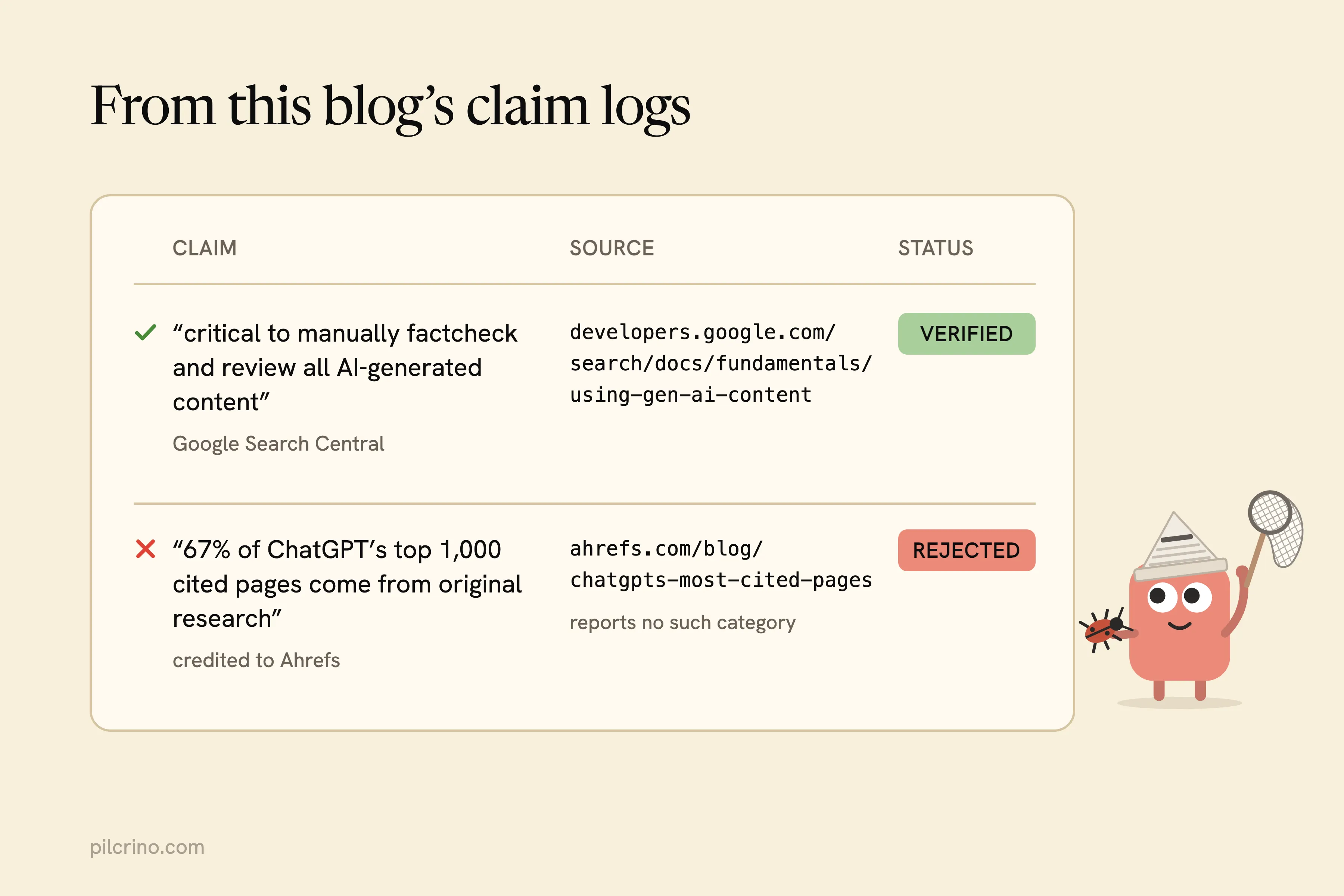
Google didn’t ban AI content, and whether Google penalizes AI content is a separate question. What changed is the review step. Google’s page on using generative AI content now says it is “critical to manually factcheck and review all AI-generated content for accuracy and trustworthiness before publishing.”
The next line reaches past the body: “This review also applies to metadata like <title> elements, meta description elements, structured data, and alternate texts for images, which can appear in Search results.”
Google also gives the reason: “Keep in mind that generative models don’t retrieve facts, but predict a likely sequence of words based on their training data.” A predicted sentence can carry a real-looking number with nothing behind it.
What the update doesn’t say matters as much:
- No new penalty. Pages mass-produced to fill search results already fall under Google’s scaled content abuse policy.
- No requirement to run an AI detector.
- No proof format. Nothing tells you how to show Google the check happened.
That last gap is what people keep asking about. “And how we do this verification visible to google eyes?” asked u/Jimmydejaime on r/SEOorganic. The honest answer: you can’t, beyond what readers see on the page.
Another commenter in that thread, u/Aqib_Javed2213, framed the goal better: making human review part of the publishing workflow rather than an optional final step. The page does offer one visible lever, in a section called “Give users context”, and step 6 uses it.
Step 1: Log Every Claim and Its Source Before You Draft
A claim log lists every stat, quote, date, name and product claim the post will use, each with the URL or file it came from and a status: verified, needs checking, or rejected. The draft may only use rows marked verified.
Why before the draft? Checking afterwards means untangling claims from sentences that were built around them. Log first, and a bad claim never reaches a sentence.
On this blog, the log is where most of the catching happens. Across the 16 posts published here, it rejected 131 claims before any draft existed: about 8 per post, with a low of 6 and a high of 16 (on the post about getting a SaaS recommended by ChatGPT). Three of them show the usual ways a claim goes wrong:
| Claim as found | What the source said | Outcome |
|---|---|---|
| “67% of ChatGPT’s top 1,000 cited pages come from original research”, credited to Ahrefs | The Ahrefs study reports no such category | Rejected on 2026-09-23 |
| “Gartner: AI software spend … up 60.2%”, on a SaaS-spend vendor’s blog | The Gartner release it linked says 47 percent | Rejected |
| “Paid Claude doesn’t use your data to train”, a Reddit claim | Anthropic’s 2025 consumer terms cover Pro and Max | Rejected |
The first row is the instructive one. A vendor page credited the 67% figure to the Ahrefs study of the top 1,000 pages ChatGPT cited, but the study reports no such category. Quote the vendor and you’d be citing Ahrefs for a number Ahrefs never published.
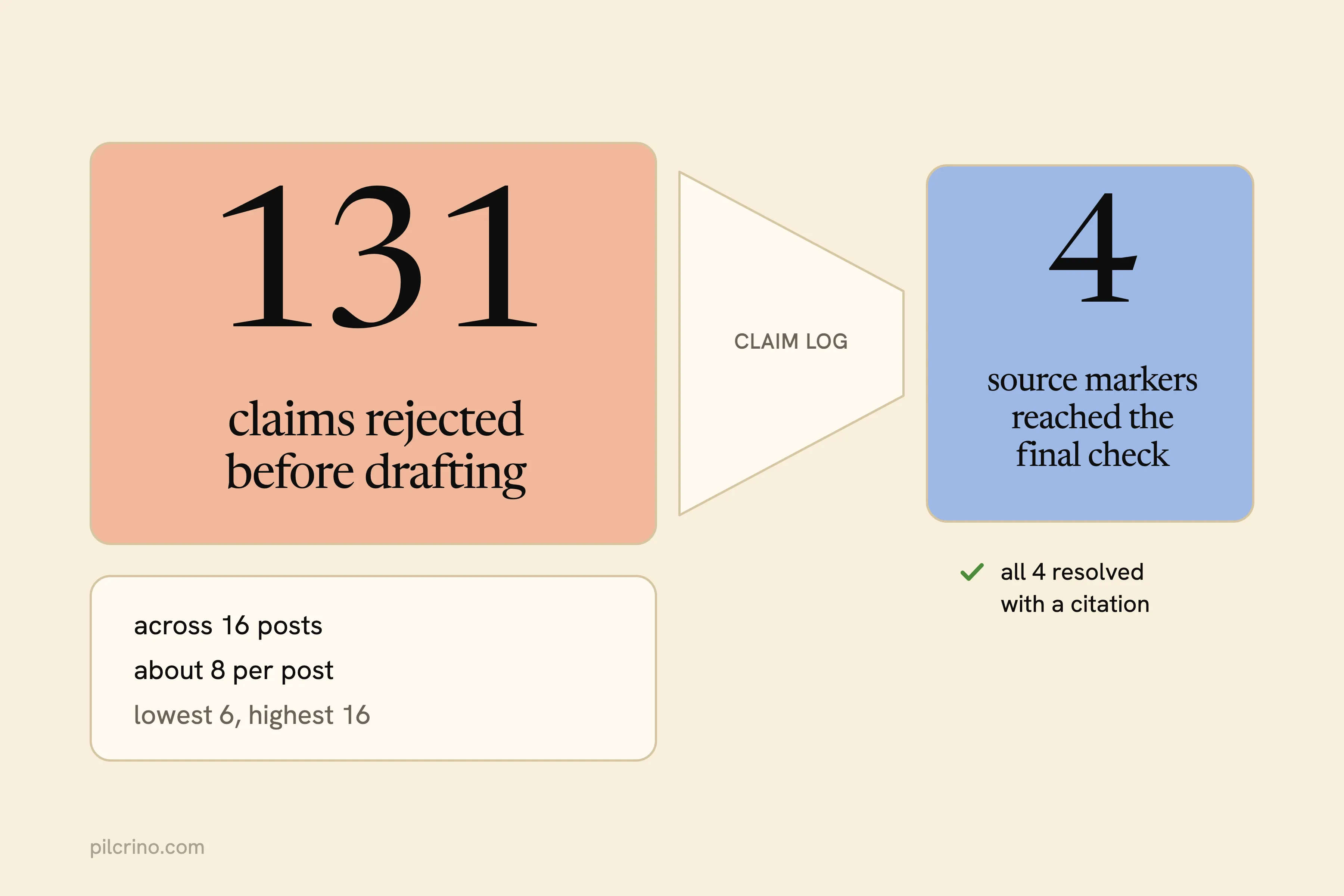
The payoff came at the end. Only 4 unresolved source markers reached the final check across those 16 posts, and I resolved all 4 with a citation. In Pilcrino, the plan stage writes this log as a facts file from the research before drafting starts, a review agent checks the plan, and the writer may cite only rows in that file.
Step 2: Check Each Stat and Quote on the Page It Came From
Open the source. Find the exact sentence: Ctrl+F the number, then confirm the number, the date and the scope all match your draft.
“ai loves to hallucinate specific stats that sound real but arent, so anything with a number gets double checked against the actual source,” wrote u/Len_BestVS on r/SEO_for_AI. That’s the job in one line.
The rules I follow:
- A search snippet isn’t the source. Neither is another blog’s summary of it.
- Follow a stat back to the study it cites. The Ahrefs catch only surfaced because someone opened the study instead of trusting the page that quoted it.
- Scope the claim to what the page says. A survey of one market isn’t a global finding.
- If you can’t trace it to a page that says it, cut it.
Which claims need this treatment? All of them. But some cost more when they’re wrong, and u/OthexCorp on r/artificial has a tiering rule worth copying: “Anything with dates, numbers, legal, medical, financial, or technical claims gets a source requirement.”
For a founder’s blog, that covers most of the post.
Step 3: Check Product Claims Against a Facts File of What Ships
The model describes your product from patterns. Ask it to write about a SaaS tool and it will add the features SaaS tools usually have, including the ones on your roadmap that never shipped.
Is this where a founder’s post goes most wrong? Usually. No outside reader catches a wrong feature claim before a buyer does.
Keep a product facts file with two sections:
- Available: what ships today, with the limits and plan names your pricing page uses.
- Planned, never described as available: everything on the roadmap.
Then check every product sentence in the draft against it, pricing and limits included. Pilcrino’s own file works this way. Windows support sits under “planned”, so a draft here can’t describe Pilcrino as running on Windows; the most it can say is “macOS only today”.
Step 4: Open Every Link and Read What It Says
A correct claim with a dead or wrong link reads as unsourced. So fact-checking is also link-checking.
What counts as checked?
For every external link, check three things:
- It loads.
- It says what the anchor text claims, in words you can find on the page.
- It’s the primary source, not a page that ranks for the same query and repeats the claim.
The third one catches more than you’d expect. Of this blog’s 131 rejected claims, 34 came with a note that the claim lived only on a page competing for the same search. Link there and you send readers to a competitor that may have got it wrong.
Internal links get the same treatment: each points to a live post, and every anchor is the literal claim, never “click here”.
Pilcrino’s fact and link checks run at this point. When one hits a judgment call, like a claim it can’t source, it pauses the post and shows the reason and the fix instead of guessing.
Step 5: Check the Title, Meta Description, Schema and Alt Text
These get written last and checked least. They’re also what appears in Search results before anyone reads the body, which is why Google’s metadata line, quoted above, names them.
Check that:
- The title promises only what the body proves.
- The meta description carries no number the body lacks.
- The FAQ schema (the code that marks up your questions and answers so search engines can read them) matches the visible FAQ.
- Each image’s alt text describes the image and invents no data.
- The structured data passes a validator.
What does that look like in practice? This post’s meta description says I run 6 checks, so the body owes you six steps, numbered. Count them.
The same fields come up again in the per-post checklist for getting cited by AI assistants, if that’s your next problem.
Step 6: Read It as the Owner, Then Approve It
The last check is one read-through by the person whose name is on the post. Ask three questions:
- Does it say anything a competitor couldn’t have written?
- Do the claims match what you know about your product and customers?
- Would you send it to a customer as it is?
The first comes from u/AccessFuel on r/SEO_for_AI: “my main one is just, could a competitor have written this exact post? if yes it’s not ready. doesn’t matter how clean it reads.” If a post fails it, the workflow is usually the cause, and why AI drafts sound generic covers the fix.
Make approval a written step, not a vibe. @eliteaeo put the test plainly on X: ask who checks the facts and where that step is written down.
Then say how the post was made. Google’s “Give users context” section suggests it: “Sharing information about how a piece of content was created can help give your readers more context.” This blog does it in one line at the end of each post: “Researched and drafted with Pilcrino. Approved by Slav.”
In Pilcrino, nothing publishes until you approve it, and the built-in preview shows the post as it will publish, images included, first.
How Long This Takes, and What to Automate
“If I have to fact check everything myself, it basically makes AI useless…” That’s the opening post of the same r/artificial thread, and it’s a fair complaint. The claim log is the answer: without it, steps 2 to 5 mean rereading the whole post to hunt for claims, and with it, you check a short list of rows the draft can’t add to.
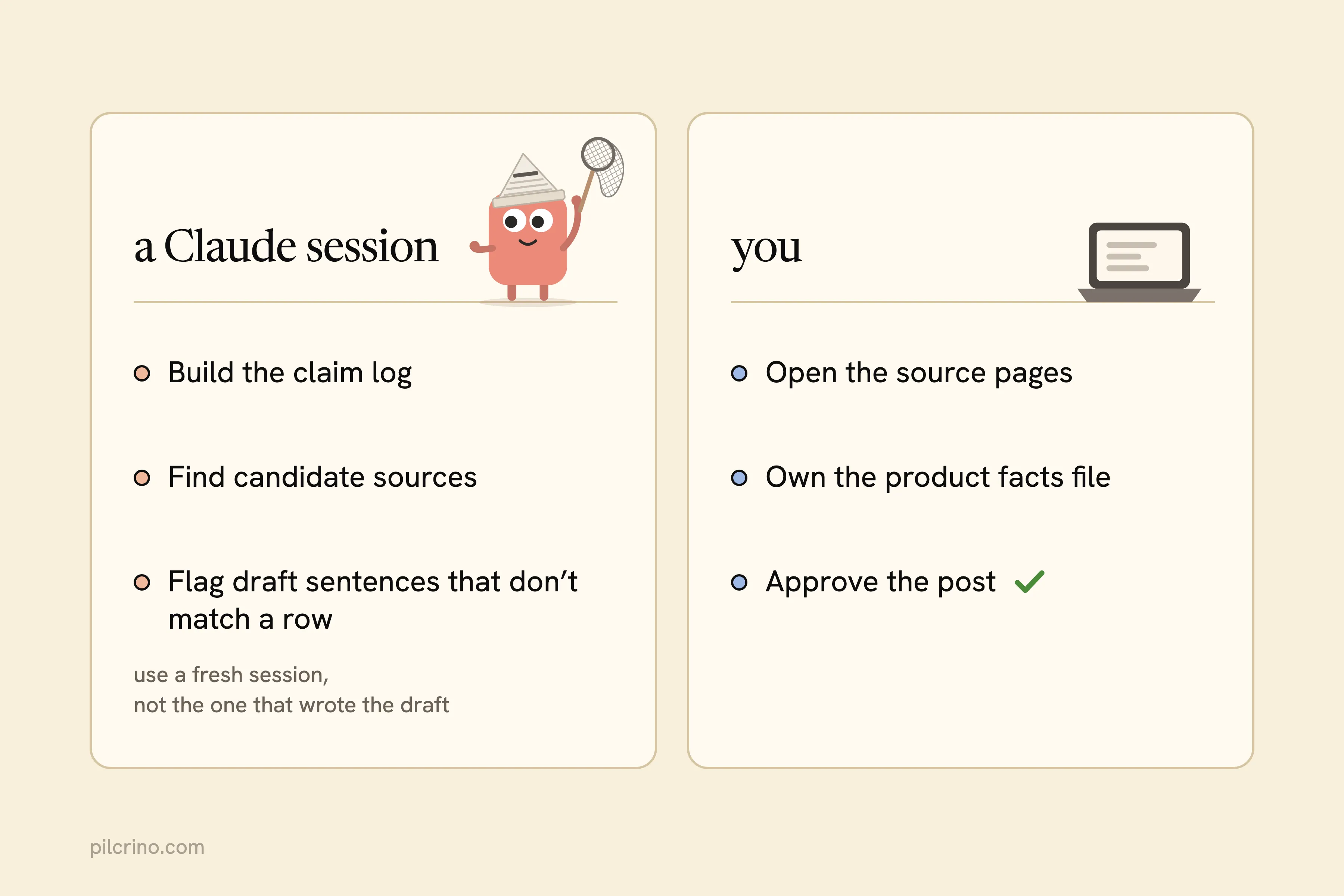
What raw Claude can do with a prompt and a second session:
- Build the claim log from your research notes.
- Find candidate sources for each row.
- Flag draft sentences that don’t match a row.
Don’t let the session that wrote the draft grade its own claims. Use a fresh one.
What you still do:
- Open the source pages.
- Own the product facts file.
- Approve the post.
A pipeline helps by running the mechanical part the same way on every post, so nothing depends on remembering; the full pipeline on a Claude plan shows how mine is set up. One thing doesn’t belong in it: an AI detector, which estimates whether text looks machine-written and says nothing about whether a claim is true.
Run the Six Checks on Every Post
If you want the claim log, source checks and approval step run on every post in your voice, on the Claude plan you already pay for, join the Pilcrino waitlist. The plugin is free, the app is $199 once with 12 months of updates and support, and nothing publishes until you approve it.
Researched and drafted with Pilcrino. Approved by Slav.
FAQ
Does Google penalize AI-written blog posts?
Not for being AI. Google’s guidance asks you to manually fact-check and review AI-generated content before you publish it, and its spam policy on scaled content abuse covers pages produced in bulk to fill search results without adding value, however they were made. A checked, useful post written with AI isn’t the problem.
Can AI fact-check its own blog post?
Partly. It can build the claim list from your research and find candidate sources for each claim. But a model checking its own draft repeats its own mistakes, because the same patterns that produced a claim also judge it. Use a separate session for the comparison, and open the source pages yourself.
Do AI detectors help with fact-checking?
No. A detector estimates whether text looks machine-written. It says nothing about whether a number, a quote or a product claim is true, and Google’s guidance doesn’t ask you to run one.
What should I do with a claim I cannot verify?
Cut it, or replace it with a claim you can source. Don’t soften it into a vaguer version, like turning a specific percentage into “most companies”, because the vague claim is still unsourced, just harder to spot.
Does fact-checking cover the title and meta description?
Yes. Google’s guidance on AI-generated content says the review also applies to title elements, meta description elements, structured data and image alt text, since all of them can appear in Search results. Check that the title and description promise only what the body proves.