
The best Surfer SEO alternatives for writing blog posts are tools that write the post, not ones that score it: Frase if you still want a score, Koala Writer or Acta AI for a hosted writer, and Daniel Agrici’s free Claude Code skills if you already pay for Claude. Surfer still writes, but its prices and its pitch are now built around a score.
None of the numbers below come from somebody else’s list. Every price and feature here comes from the vendor’s own pages, read in the first week of November 2026, plus the seven pages that rank for this search, checked on 5 November. I also build one of the options, and I’ll flag it where it comes up.
Most of those ranking pages answer a different question. They swap one scorer for another.
Below: which job Surfer was doing for you, a table of five writers plus raw Claude on one rubric, a short take on each, and who should stay on Surfer.
Key takeaways
- Pick a tool that writes the post: Frase (score plus writer), Koala Writer or Acta AI (hosted writers), or Daniel Agrici’s free Claude Code skills on the Claude plan you already pay for.
- Surfer now sells itself as an “AI visibility platform” and costs $59 to $359 a month, or $49 to $299 a month billed yearly, per its own pricing page in November 2026.
- None of the seven pages ranking for this search lists Koala Writer, Acta AI, raw Claude or Agrici’s skills; they replace one scorer with another.
- Stay on Surfer if your team already writes well and wants a content score plus AI visibility tracking in one product.
What are the best Surfer SEO alternatives for writing blog posts?
Start with which half of Surfer you used. Its core is the Content Editor and its live Content Score, which grades a draft for SEO and AI search as you type. Surfer AI also writes full articles, and Auto-Optimize adds missing terms, entities and facts to a draft. So Surfer writes. That part is fair.
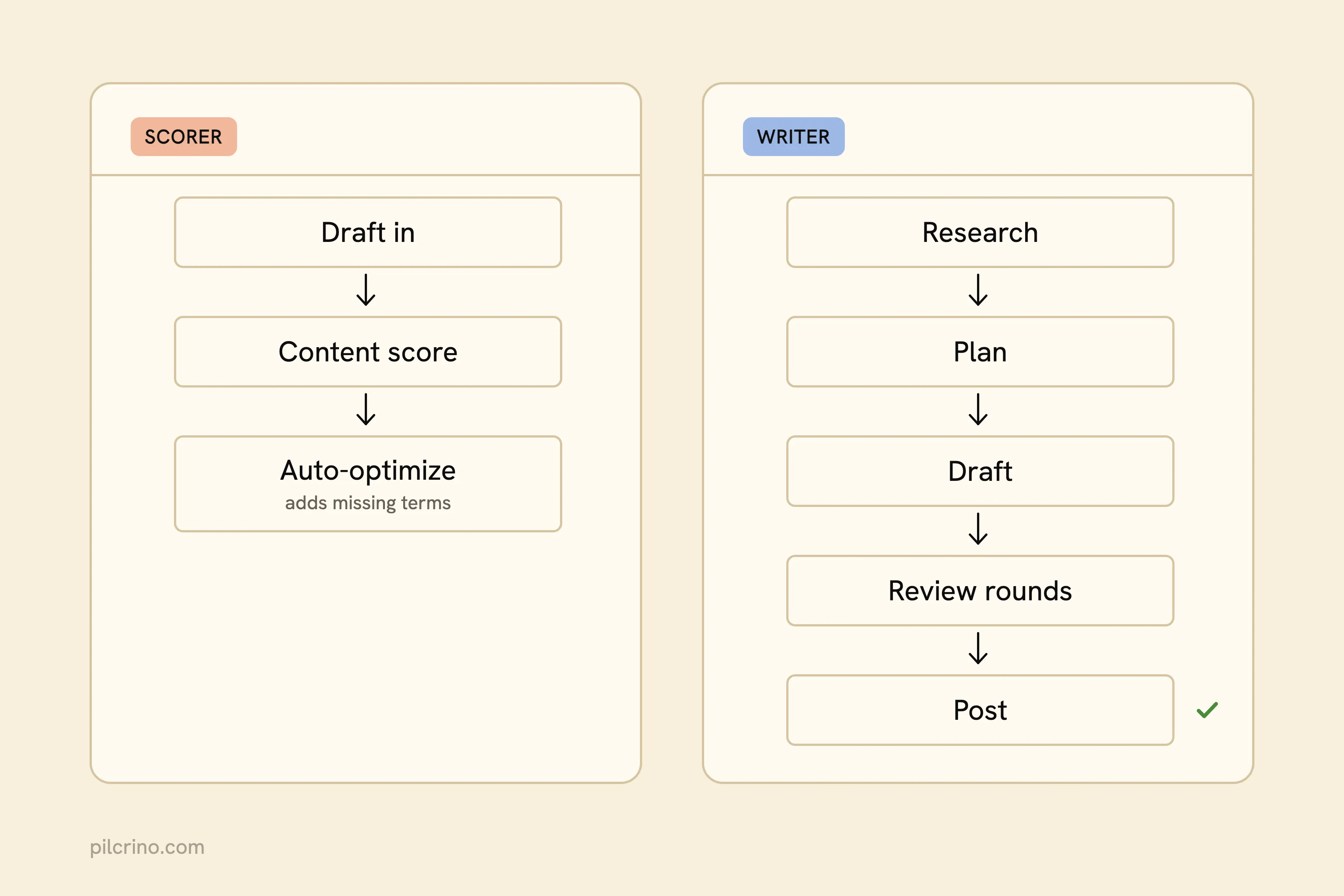
A scorer grades a draft and fills in missing terms. A writer researches, plans, drafts and reviews the post.
Which job do you need done?
If you’re a founder, it’s a post about your product: researched, argued and in your voice. A score grades a draft against what already ranks. It can’t tell you whether the post says anything a buyer needs to hear, which is most of why AI drafts sound generic.
Surfer’s own pitch has moved further toward measuring. The homepage hero reads “AI VISIBILITY PLATFORM”, the pricing page carries the title “Pricing & Plans for teams that want to win AI search”, and on 22 October 2026 Surfer moved from surferseo.com to surfer.ai because the old domain “kept putting us in the same drawer as legacy SEO tools”. The same announcement says: “We want to be the best AI SEO plugin you connect to your assistant.”
Practitioners see the split too. “Surfer SEO is great for on-page content optimization. Its keyword research tool? Not so much,” wrote Shamsudeen Adeshokan (@cybernaira on X) on 3 November 2026.
The older indie setup made this worse: one tool to write, such as Jasper, and Surfer to optimize, billed twice. I covered the writing half in Jasper alternatives for founders.
The ranking lists keep that frame. They define an alternative as another scorer:
- Their picks are content optimizers such as Clearscope, NeuronWriter and MarketMuse.
- The best-sourced page on this search leaves AI writers out on purpose.
- Zero of the seven pages list Koala Writer, Acta AI, raw Claude or Agrici’s Claude Code skills.
How I compared them
I build Pilcrino, so weigh this accordingly. I applied seven criteria, in this order:
- Writes the post or scores it, and what it does with a draft: score it, auto-optimize it, or put it through review rounds.
- Posts about your product or keyword articles, and where the product context comes from.
- Research sources, including Reddit and X through your own logged-in browser.
- Voice: learned, imported or pasted.
- Approval before publish: the default, and how you opt out.
- Pricing model and engine: subscription, credits, free or one-time, and whether it runs on the Claude plan you already pay for. Pilcrino gets held to the same test.
- Where your docs and drafts live.
How did I check each one? Public pages only: pricing, features, docs. I didn’t run a hands-on writing test. Agrici’s skills come from the GitHub repository and its changelog. For raw Claude I counted only what you paste into it.
Surfer alternatives compared
Surfer is the reference row and raw Claude is the baseline. Every cell comes from the vendor’s own pages.
| Option | Writes or scores | Product context | Research | Approval default | Pricing (Nov 2026) | Where docs live |
|---|---|---|---|---|---|---|
| Surfer (reference) | Scores (Content Score); Surfer AI writes; Auto-Optimize | Brand Knowledge | Top-ranking pages and scraped AI answers | No auto-publish seen; WordPress plugin and export | $59 to $359/mo; $49 to $299/mo billed yearly | Surfer’s cloud |
| Frase | Researches, writes, scores SEO and GEO (visibility in AI answers) | Learned Brand Voice | Live top results | “Nothing ships until you approve it”; auto-publish opt-in | Starter $49/mo or $39/mo yearly, 10 articles | Frase’s cloud |
| Koala Writer | Writes | Brand DNA from a site crawl or Google Maps | Deep and Extended Research (Professional) | Drafts or auto-publish, per brand | Starter $25/mo or $20/mo yearly, 45,000 words + 500 credits | Koala’s cloud |
| Acta AI | Writes from your interview or notes | Your own experience | Web research from Tribune | Editorial Review pass required to publish | Scriptor $29/mo, monthly only | Acta’s cloud; content sent to OpenAI and Anthropic |
| Agrici’s Claude Code skills | Writes; reviewer blocks under 90/100 | What you give it | Factcheck fetches every cited page | Local files, no built-in publishing | Free, MIT, on your Claude Code plan | Your machine |
| Pilcrino | Writes; review rounds; no content score | Plans posts around your product and competitors | Google, Reddit and X through your logged-in browser | Nothing publishes until you approve | Plugin free, MIT; app one-time price; your Claude plan | Your machine and your GitHub repository |
| Raw Claude (baseline) | Writes from what you paste | Only what you paste | Only sources you supply | Nothing publishes; you copy the draft out | The Claude plan you already pay for | Wherever you keep them |
Three things stand out. Surfer’s lowest plan, Discovery, includes 10 documents a month and 1 seat. Koala meters words, and Claude Opus 5.5 counts at 3x. Acta has no annual billing at all.
The metered tools also sit on top of whatever AI plan you already pay for, which is how a stack gets expensive. I added that up in what an AI writing stack costs in a year.
Why take prices from the vendor’s own page and not from a list?
Because the pages ranking for this search quote four different Surfer entry prices ($49, $69, $89 and $99), mostly under plan names Surfer no longer lists. Only one matches the current page.
The 5 best Surfer alternatives for writing blog posts
Each pick gets the buyer it suits and the main trade-off. The order follows the table, not a ranking.
Frase
Frase is the closest thing to Surfer with the writing half left in. It researches the live top results, drafts in a Brand Voice it learns from you, and scores SEO and GEO as you edit. Then it publishes to WordPress, Webflow, Sanity, Wix or its own FraseCMS.
The approval default is the good part. “Nothing ships until you approve it”, and auto-publish is an opt-in per content type, with a quality bar, a monthly cap and an auto-pause.
Starter is $49 a month, or $39 billed yearly, for 10 articles and 50 audit pages a month. There’s no free plan, but the 7-day trial needs no card and stops at 5 articles. All fees are final.
Best suited to: a team that wants Surfer’s two halves, a writer and a live SEO score, in one tool at a lower entry price.
Trade-off: it’s still a metered subscription on Frase’s own models, with no drafting model named and no way to bring your own key. Claude can call Frase through its hosted MCP, the standard connector that lets an assistant drive another tool, and through its command line, but that’s metered per request too. No Reddit or X research, and no Astro or GitHub publishing.
Koala Writer
Koala Writer is the cheapest hosted writer here. Starter is $25 a month, or $20 billed yearly, for 45,000 words and 500 credits a month. The free tier is a one-time 5,000 words and 25 credits, no card.
It starts from a keyword. Brand DNA then imports a knowledge base from a site crawl or Google Maps, so articles are “grounded in what you actually do”. You can “Publish as drafts to review, or auto-publish per brand” to WordPress, Shopify, Webflow, Ghost or a webhook.
So what does a strong model cost you?
Claude Sonnet 5 counts words at 2x and Claude Opus 5.5 at 3x. On Starter, that’s 15,000 words of Opus output a month. Koala’s MCP works with Claude Code, but “Generating an article through MCP uses your Koala AI word allowance.”
Best suited to: a founder on a tight budget who wants long keyword articles drafted fast and published to WordPress, Shopify, Webflow or Ghost.
Trade-off: words-and-credits metering, the strongest models cost the most words, and no Astro target. More in Koala AI alternatives.
Acta AI
Acta starts with you, not a keyword. It drafts from an interview, your notes or a recording; its homepage puts it as “Good content starts with you.”
Then it checks its own work. Editorial Review checks claims against sources, attempts one correction and re-reviews, and “Publishing through Acta requires a current Editorial Review pass”. No other hosted writer here ties a check to the publish button.
Scriptor is $29 a month for 15 articles on 1 site. Tribune is $79 for 40 articles on 3 sites. Unused articles don’t carry over, and there are no overage fees.
Best suited to: an expert founder who would rather be interviewed than prompt, and wants every post fact-reviewed before it goes out.
Trade-off: monthly billing only and no free plan, though a 14-day Tribune trial gives 10 articles without a card. Scriptor has no voice matching or web research; both start at Tribune. Direct publishing covers WordPress and Shopify only, and your content goes to OpenAI and Anthropic rather than through a Claude plan you already have.
Daniel Agrici’s free Claude Code blog skills
Daniel Agrici’s Claude Code blog skills are free and MIT-licensed. The repository sums up the cost: “Free, with your Claude Code plan.” A paid Gemini API is optional, only for generated images and narration, behind a consent gate.
They run research, an outline, a draft, then an independent reviewer that blocks any post under 90/100 or with a P0 issue. Five code-enforced gates, up to 3 runs. And /blog factcheck “fetches every cited page to confirm the claim is there”.
The project is active. Version 2.3.2 shipped on 3 November 2026, and the repository has 2.6k stars.
Best suited to: a technical founder who already uses Claude Code and is happy in the terminal.
Trade-off: you run it yourself, on Claude Code plus Python 3.11 or newer, in the terminal. Output is local files (markdown, HTML, PDF, images), with no built-in publishing; WordPress needs a separate plugin. It doesn’t plan posts around your product for you.
Pilcrino
Pilcrino is mine. The writer is a free, MIT-licensed Claude Code plugin, and the app that runs it for you has a one-time price. Both run on the Claude plan you already pay for, with no API key.
It plans posts from your product docs and competitors, so each one argues for something you actually sell. The images show your product too: diagrams in your blog’s palette and fonts, screenshots, and AI illustrations through a Codex login. Nothing leaves your machine. Your docs and drafts stay there and in your own GitHub repository.
Best suited to: a founder who wants posts argued around their own product, researched from real Google, Reddit and X sources, in their voice, on the Claude plan they already pay for.
Trade-off: macOS only today, and Claude only. There’s no content score either: if you want a live keyword score as you edit, Frase or Surfer does that and Pilcrino doesn’t.
Here is what replaces the score.
How Pilcrino researches and reviews a post instead of scoring it
Surfer gives a draft a number. Pilcrino runs the post through steps instead: a brief, research, a plan that an agent reviews, an outline, a draft, a review loop, a humanizing pass, then fact and link checks.
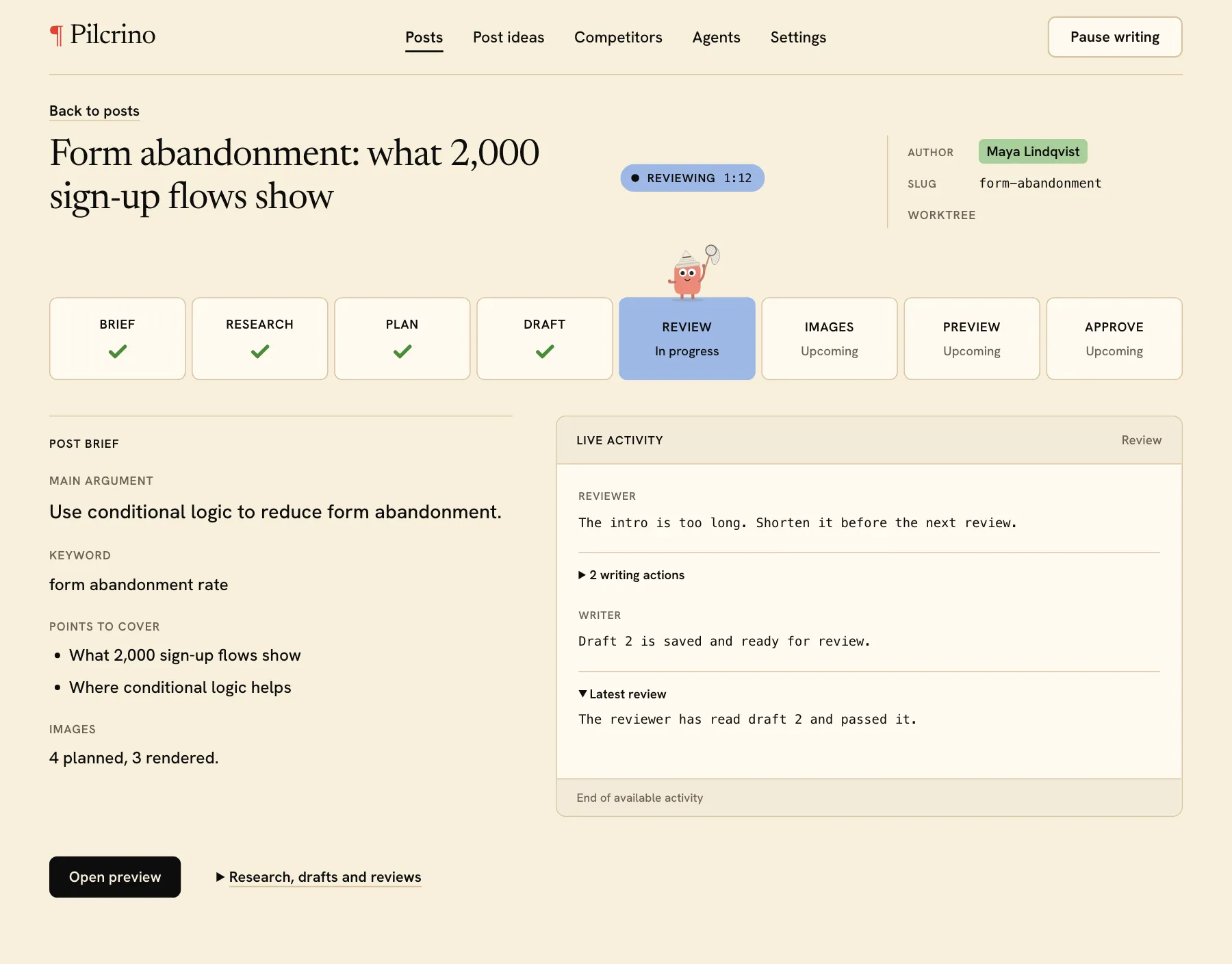
Research is the part a score can’t fake. Pilcrino pulls Google results, Reddit threads and X posts through your own logged-in browser, and the post cites them with links. Then the draft goes through a review loop before the humanizing pass and the fact and link checks.
Does that mean nobody has to read it? No.
You still read the post, and the app is built for that step. Astro posts arrive as a GitHub pull request (a proposed change you read and merge), WordPress posts as a draft. Each one gets a build check and a visual check on the live preview, and the built-in preview shows the post as it will publish, images included.
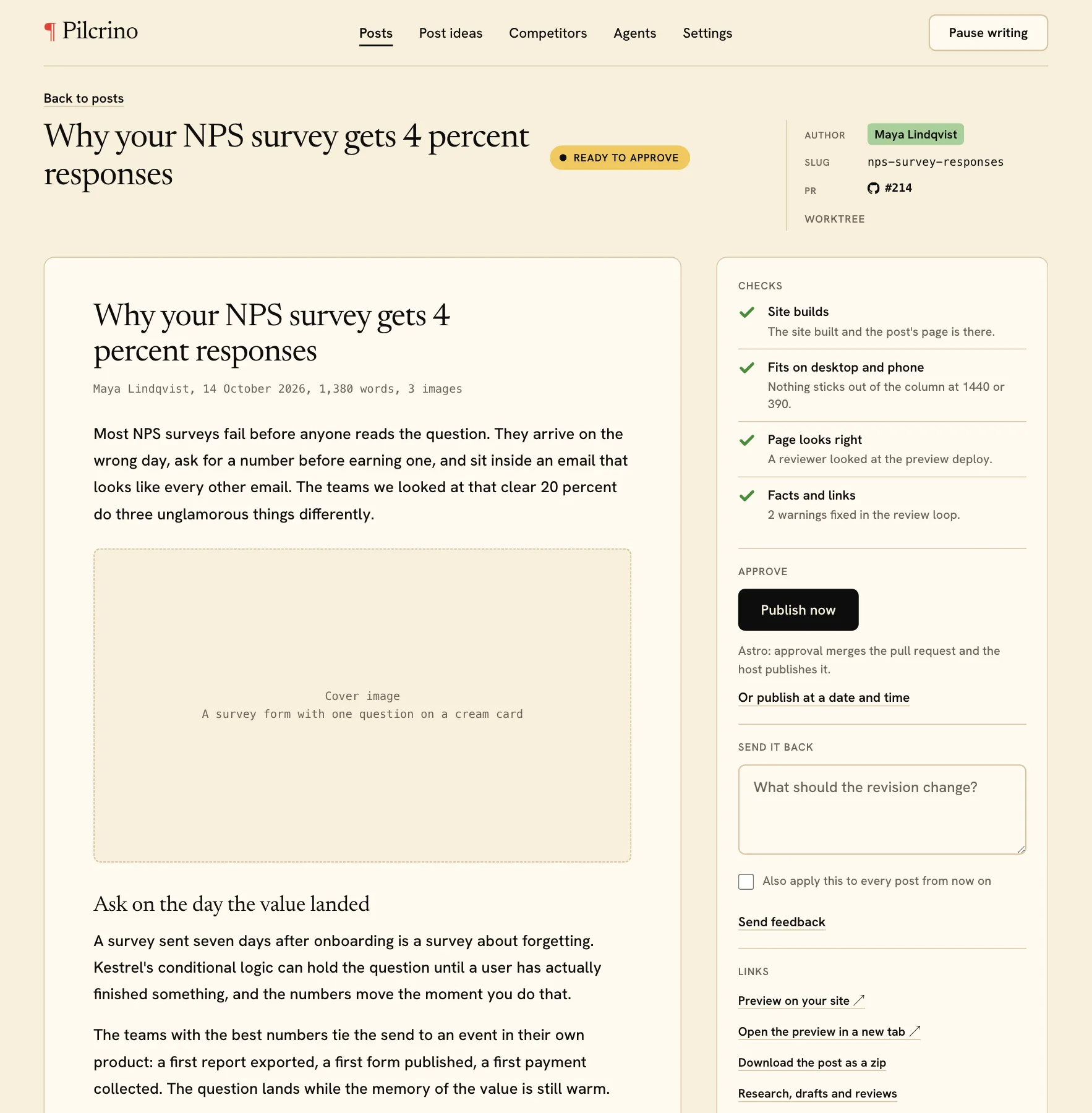
The output of all that isn’t a number. It’s a researched, reviewed post with its sources linked, ready for you to read.
When raw Claude is enough, and who should stay on Surfer
Not everyone needs a new tool. Here is the short version:
- One post at a time, from your own notes: raw Claude.
- Review gates without paying for a tool: Agrici’s Claude Code skills.
- Posts argued around your product: a writer from the list above.
- A team that writes well and wants a score or AI visibility tracking: stay on Surfer.
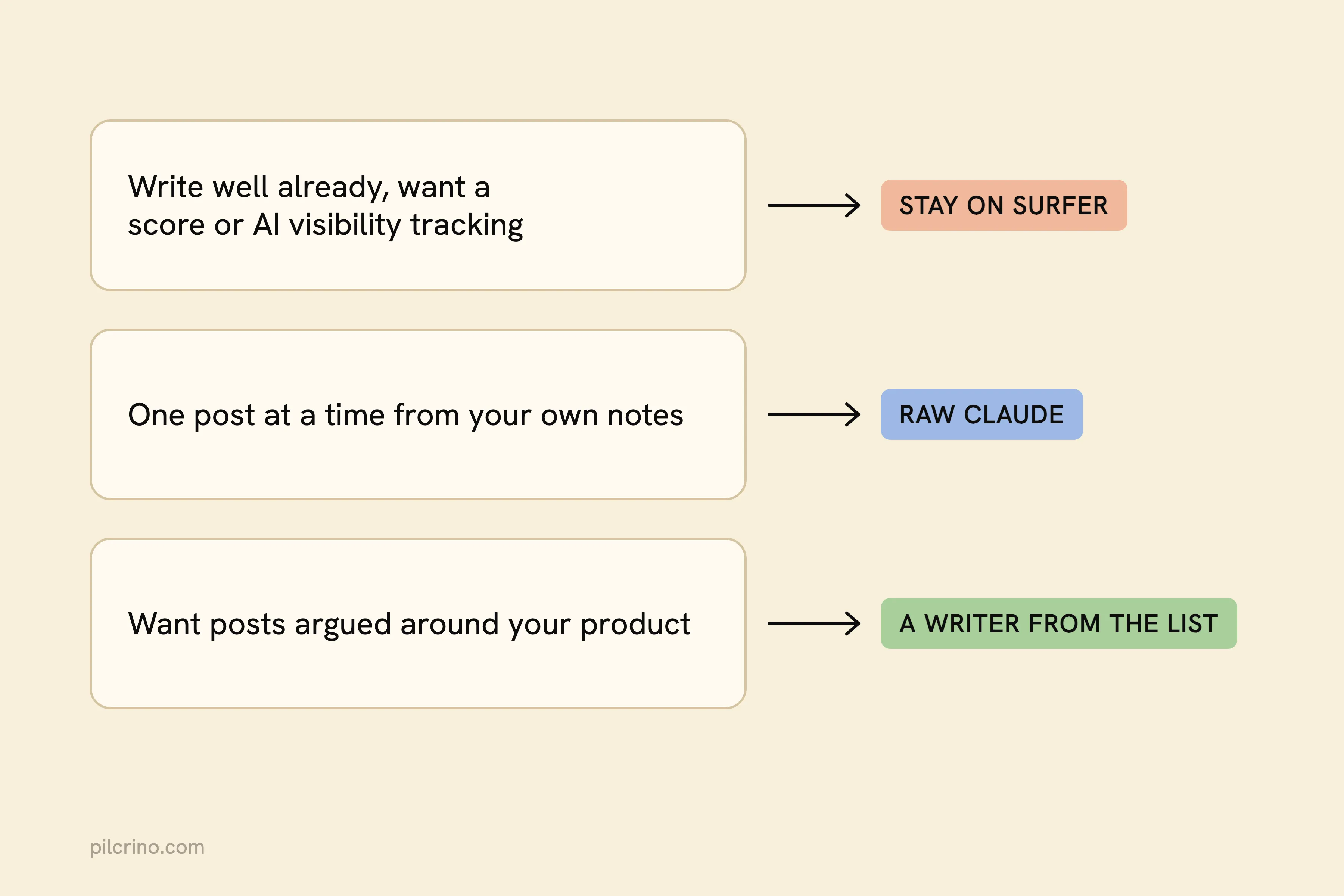
Raw Claude is enough when you write one post at a time, paste in your own notes and sources, and edit the draft yourself. It writes from what you give it, on the plan you already pay for, and nothing publishes unless you copy it out. I walked through a Claude Code blog workflow for founders who want to script some of it. When you want review gates on top without paying for a tool, Agrici’s skills are the next step.
Who should stay on Surfer?
A team that already writes well and wants a content score while editing. Or a team that wants AI visibility tracking: AI Tracker follows prompts across ChatGPT, Perplexity, Gemini, Google AI Mode and AI Overviews, and the standalone AI Search Analytics plan is $95 a month, or $82 billed yearly, with no documents. Surfer’s MCP, on Pro, Peace of Mind and Enterprise, lets Claude call Surfer, but Surfer still needs its own subscription.
Before you renew, check the billing terms. Surfer’s annual plans are paid upfront for “a discount of up to 17%”, they auto-renew, and the pricing page states no refund policy.
If you want posts argued around your product, researched from real sources and written on the Claude plan you already pay for, join the Pilcrino waitlist.
Researched and drafted with Pilcrino. Approved by Slav.
FAQ
Is there a free Surfer SEO alternative for writing blog posts?
Yes. Daniel Agrici’s Claude Code blog skills are free and MIT-licensed and run on your Claude Code plan. Raw Claude costs nothing beyond the Claude plan you already pay for. Koala Writer has a one-time free allowance of 5,000 words and 25 credits. Surfer itself has no free plan.
Does Surfer still write articles?
Yes. Surfer AI writes full articles, and Auto-Optimize adds missing terms, entities and facts to a draft. But the product and its pricing now lead with the Content Score and AI visibility tracking, and Surfer moved to surfer.ai in October 2026 to say so.
What is the cheapest paid Surfer alternative for writing?
Koala Writer Starter, at $20 a month billed yearly or $25 monthly, for 45,000 words and 500 credits. Next is Acta AI Scriptor at $29 a month for 15 articles, monthly only. Surfer’s cheapest plan, Discovery, is $49 a month billed yearly. All prices are from each vendor’s pricing page in November 2026.
Can I use Claude instead of Surfer?
For writing, yes: Claude writes the post from what you give it, on the plan you already pay for. It gives you no content score, though. Surfer’s MCP lets Claude call Surfer, but that still needs a Surfer subscription on Pro or higher.