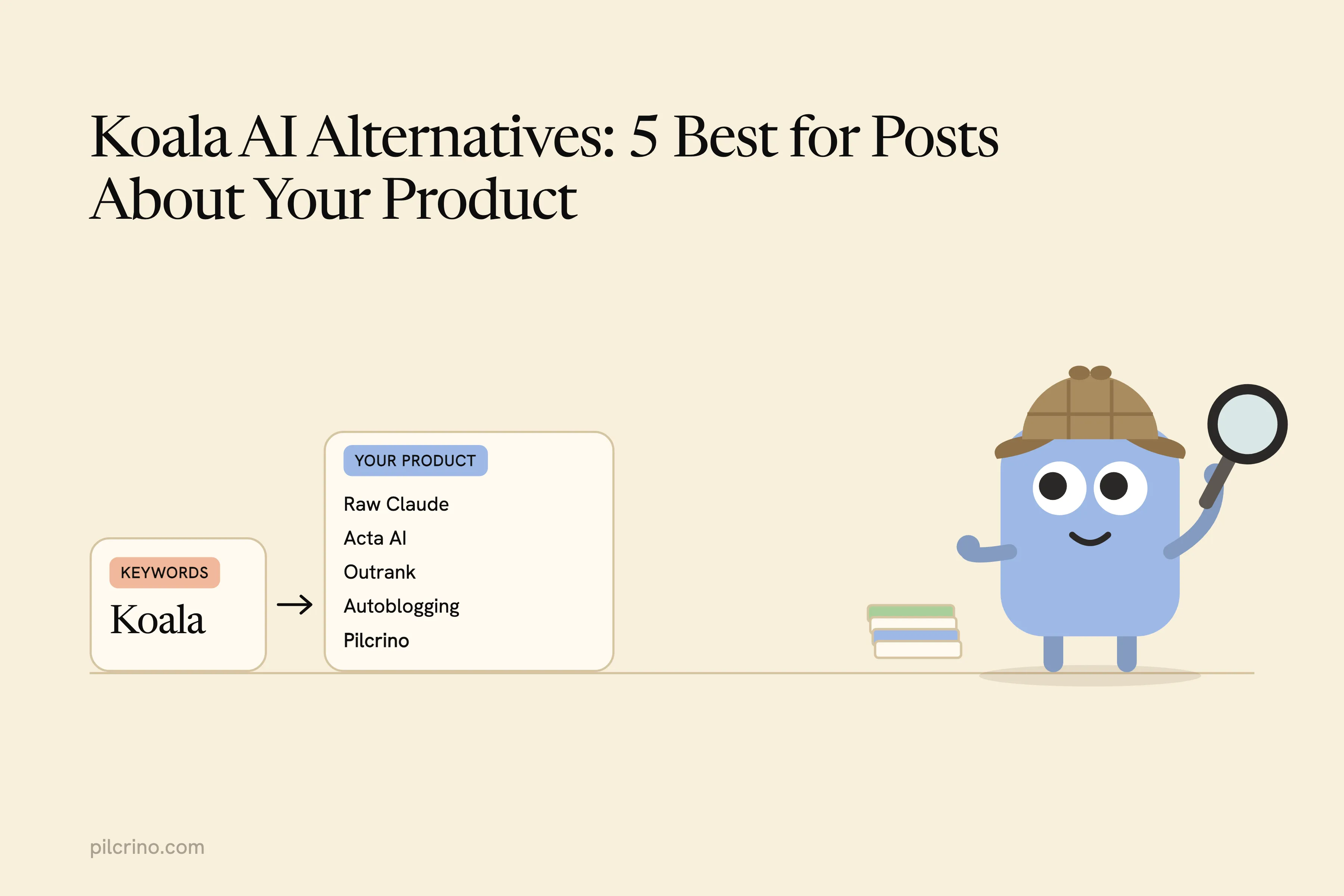
The best Koala AI alternatives depend on what you publish. Koala Writer (koala.sh, not the sales-intelligence tool that shares the name) is built to turn a keyword into a long SEO article for affiliate sites, agencies and high-volume programmatic SEO. If your blog exists to sell your own product, you want a tool that writes about that product instead.
I build Pilcrino, one of the five options below, so I’ll say that once here and rate it by the same rubric as the rest.
You still have to rewrite a keyword draft about your niche before it argues for anything you sell, which is most of why AI blog posts sound generic.
Below: the comparison tables, who should stay on Koala, the rubric, a short review of each option with prices as of September 2026, and how to pick.
What are the best Koala AI alternatives?
Short version first. Each pick depends on how many posts you write and who approves them:
- Raw Claude if you publish a few posts a month and don’t mind running the steps yourself.
- Outrank if you want one keyword article a day and don’t want to touch it.
- Autoblogging.ai for bulk volume.
- Acta AI if you want an interview step and a review queue in the cloud.
- Pilcrino (waitlist) if you want posts planned around your product that you approve before they go out.
Here is how they compare with Koala Writer on the same six criteria, split across two tables. Prices come from each vendor’s own pages, and Claude Pro costs $20 a month, or $17 billed annually.
Where the ideas, voice and research come from:
| Tool | Plans posts around | Voice input | Research sources |
|---|---|---|---|
| Koala Writer (baseline) | Keywords; bulk mode queues 10 to 100+ articles | Brand DNA imported from Google Maps or your website | Live SERP research, up to 10 sources per article |
| Raw Claude | Whatever you prompt | Whatever samples you paste in | Whatever you gather yourself |
| Acta AI | Prompt templates and schedules, plus an experience interview | Voice Matching (Tribune and up) | Web Research and SERP analysis (Tribune and up) |
| Outrank | A keyword plan, one key phrase per day | “Your published pieces” | Keyword data; sources not named |
| Autoblogging.ai | Keywords, news, feeds or a CSV | Style Studio: up to 8 URLs or your uploads | SERP data (Godlike Mode), Google News |
| Pilcrino (waitlist) | Your product docs and competitors | Your blog’s own posts | Google, Reddit and X through your logged-in browser, cited |
Who approves, what it costs and where your documents sit:
| Tool | Approval before publish | Pricing (Sept 2026) | Where your docs live |
|---|---|---|---|
| Koala Writer (baseline) | Drafts or auto-publish, per brand | Professional $49/mo; Essentials $9/mo listed on the pricing page | Koala’s cloud |
| Raw Claude | You paste it yourself | Claude Pro $20/mo ($17/mo billed annually) | You choose what to paste |
| Acta AI | Review First or Auto-Publish, per schedule | $29, $79 or $249/mo, month-to-month | Acta’s cloud |
| Outrank | WordPress auto-publish on generation, Draft Mode optional | $99/mo or $999/yr | Outrank’s cloud |
| Autoblogging.ai | Draft or live, per setting | $19 to $999/mo in credits | Autoblogging.ai’s cloud |
| Pilcrino (app on a waitlist) | Nothing publishes until you approve | Plugin free; app $199 once | On your machine |
Who should stay on Koala Writer
Koala is good at the job its own site names. It targets “Affiliate + niche sites”, “Agencies + freelancers” and “High-volume programmatic SEO”, and its bulk mode will “Queue 10 to 100+ articles at once”. If that’s your blog, switching buys you little.
Its users say the same thing. u/Kitchen_Date_9711 called Koala plus a bulk keyword list “scalable gold” for niche sites, and u/Open-Editor-3472 in r/WritingWithAI called it “Best value for high volume bloggers by far.”
So is the output ready to publish?
Even fans don’t call it finished copy. Mike Futia (@mikefutia on X), who liked the tool, wrote in 2023: “If you think the output, as-is, is going to be ‘publish ready’ on a site that you actually care about: You’re going to be disappointed.” He added that he “heavily edited and re-wrote large sections of it. Probably took me 45 minutes.”
One cost detail matters if you pick a stronger model. Koala meters words by model: Claude Sonnet 5 counts at 2x and Claude Opus 5 at 3x, so “a 1,000-word article on Claude Opus 5 or GPT-5.6 Sol burns 3,000 words from your monthly allowance.” Professional’s 100,000 words a month covers 33 of those.
And an honest note on this search. When I ran it, a third of page one was about a different product called Koala, and rival AI writers had published most of the writer results, ranking themselves first. I have a stake too, which is why it sits in the second paragraph of this post.
How I rated them: posts about your product, not keyword articles
Every tool below writes decent English. What separates them for a product blog is where the post starts and who signs off on it, so I rated each one on six things:
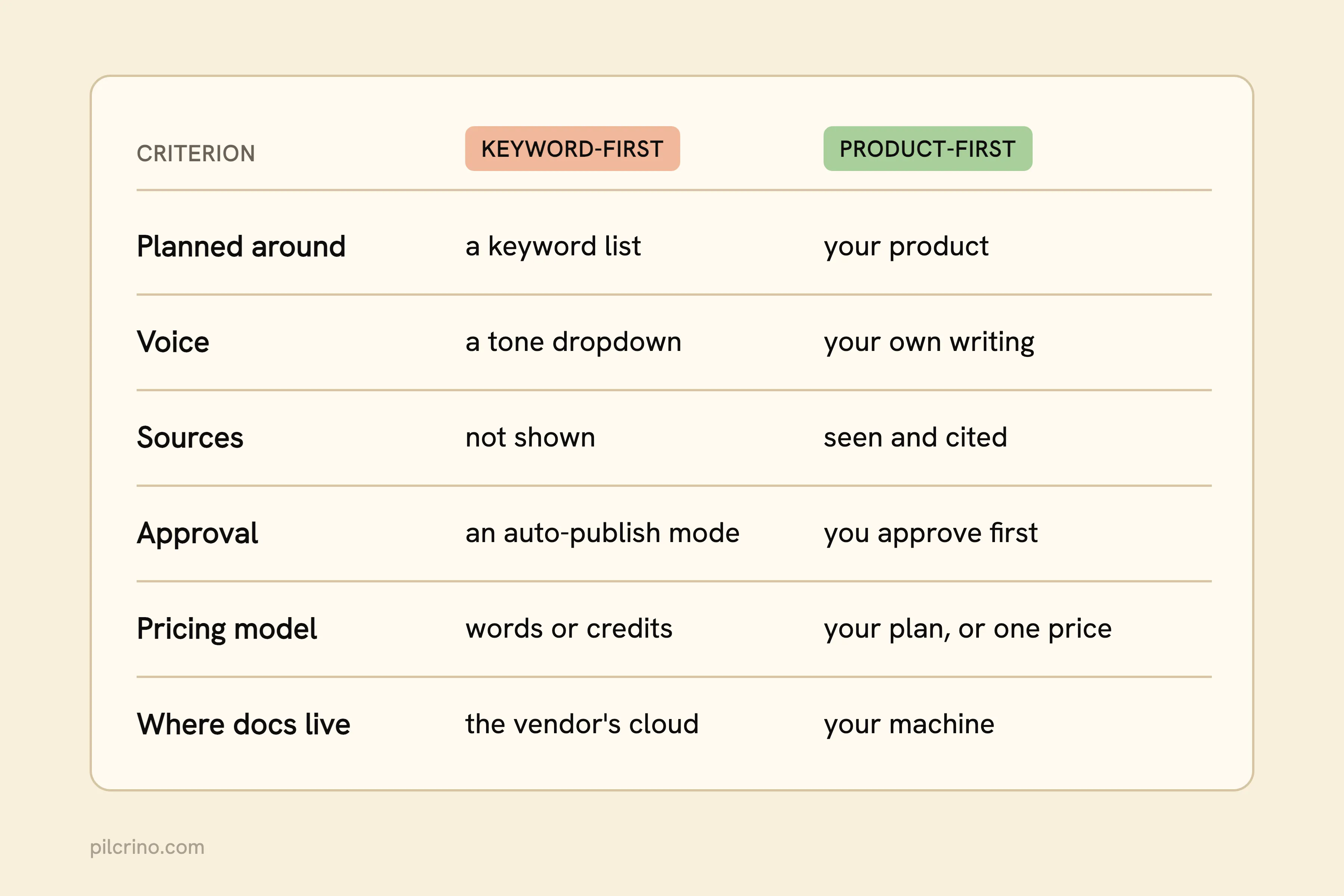
- Planned around your product, not around a keyword list.
- Voice from your own writing, not a tone dropdown.
- Research sources you can see and cite in the post.
- Approval before anything publishes.
- Pricing model: subscription or credits, the plan you already pay for, or a one-time price.
- Where your docs and blog credentials live, which matters more than most people check. I covered where your docs go with a SaaS writer separately.
Why is approval a column at all?
Because Google lists “Using generative AI tools or other similar tools to generate many pages without adding value for users” as an example of scaled content abuse. Every subscription tool in this list has a mode that publishes without you looking. That isn’t automatically a problem, but it is the setting to check first, and I went through the rest of the risk in AI content and SEO.
The product-first criterion comes from a line I keep thinking about. “The draft the AI hands you is competent and authorless,” wrote u/Lonely-Quit7504. On a product blog, the author is what you know about your product and your competitors. It has to go into the plan before the draft exists, not get pasted in after.
The 5 best Koala AI alternatives, reviewed
Prices below come from each vendor’s own pages, checked in September 2026.
Raw Claude: best if you write a few posts a month
If you already pay for Claude, you already own a capable writer. Claude Pro is $20 a month, or $17 billed annually, and every paid plan includes Claude Code. Heavier use starts at $100 a month on Max.
Pros:
- No new subscription if you already pay for the plan.
- Your prompts, your process, full control over every step.
- Practitioners back it: “chatgpt works fine if you know how to use it,” wrote u/AbleInvestment2866 in r/SEO about the paid writers.
Cons:
- You build research, sourcing, review and publishing yourself.
- Nothing keeps your voice or competitor facts between sessions unless you set that up.
I wrote up a seven-step Claude workflow for exactly this route.
Best for: founders publishing a few posts a month who are happy to run the process by hand.
Acta AI: best for an interview step and a review queue
Acta is the closest to a product-first tool among the paid options. Before writing, “Acta generates five focused questions about your real expertise” and weaves your answers into the post. Then a 10-stage pipeline runs, including a separate AI review pass and a six-dimension Acta Score, and “A typical article takes 60 to 90 seconds.” I compare it with seven other tools in Acta AI alternatives.
Pros:
- The experience interview puts your own stories into each post.
- 186 banned phrases that are “Always on. Cannot be disabled.”
- Each schedule runs in Review First mode or Auto-Publish mode, and it publishes to Astro, Next.js, Hugo or Gatsby through a Content API.
Cons:
- Scriptor ($29 a month) has no web research or voice matching and adds a “Blog powered by Acta” credit. Tribune ($79) and Imperator ($249) are month-to-month, with a 14-day Tribune trial.
- Your content and platform credentials sit in Acta’s database, and “Token costs are covered by your subscription”, so the Claude plan you already pay for doesn’t help.
- The changelog shows no entry after v1.21 on 2026-05-14.
Best for: experts who want their own stories in each post and are fine with a cloud review queue.
Outrank: best for a daily keyword article done for you
Outrank sells one plan: $99 a month or $999 a year for 30 articles a month per site, one a day. Add-ons go from 60 articles for $85 more a month up to a Human Curated Service at $1,399 a month.
Pros:
- The plan runs on “one key phrase per day”, so you never pick topics.
- It learns your voice if you “Share your published pieces”.
- You can pre-create scheduled articles up to 7 days ahead to “Review it, edit it, approve it”.
Cons:
- Its WordPress integration publishes articles as soon as they’re generated unless you switch on Draft Mode.
- No Astro target, no free plan, and trial articles carry an Outrank watermark. Refunds cover first-time subscribers within 7 days.
- The AI model isn’t named, and you can’t use your own plan.
Best for: sites that want a steady keyword post without touching it.
Autoblogging.ai: best for bulk volume
Autoblogging.ai does what Koala does, with more knobs. You can “Generate up to 500 articles at once via CSV upload”, and its Style Studio mimics up to 8 URLs or past write-ups you upload.
Pros:
- Credit pricing from Starter at $19 a month (40 credits) to Enterprise at $999 a month (5,000 credits). A Quick Mode article costs 1 credit, a Godlike Mode article 2.
- “Every new account gets 10 free credits per month, no credit card required.”
- A Knowledge Base for your own documents, and publishing as draft or live.
Cons:
- Keywords, news, feeds or a CSV drive the topics, not your product.
- Its homepage testimonials frame use on “personal sites, parasite SEO, affiliates”, and its changelog pitches adding articles “to all your PBNs” (private networks of sites built to pass links).
- “No refunds shall be provided in case of cancellation,” and no page names the AI model.
Best for: high-volume niche operators, the same job Koala does.
Pilcrino: best for posts planned around your product (waitlist)
This one is mine, and it is on a waitlist, not on sale today. Pilcrino plans posts from your product docs and competitors, researches through your logged-in browser (including Reddit and X), and cites what it finds.
Pros:
- Runs on the Claude plan you already pay for, with no API key. The plugin is free; the app is $199 once with 12 months of updates and support.
- Your docs, drafts and blog credentials stay on your machine.
- Nothing publishes until you approve it. Astro posts arrive as a GitHub pull request, WordPress posts as a draft.
Cons:
- Waitlist only.
- macOS only today, and WordPress posts stop at a draft you publish yourself.
- It runs on your machine, so it isn’t a hosted service you can open from any browser.
Best for: founders whose blog exists to sell their product.
How Pilcrino keeps a comparison post honest: competitor profiles
A comparison post is only as good as its prices. Pilcrino reads a competitor’s site when you ask and keeps its pricing, features and key facts as a profile on your machine, each marked with when it was read. A comparison post quotes only a fresh profile. A stale one stops the post and asks you to refresh it.
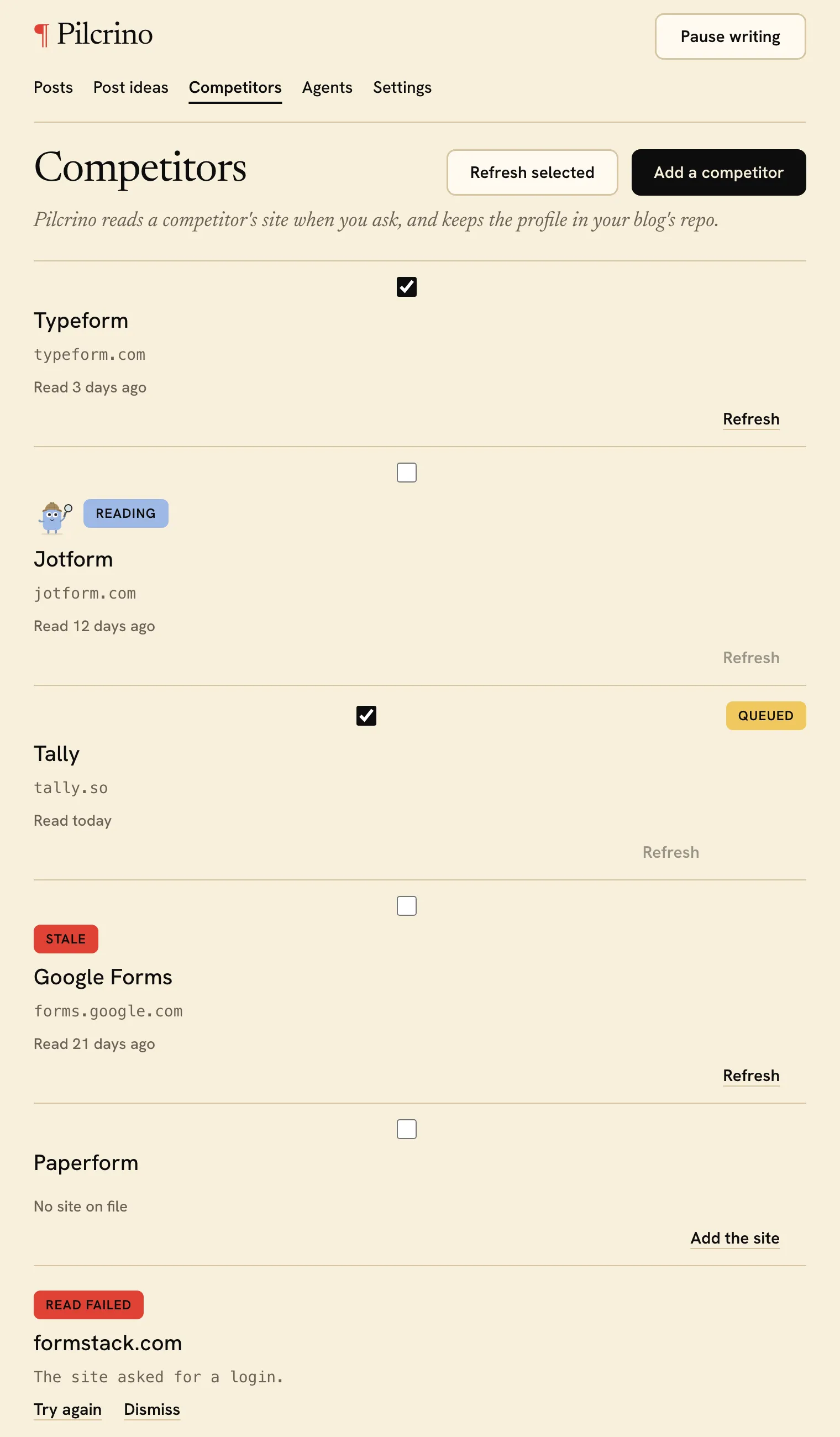
Does that hold up on a real post?
The screens in this section use an example blog. This post is a real one: every Koala, Acta AI, Outrank and Autoblogging.ai price in the tables above came from a profile Pilcrino read this month. One Koala list on page one for this search still quotes Koala prices from two years ago.
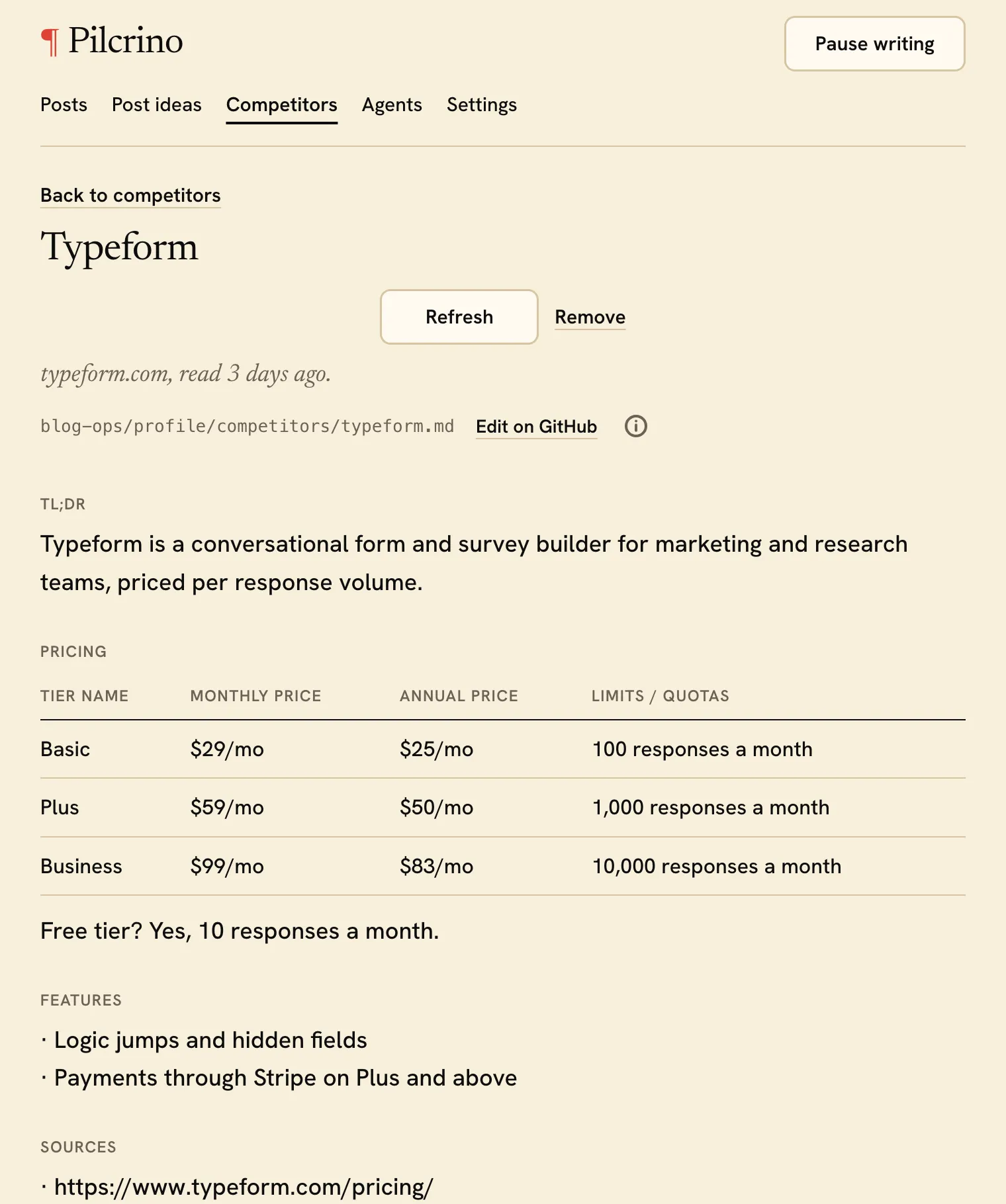
The profiles also feed the content plan. Pilcrino proposes topics from your product docs and competitors, and each planned post names the feature it argues for. You edit the list and the order. That’s the difference from a keyword list: you get a plan built around your product, and the competitor facts in it are dated.
Which Koala AI alternative should you pick?
Pick by the job, not by the feature list:
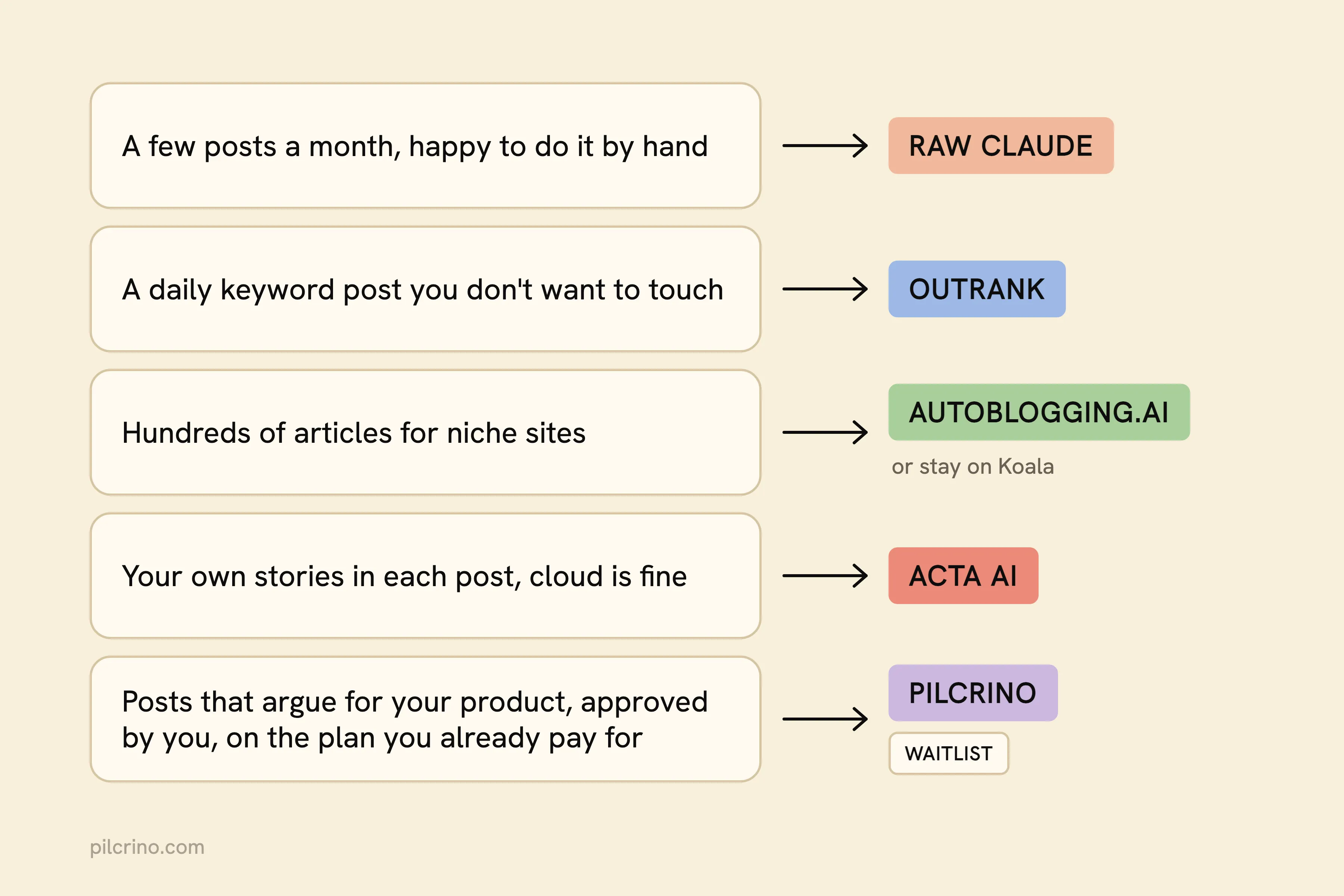
- A few posts a month, happy to do it by hand: raw Claude.
- A daily keyword post you don’t want to touch: Outrank.
- Hundreds of articles for niche sites: Autoblogging.ai, or stay on Koala.
- Your own stories in each post, cloud is fine: Acta AI.
- Posts that argue for your product, approved by you, on the plan you already pay for: Pilcrino, once you’re off the waitlist.
One reality check applies to all of them. “Writing tools help expand breadth, not depth,” as u/WebLinkr put it in r/SEO. The depth still comes from you.
If your blog exists to sell your product, Pilcrino writes posts in your voice that argue for it, on the Claude plan you already pay for. The plugin is free; the app is $199 once, $129 for the first 50, with 12 months of updates and support. Join the Pilcrino waitlist.
Researched and drafted with Pilcrino. Approved by Slav.
FAQ
Is Koala Writer still worth it in 2026?
Yes, for the sites it targets: affiliate and niche sites, agencies and high-volume programmatic SEO, where turning keywords into long articles in bulk is the whole job. It’s a weaker fit for a product blog, because it starts from a keyword rather than from your product, so each draft needs your knowledge added by hand before it argues for anything you sell.
Is there a free Koala AI alternative?
Autoblogging.ai gives every new account 10 free credits a month with no card, and Koala itself gives new accounts 5,000 free words and 25 credits. If you already pay for Claude, using it directly adds no extra cost.
Can I use Claude instead of Koala Writer?
Yes. Koala’s own default model is Claude Sonnet 5, Anthropic’s model, so the plan you already pay for runs the same family of models without Koala’s word allowance on top. The trade-off is that you build the research, sourcing and publishing steps yourself.
Which Koala alternatives publish without my approval?
All four paid tools here (Koala, Outrank, Acta AI and Autoblogging.ai) have a mode that does. Outrank’s WordPress integration publishes articles as soon as they’re generated unless you turn on Draft Mode, Acta AI has an Auto-Publish mode per schedule, and Autoblogging.ai can post live. Koala can auto-publish per brand. Pilcrino never publishes without your approval.