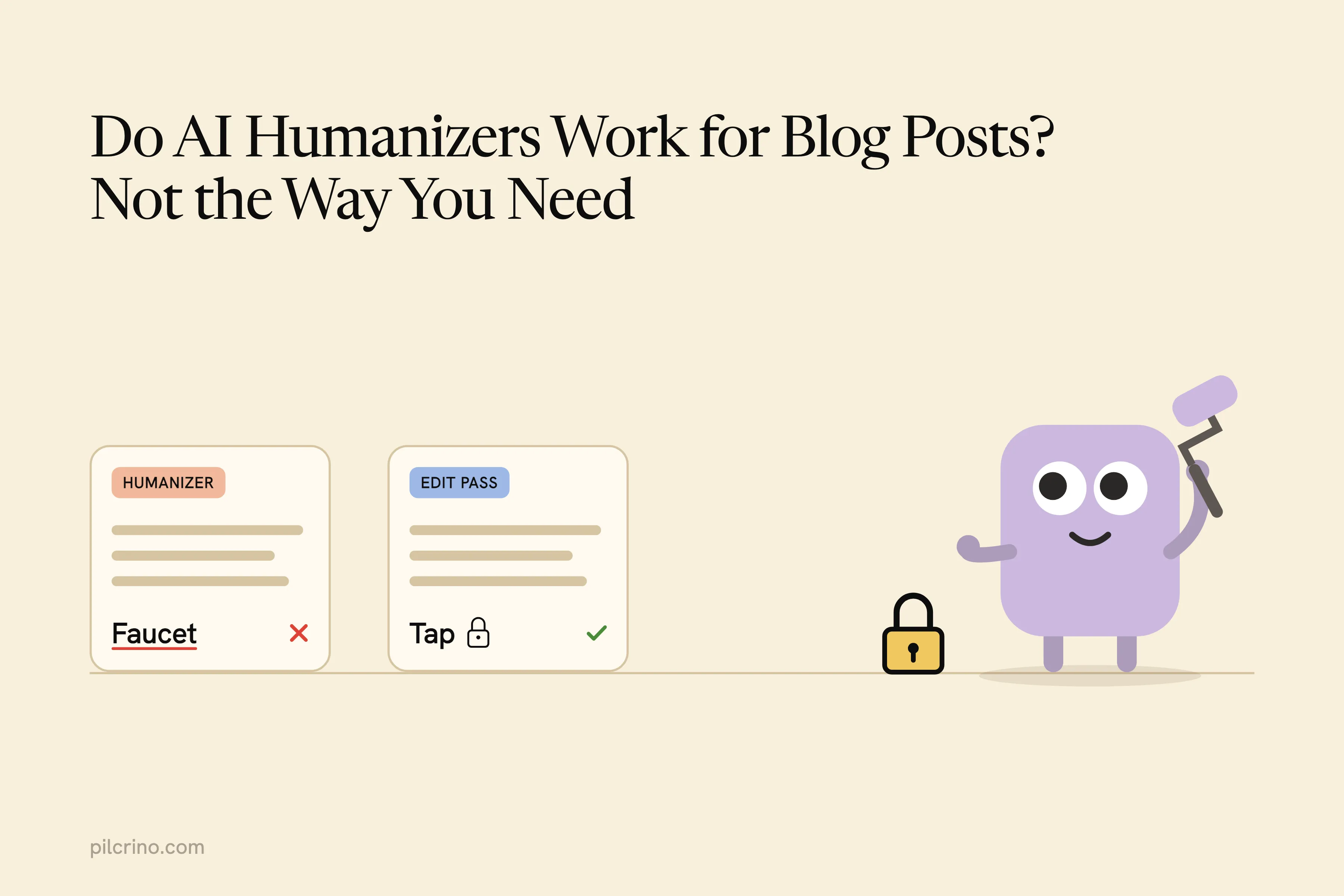
Do AI humanizers work for blog posts? They can move a detector score, but that score isn’t what loses you readers, and the rewrite can bend your facts on the way without telling you.
I build the editing pass in a blog-writing pipeline, so I spend my days on the gap between “passes a detector” and “reads like a person wrote it”.
I’ve written separately about why AI posts sound generic in the first place, which covers the whole voice workflow. This post answers the narrower question of whether a humanizer tool fixes it: what a humanizer actually does to a post, why the detector is the wrong judge, and the edit pass that works instead, with ten tells to check and the things it must never touch.
What a Humanizer Actually Does to a Blog Post
SlashGear tested 10 humanizers on their free plans, and the worst failures were about meaning, not style. Humbot turned “Tap your Apple ID” into “Faucet your Apple ID.” ContentShake swapped “Understanding” for “Grasping”, which the tester said “doesn’t convey the same meaning at all.”
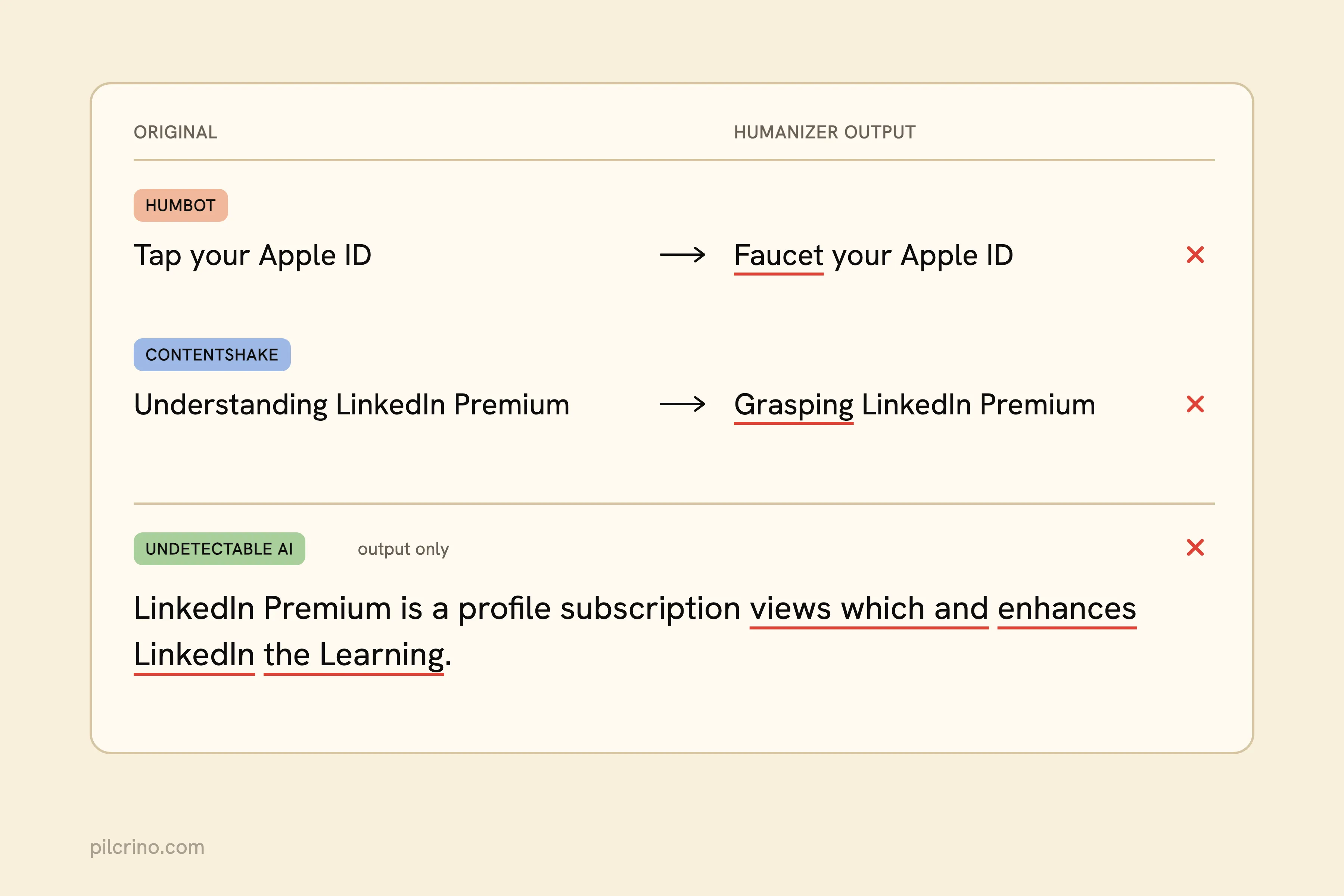
Undetectable AI did worse: “LinkedIn Premium is a profile subscription views which and enhances LinkedIn the Learning.” SlashGear’s verdict on whether humanizers work was “Yes and No.”
That’s the mechanism. A humanizer is a paraphraser aimed at a detector score. It doesn’t know which word is a product name, which number is a claim, or which phrase is a link’s anchor text.
In a post about your own product, those are the words that matter most. A swapped feature name reads fine at a glance. It’s still wrong on the page, and your name is on it.
Even when nothing breaks, the result is flat. Anangsha Alammyan tested more than 30 humanizers on blog posts and other drafts, and the best output read “like a well-edited article written by no one in particular.” A founder on r/microsaas got the same answer from a commenter: most tools “reword the same robotic voice … You end up with the same cadence, just with fancier adjectives.”
What changes and what doesn’t:
- Changes: individual words, sentence order.
- Stays: the cadence, the paragraph shape, the predictable structure.
- Breaks: meaning, product terms, sometimes grammar.
Why the Detector Score Is the Wrong Target
The pitch for humanizers runs on fear. One X post with 288 likes opens with “Claude writing is easily detectable.” and then offers a prompt hack to fix it.
But what would you be fixing? The score moves for reasons that have nothing to do with how a post reads. A Substack writer watched a note go from 100% human to “100% AI assisted” after adding one paragraph. Their reaction: “I’m not interested in trying to ‘beat’ the detector. My concern is that if I genuinely write something myself, it could still be labeled as AI-assisted with no explanation.”
The tools also disagree with each other. In the SlashGear test, scores for the same text differed considerably between detectors. Alammyan saw it too: “I’ve seen paragraphs pass one detector and fail another.”
Some detectors are accurate on some text. That’s not the point. Wikipedia’s own cleanup guide tells editors not to rely solely on detection tools, which “have non-trivial error rates”, and adds that “Not all text featuring these indicators is AI-generated.”
Google doesn’t grade the score either. Its Search Central guidance says it rewards high-quality content however it is produced, and that automation used with “the primary purpose of manipulating ranking” breaks its spam policies. I went through what Google actually says about AI content in more detail elsewhere.
Even the subreddit built around beating detectors concedes it. The top humanizer test on r/BypassAiDetect says “No tool beats every detector every time. that’s just reality.” Then it ends with a manual edit checklist.
Readers Leave on the Smell, Not the Score
The real cost is a reader who closes the tab. Cynthia Dunlop ran an anonymous survey of 668 tech-blog readers, and 78% said they leave immediately when a post seems AI-assisted or AI-authored.
The rest of the numbers point the same way:
- 85% rated how much it matters to them a 5 out of 5.
- 71% said they avoid the author afterward.
The question was multi-select, the respondents were mostly developers, and they were reacting to posts that seem AI-written, not to a detector label.
Nobody in that survey ran your post through GPTZero. They read it and noticed something.
What do they notice? Readers name words and shapes. On r/copywriting, one commenter called AI’s “quietly” “a load-bearing adverb.” The r/microsaas founder listed the shape: “every paragraph has roughly the same length, and the conclusion somehow summarizes everything that was already said five times.”
The cost runs both ways. In the same r/copywriting thread, several writers said they now avoid normal words like “genuinely” because they’re afraid of reading as AI.
A humanizer keeps exactly what readers notice. It swaps the words and leaves the cadence and the shape alone.
What Works Instead: An Edit Pass With the Facts Locked
An edit pass changes only the parts readers flag, and nothing else. It has three steps.
Lock the Facts First
Before you edit a word, decide what the pass may never change. Check the facts before the edit pass, then lock:
- Numbers and the claim around them
- Quotes, word for word
- Links and their anchor text
- Product names and feature claims
- Headings
Edit Against a Numbered List of Tells
Then go through the draft with a list. These ten come from what readers and editors actually name:
- Pet adverbs and adjectives: “quietly”, “genuinely”. Fix: delete them.
- Words that hit things: everything “lands” or “hits hard”. Fix: say what happened.
- “It’s not just X, it’s Y” and “not just X, but also Y”. Fix: state Y.
- Stock lines: “Let that sink in.”, “Here’s the thing.”, “And honestly?” Fix: delete.
- Filler signposts: “it is worth noting”, “delve into”, “let’s dive in”. Fix: cut to the point.
- “Serves as” where “is” works, and words that inflate importance. Fix: use “is” and cut the inflation.
- Paragraphs all the same length. Fix: vary them, and let one sentence stand alone.
- Predictable headings that restate the question, and bold scattered through every paragraph. Fix: headings that say something, bold only where it earns it.
- A conclusion that summarizes everything again. Fix: cut it or end on the next step.
- Claims without a source or a date. Fix: cite it or cut it, which is why the lock list comes first.
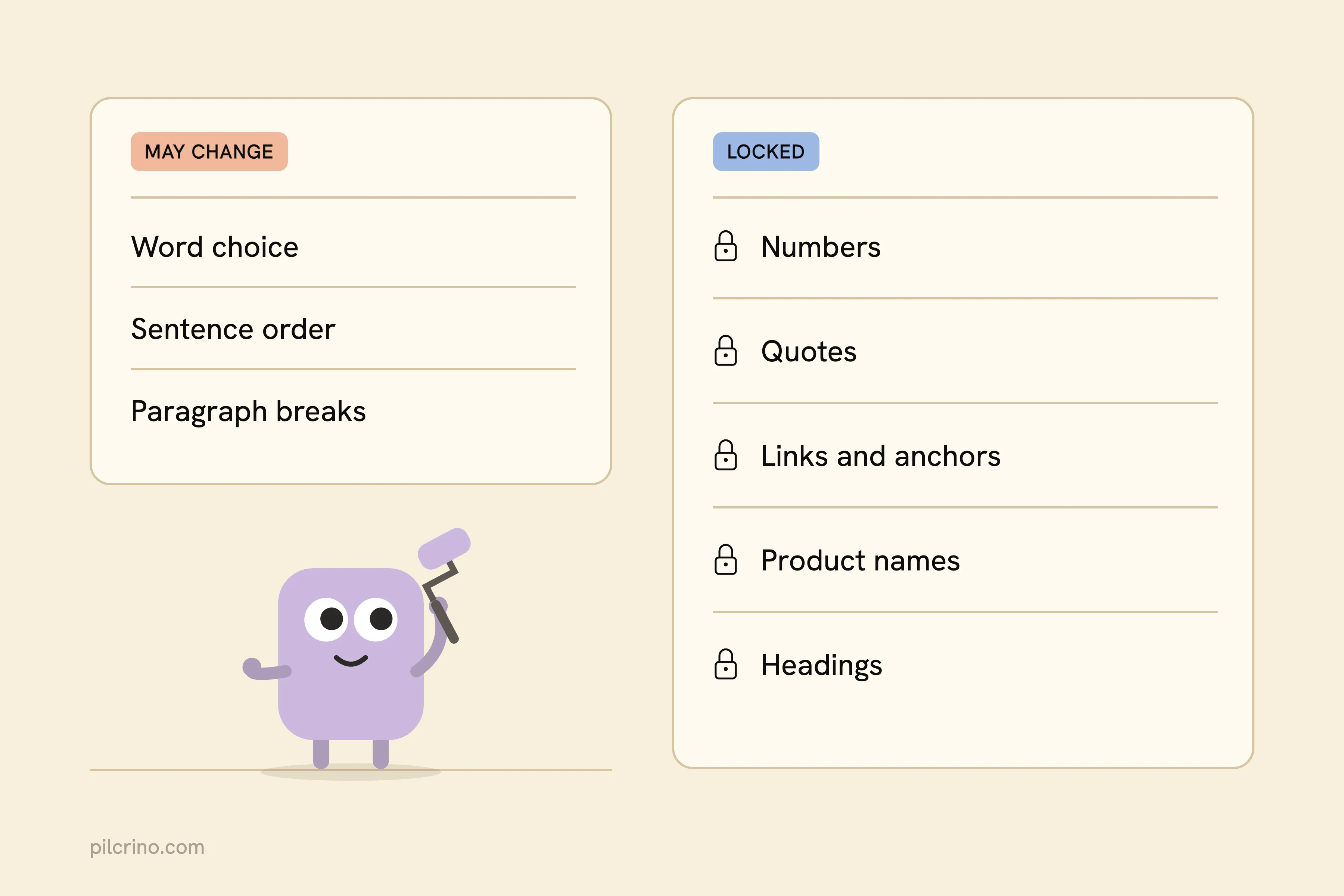
The pass may change word choice, sentence order and paragraph breaks. Everything on the lock list stays as it is.
Read It Aloud, Then Check the Facts Again
Read the edited post out loud. Anything you trip over still has a tell in it. Then diff the numbers and links against the pre-edit draft, because an edit pass can slip too.
How Pilcrino Runs This Pass
This is the step I built into Pilcrino. The writing pipeline calls it a humanizing pass, but it doesn’t paraphrase for a score. It edits against a numbered list of tells (a standard list of forbidden phrases plus the ones your blog adds) and runs after the draft and the review rounds.
The order matters. Review rounds still move facts and sections around, so editing tells before them means editing twice.
The pass may change phrasing, sentence structure and paragraph breaks. It must keep every number, citation (URL and anchor text), heading, FAQ question and frontmatter value (the title, date and tags at the top of the post). A check after the pass compares the two versions, and if the pass dropped anything, it restores the draft. The worst case is the unedited draft, never a post with a changed number or a lost link.
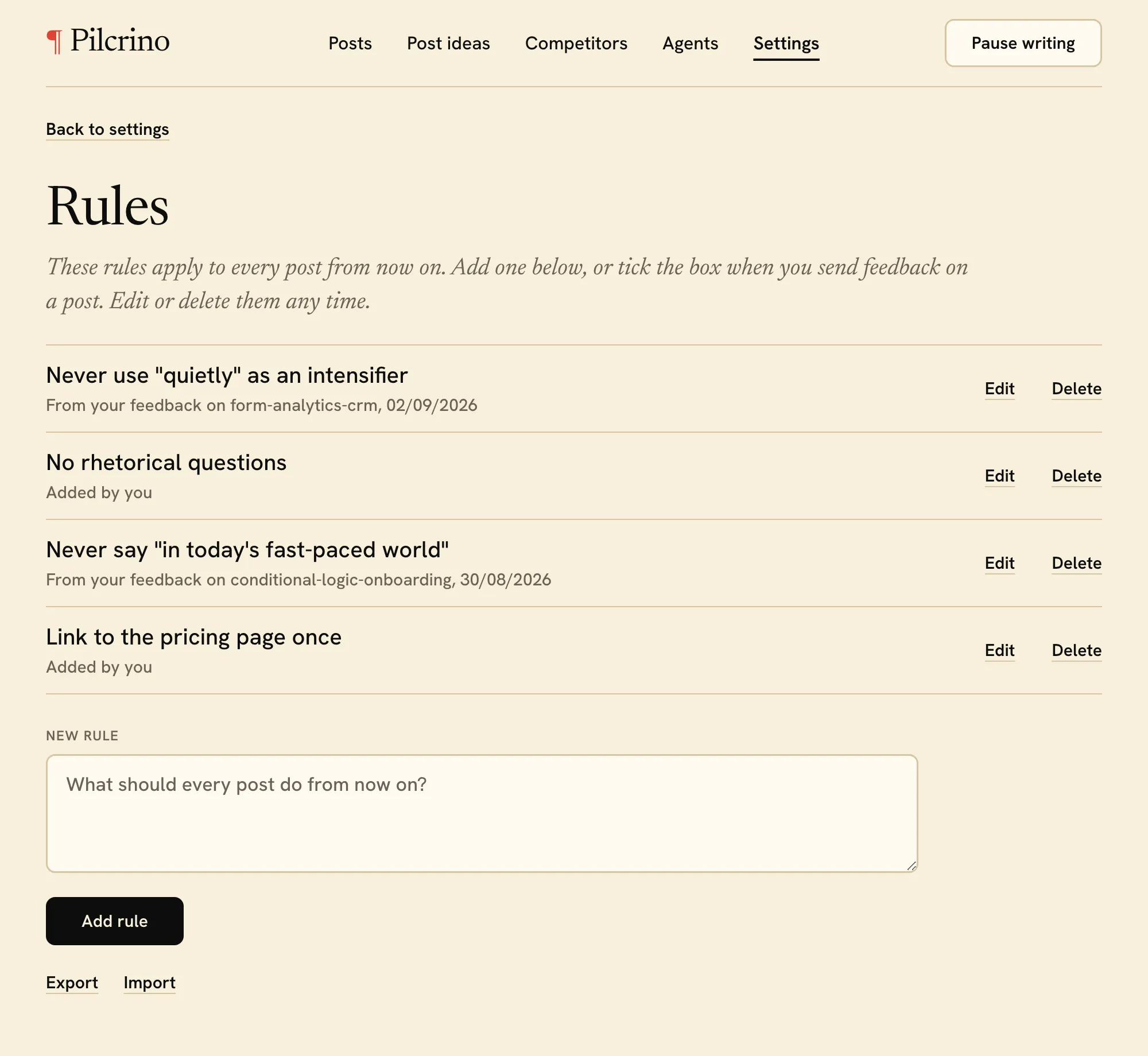
Illustrative example rules from a sample workspace, such as “Never use ‘quietly’ as an intensifier”, not a real customer’s list.
Some tells are specific to you. If one keeps coming back, say so in plain words on a finished post, and Pilcrino turns it into a rule applied to every later post. You can view, edit and delete those rules on the Rules screen.
When a Humanizer Is Fine
So do AI humanizers work for blog posts at all? The SlashGear verdict was “Yes and No”, and that’s fair. Even humanizeai.com, a humanizer vendor, writes that a humanizer “cannot verify facts.”
Use one where there are no facts to bend:
- A rough social caption draft
- A paragraph you plan to rewrite anyway
Read the output afterwards, and check that nothing it touched carries a number, a name or a link. For anything you publish, run a pre-publish checklist for AI posts instead.
Write for the Reader, Not the Detector
A detector score is a number one tool gives you today. The reader decides whether to stay. If you want this pass, and the rest of the work, done on every post, Pilcrino writes posts about your product in your voice: research through your own browser, several review rounds, the edit pass with facts locked, on-brand images of your product, your approval before anything goes live, and a one-time price.
FAQ
Will an AI humanizer get my blog post past GPTZero?
Nobody can promise that either way. Scores for the same text differ between detectors and can flip after a one-paragraph edit, so a pass today says little about tomorrow. The test that matters for a blog post is whether a reader stays, and that depends on the tells, not the score.
Can Google tell if a blog post was run through a humanizer?
Google doesn’t publish a humanizer check. Its Search Central guidance says it rewards high-quality content however it is produced, and that automation used mainly to manipulate rankings breaks its spam policies. Judge the post on quality, because that’s what Google says it judges.
What’s the difference between a humanizer and an edit pass?
A humanizer rewrites everything to change a detector score, including the words that carry facts and product names. An edit pass changes only the tells readers notice, such as pet adverbs, stock lines and same-length paragraphs, and it locks numbers, quotes, links and headings before it starts.
Is it safe to run part of a post through a humanizer?
Only for text with no numbers, names or links in it, such as a rough paragraph you plan to rewrite. Read the output afterwards, because a humanizer can change meaning as well as words, and check that nothing factual slipped in or out.