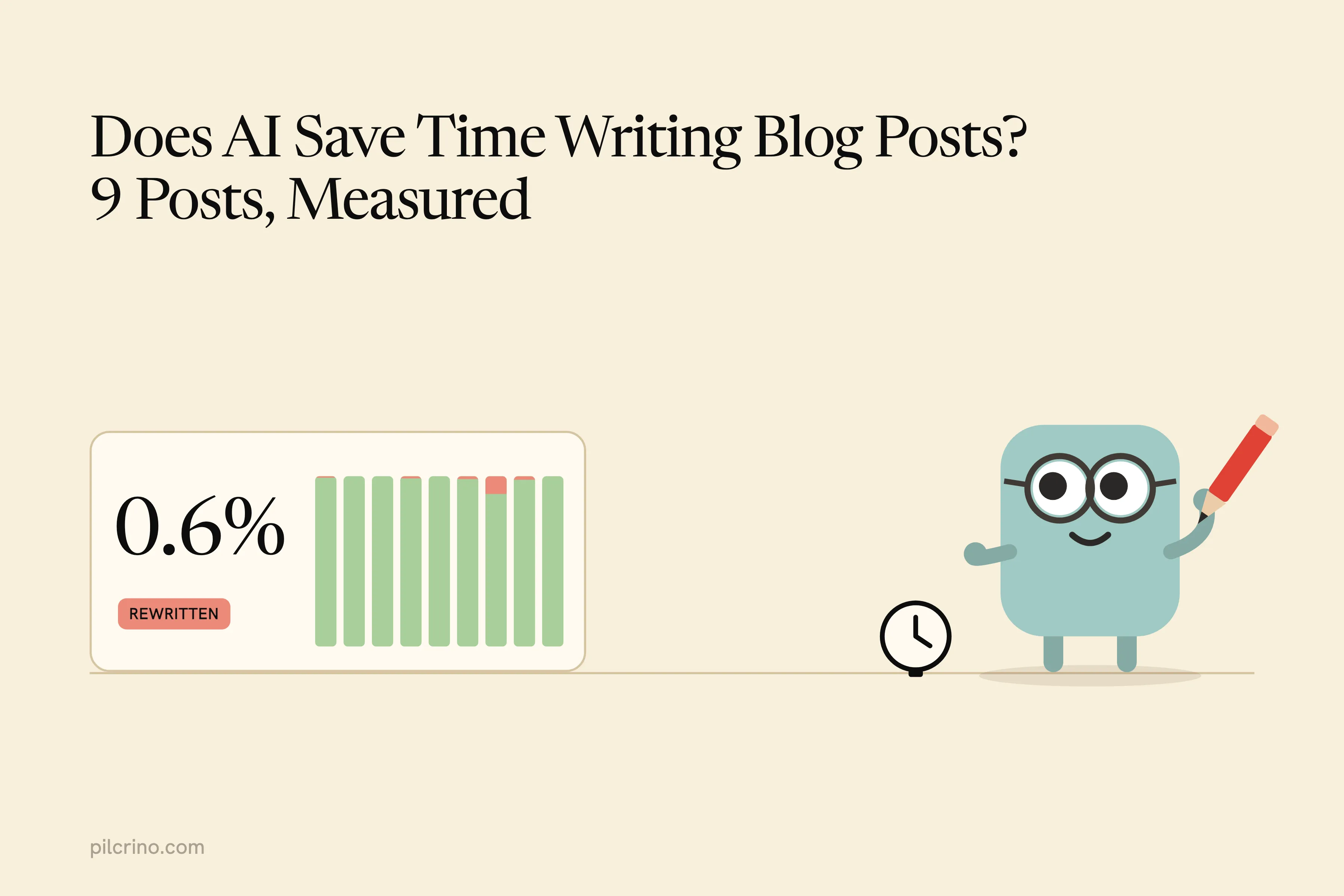
Does AI save time writing blog posts? Yes, but only when you measure how much of the AI’s work you rewrite, not how fast it drafts. Across the 9 posts on this blog, a median of 0.6% of the finished post changed between what the AI handed me and what I published.
I run this blog through my own writing pipeline on a Claude plan, I approved every one of those posts, and the numbers here come from comparing each post as the AI handed it over with the version that went live, not from memory.
Below: why hours saved is the wrong measure, the per-post rewrite numbers, the bill of materials for one post, what a freelancer or an agency would charge for the same post, and where AI still costs you time.
The Short Answer: Measure the Rewrite, Not the Draft
Does AI save time writing blog posts? It does when most of what it writes survives to publication. The number that tells you is rewrite share: the share of the AI’s finished post that a human changes before it goes live. Drafting speed tells you very little, because a draft that arrives fast and then needs rewriting has only moved the work to you.
Here’s what that looks like on this blog, measured from the records:
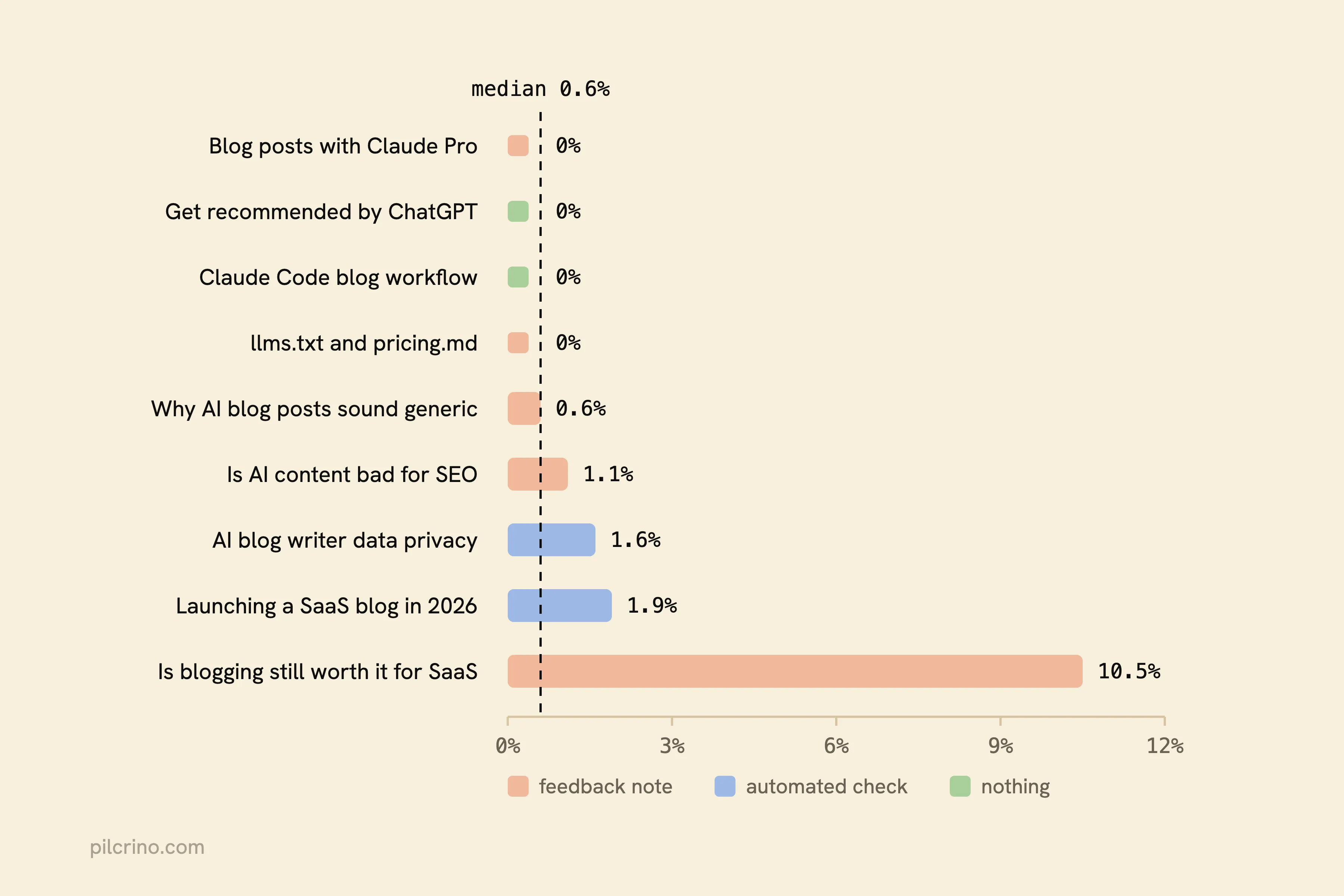
- Rewrite share: a median of 0.6% of words changed after the AI finished, across 9 posts (range 0 to 10.5%).
- Unattended write: about an hour of machine time per post, from rough logs. My time isn’t in that number.
- Cost: about $60 of plan usage per post at API list prices (median of 44 posts run through the same pipeline), against $625 to $1,125 for a 2,500-word post from a freelancer at published rates.
So is the answer yes?
On these numbers, yes. The rest of this post shows where each one comes from, and where it stops helping.
Why “Hours Saved” Is the Wrong Measure
Every AI writing tool advertises drafting speed. The Reddit thread that ranks first on Google for this exact question shows what that speed is worth when the draft is wrong.
The poster rewrites about 70 percent of each draft: “I end up rewriting probably 70 percent of what comes out because the voice is just off.” Then the part that matters: “I’m spending close to the same amount of time either way.” Another commenter put it more bluntly: “It’s a weird time shift, not a time save.”
The survey data points the same way. In Orbit Media’s 2026 blogger survey, 92.4% of bloggers use AI, yet the average post still takes 3 hours 20 minutes, down from 4 hours 10 minutes in 2022. The same survey found AI users no more likely than non-users to report strong results.
So where did the time go?
Into the edit. A fast draft you rewrite 70 percent of saves you the blank page and little else. The saving lives in how much of the draft survives, and the causes of a high rewrite are mostly fixable, as I covered in why AI blog posts sound generic.
One commenter in that thread gave the reason to count instead of guess: “check honestly if the rewrite percentage actually drops, or if it just feels more polished while you’re still rewriting the same amount. those aren’t the same thing and it’s easy to fool yourself there.”
So I counted.
Rewrite Share Across 9 Posts on This Blog
The method is simple. The staged version is the post as the pipeline committed it to its pull request, the proposed change I review before a post goes live; the shipped version is the post as it merged. I ran a word-level diff of the body on each pair and counted the share of the staged post’s words that didn’t survive into the shipped one. I left out the title, date and tags block at the top.
| Post | Rewrite share | What changed it |
|---|---|---|
| Why AI blog posts sound generic | 0.6% | 3-item note: 2 sentence cuts, 1 image fix |
| Blog posts with Claude Pro | 0% | Note was about table styling; post text untouched |
| Get recommended by ChatGPT | 0% | None |
| Is AI content bad for SEO | 1.1% | 2-item note: an intro sentence, the closing call to action |
| Claude Code blog workflow | 0% | None |
| AI blog writer data privacy | 1.6% | Automated check removed a leftover placeholder |
| Is blogging still worth it for SaaS | 10.5% | 4-point note plus an image |
| Launching a SaaS blog in 2026 | 1.9% | Automated check reshaped a table |
| llms.txt and pricing.md | 0% | Note was about the featured image only |
What the table adds up to:
- The median is 0.6%, the range is 0 to 10.5%, and 4 of 9 posts shipped with an identical body.
- In the records, 0 words of body change trace to hand typing. Every change maps to a logged pipeline run.
- Every change started from a note of 1 to 4 sentences or from an automated check, and the pipeline made the edit.
The worst case is worth showing. The llms.txt post’s first version was replaced after I changed what the post was about, and against that first version, 21.2% of the post was rewritten. Count it that way and the median becomes 1.1%.
Where did the editing go?
Inside the pipeline, before I ever saw a post, the first draft changed by a median of 4.3% through its own review loop (8 posts). The rewriting still happens. It moved out of my hours.
The Bill of Materials for One Post
What goes into one of these posts?
I pulled the per-post records from this blog, and the usage figures from two other live blogs I run through the same pipeline, because this blog’s own usage records don’t cover the original writes.
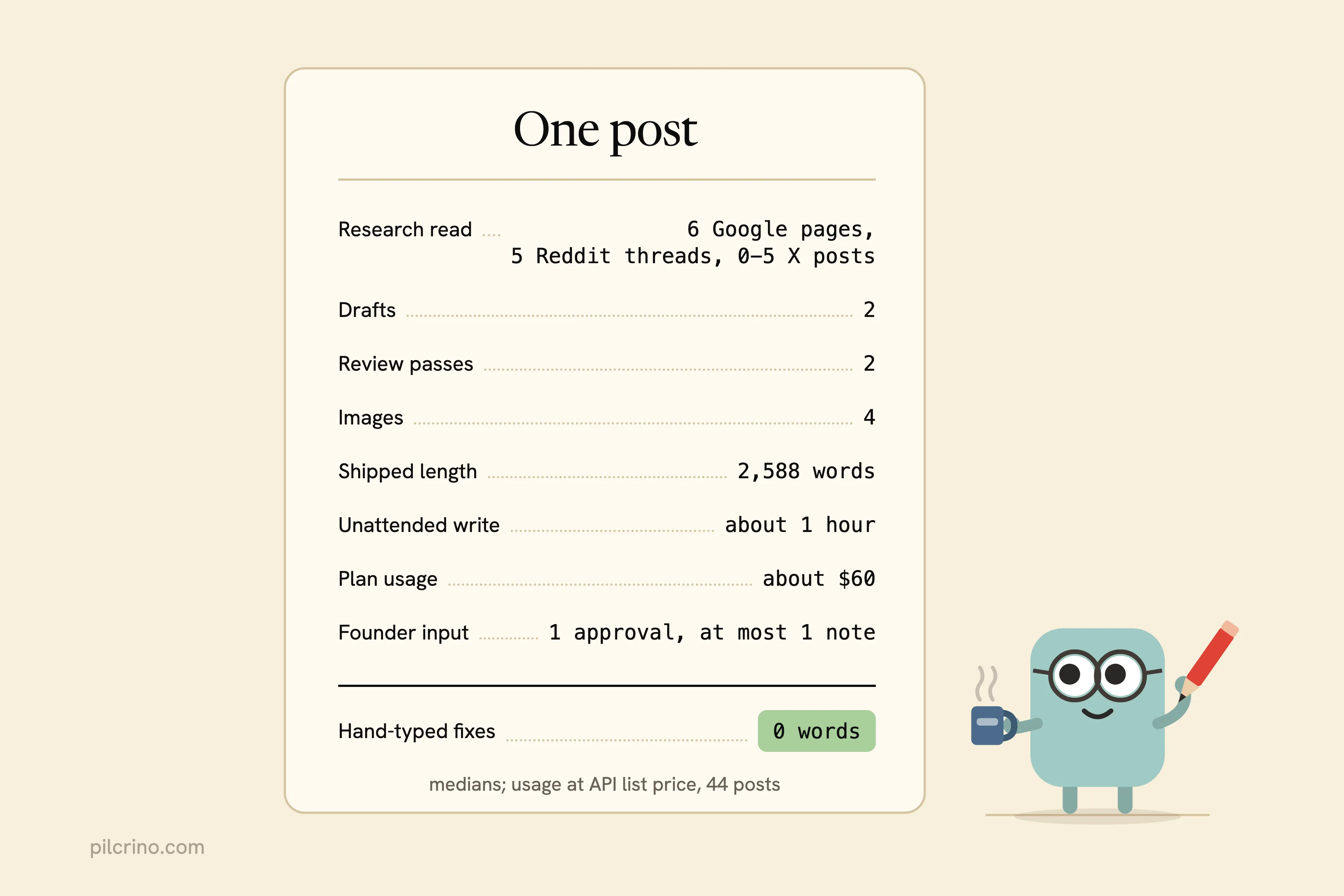
- Research read: about 6 Google result pages, 5 Reddit threads and 0 to 5 X posts, read in full.
- Drafts: a median of 2.
- Review passes: a median of 2.
- Images: 4, one featured plus 2 or 3 in the post.
- Shipped length: a median of 2,588 words.
- Unattended write: about an hour on this blog (median 66 minutes over 5 posts). The model writes the timestamps, which were checked against the commit times in the site’s history, so treat this as rough.
- Plan usage: a median of $60 at API list price, about 78M tokens, 97% of them cache reads (text the model re-reads from its cache, which costs far less), measured on 44 posts. On a Claude plan that is plan usage, not a bill.
- Founder input: one approval and at most one short note.
At that usage, a standard Claude plan with the default model mix gets through about three posts a day. The setup behind it is in the full pipeline on a Claude plan.
Notice what isn’t on the list. There’s no line for my editing time, because in the records none of the changes trace to my typing.
What the Same Post Costs From a Freelancer or an Agency
A freelancer is the fair comparison, since that’s who most founders would hire instead. The Editorial Freelancers Association’s 2026 rate chart, from a survey of more than 1,100 members, lists $0.25 to $0.45 per word for blog posts: $0.25 to $0.40 ghostwritten, $0.25 to $0.45 as work for hire.
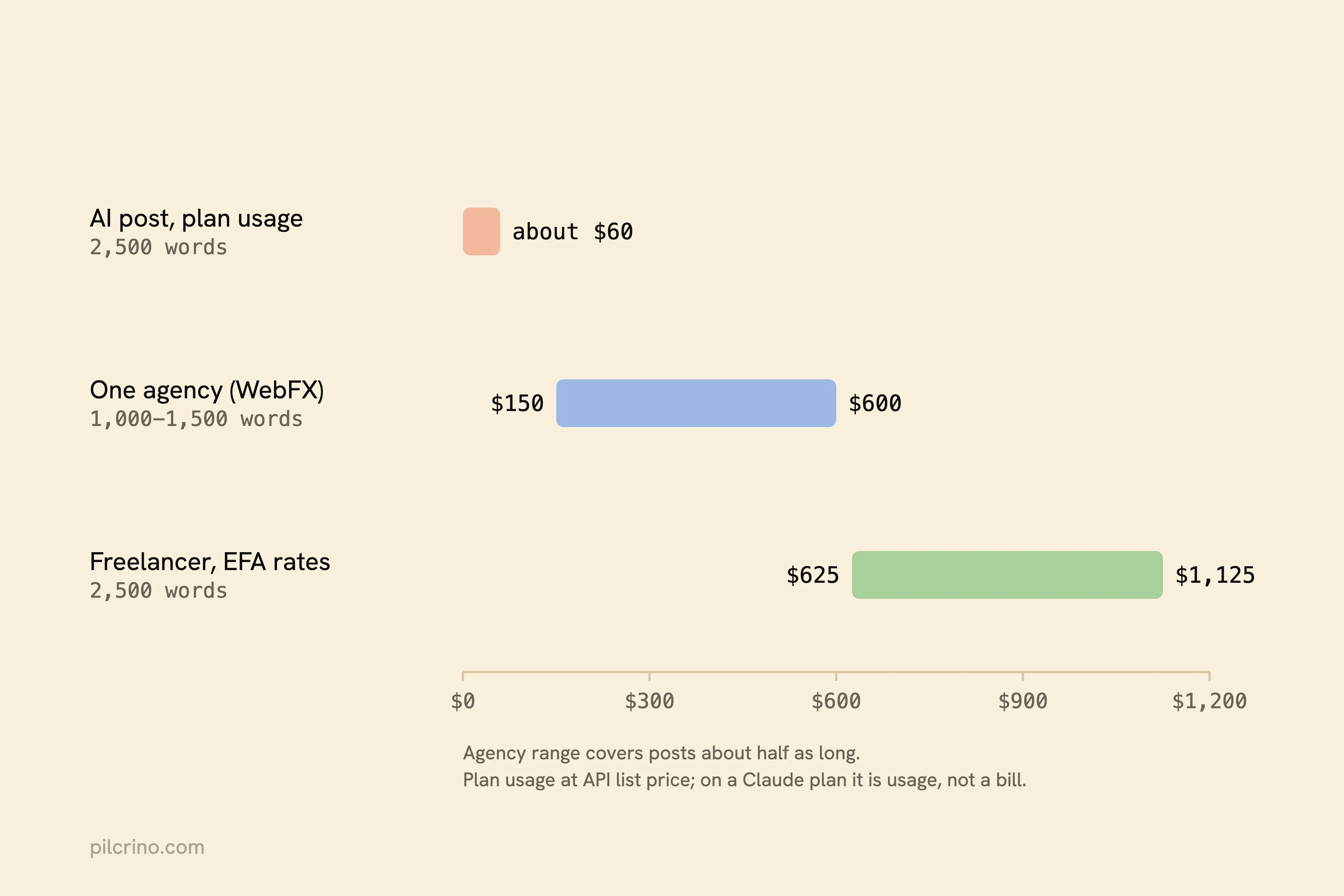
My posts ship at a median of 2,588 words, so call it 2,500. At EFA rates that’s $625 to $1,125 per post.
Agencies price per post instead. One agency’s published range, from WebFX in March 2026, is $150 to $600 per blog post of about 1,000 to 1,500 words. A 2,500-word post is roughly double that length, so the figures don’t compare one to one.
Against that:
- About $60 of plan usage for a post the AI wrote, on a plan you already pay for.
- $625 to $1,125 from a freelancer for the same length.
- $150 to $600 from one agency for a post about half as long.
Is that a fair fight?
Not entirely. A good freelancer brings judgment, interviews your customers and knows when an angle is wrong. The AI post still needs your facts and your read before it goes out.
Where AI Still Doesn’t Save You Time
Some of the work doesn’t shrink, whatever the rewrite share says.
- Reading and approving. I read every post before it ships. That time isn’t in any record, so I won’t estimate it. It’s also the one part you can’t hand off.
- Facts only you know. Product details, your opinions, what actually happened with a customer. The AI can’t invent these safely, and it shouldn’t try.
- Scope changes. When I changed what the llms.txt post was about, 21.2% of it was rewritten. A new direction is close to a new post.
- Setup. Getting rewrite share this low is its own project. The Reddit poster asked exactly this: “How long before the workflow started saving you time instead of eating more of it?” If you build it yourself, a hand-built Claude Code pipeline is a real option, but the building is work you do before any post gets cheaper.
Can you skip the read to save more?
You can, and it’s the one saving I’d refuse. Unread AI posts are where the quality problems start, and I covered the ranking side of that in AI content and SEO.
What Happens to Your Feedback in Pilcrino
When I wanted something changed after the pipeline finished, I wrote a note of one to four sentences: cut these two sentences, fix the intro, redo the call to action. In the records, I typed none of the fixes. The pipeline revised the post from the note.
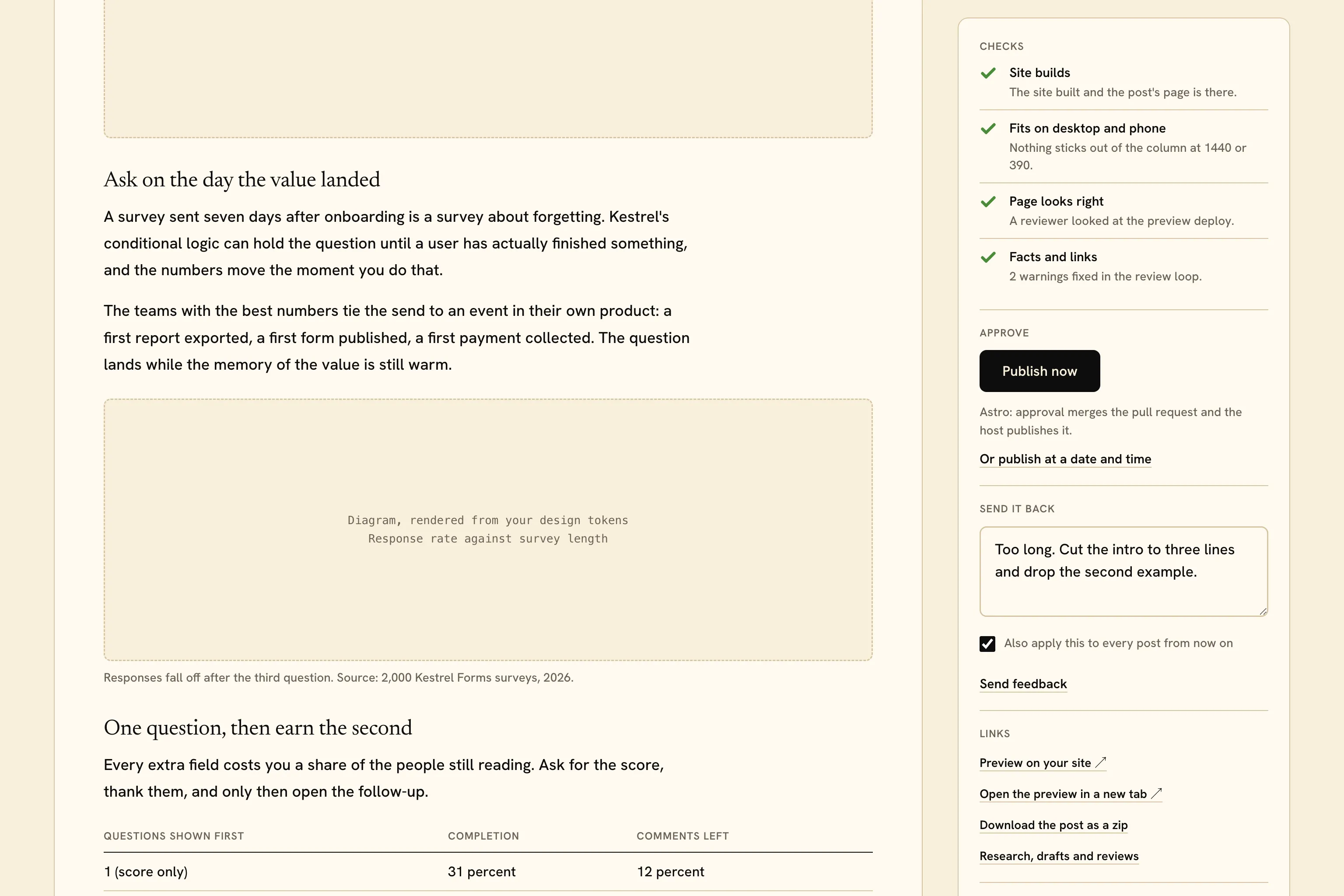
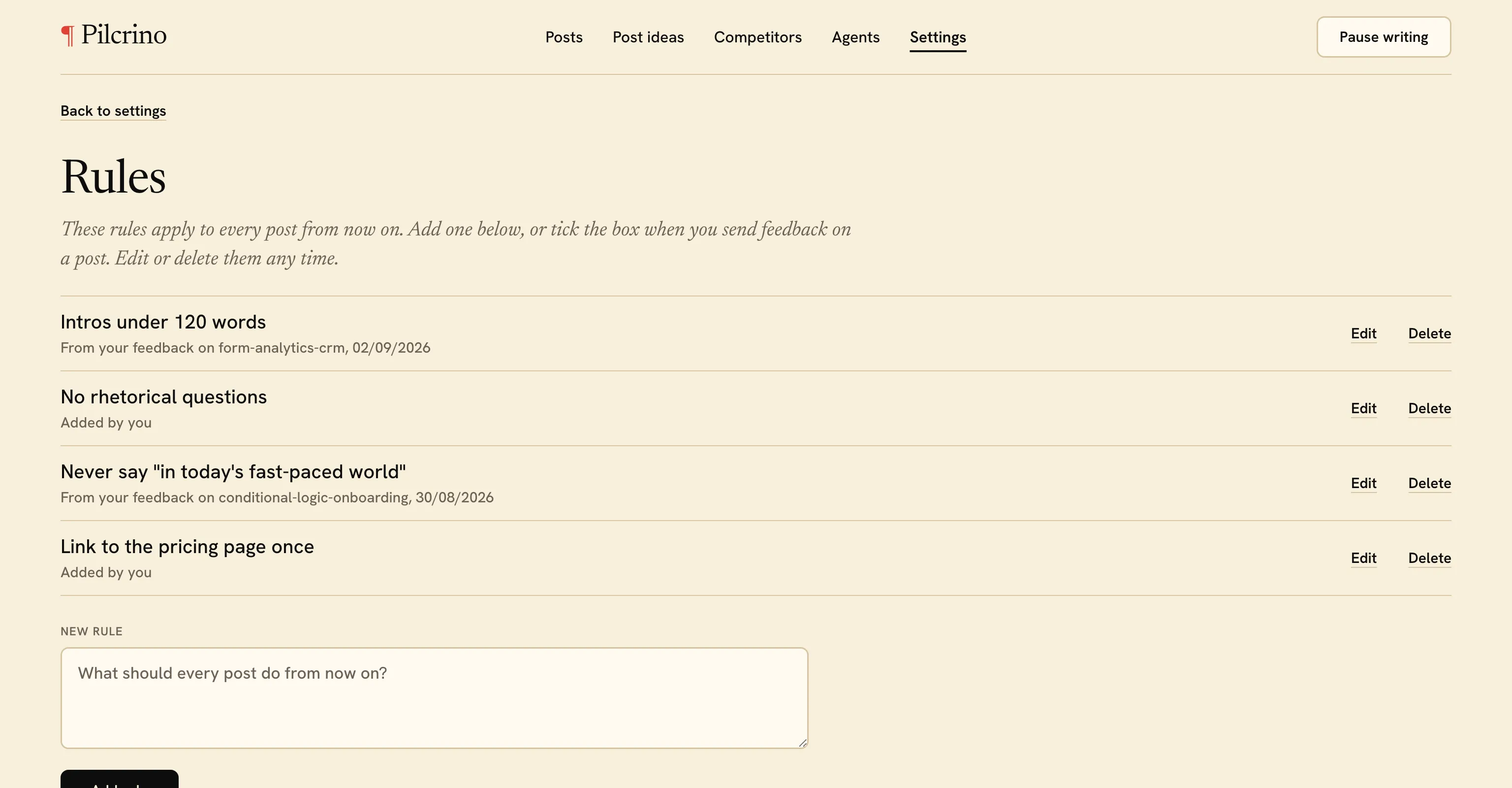
In Pilcrino, you write that note in plain words on the finished post. “Too long” or “fewer competitor mentions” is enough. Pilcrino turns the note into proposed rules, and you confirm or skip each one. A confirmed rule applies to every later post.
Why keep a note once the post is fixed?
Because otherwise the next post needs the same note, and you end up writing it every week.
The rules live in one list, each tagged with the post whose feedback created it. You can view, edit or delete any of them.
None of this skips your say. Nothing publishes until you approve it, either now or at a date you schedule.
How to Measure Your Own Rewrite Share
You don’t need my pipeline to get this number. It works with raw ChatGPT or Claude, and it takes one extra habit.
- Save the AI’s finished version before you touch it. A file or a commit, anything you can diff later.
- Publish your edited version the way you normally would.
- Diff the two word by word. Use
git diff --word-diffor any diff tool, then count the AI’s words that you deleted or replaced, and divide by the AI version’s word count. - Track it per post for a month. If it stays above half, fix the workflow, not the prompt.
Why a month?
One post can be an outlier, like my scope change. A month of posts shows whether the voice problem is real or a bad topic.
If your number sits above half, the time isn’t going into writing. It’s going into rewriting, and that’s the part a better workflow removes.
If you want posts where your job is the read and a one-line note, join the Pilcrino waitlist. You get posts in your voice about your product, running on the Claude plan you already pay for. The plugin is free; the app is $199 once, $129 for the first 50, with 12 months of updates and support.
Researched and drafted with Pilcrino. Approved by Slav.
FAQ
Does AI actually save time writing blog posts?
Yes, when most of what the AI writes survives to publication. Drafting speed alone doesn’t tell you, because a fast draft you rewrite heavily only moves the work. Across 9 posts on this blog, a median of 0.6% of the finished post changed between what the AI produced and what I published.
What is rewrite share?
Rewrite share is the share of the AI’s finished text that a human changes before publishing. You measure it by saving the AI’s version, diffing it word by word against the published version, counting the AI’s words you deleted or replaced, and dividing by the AI version’s word count.
How much does an AI-written blog post cost compared to a freelancer?
About $60 of plan usage per post at API list prices, measured on 44 posts run through the same pipeline; on a Claude plan that is usage, not a separate bill. At the Editorial Freelancers Association’s 2026 rates of $0.25 to $0.45 per word, a 2,500-word post from a freelancer costs $625 to $1,125.
How long does it take to write a blog post without AI?
There’s no clean without-AI figure. Orbit Media’s 2026 blogger survey puts the average post at 3 hours 20 minutes, down from 4 hours 10 minutes in 2022, and most respondents now use AI for some of the work.
What part of blogging can’t AI speed up?
Reading and approving each post, supplying the facts only you know, and handling scope changes. When a post’s direction changes, a large part of it gets rewritten, and no pipeline removes the final read that decides whether it ships.