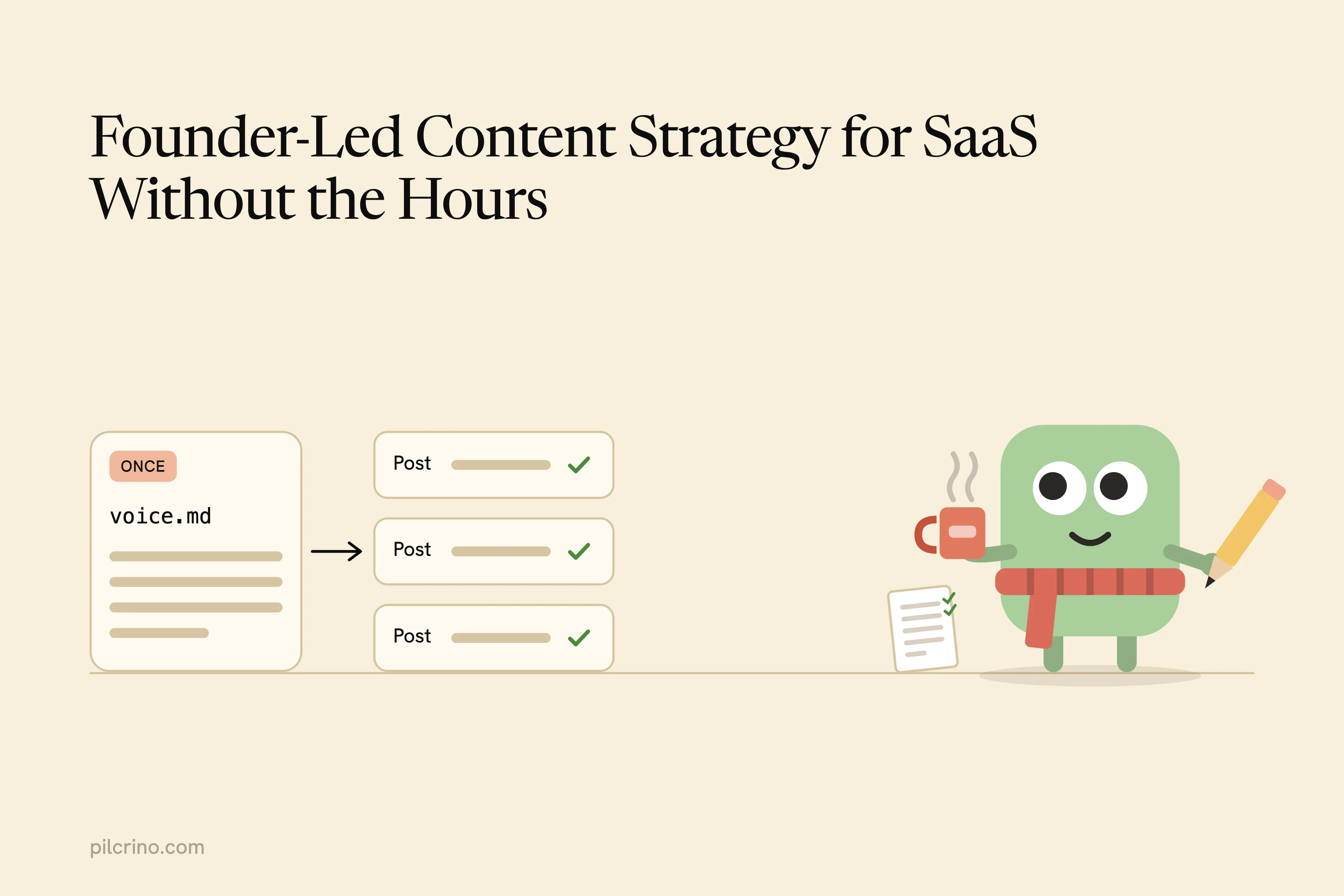
Every founder-led content strategy for SaaS I found in the top Google results asks the founder for the same thing: more of your week. Audio every week, a voice memo every week, face time every month, and nearly all of it pointed at LinkedIn.
I run this blog the other way: my voice, opinions and positioning are written down once, every post waits for my approval, and when I say “don’t repeat that line in every post”, it becomes a rule for every post after it.
Here is how to split the founder’s job into what you write down once and what you still do per post, and why the blog is where it pays off.
Why Founder-Led Content Stalls
Founder-led content rarely stops for lack of ideas. It stops because the founder’s input is a weekly bill that never gets smaller, and the first launch or fundraise that eats the calendar leaves it unpaid.
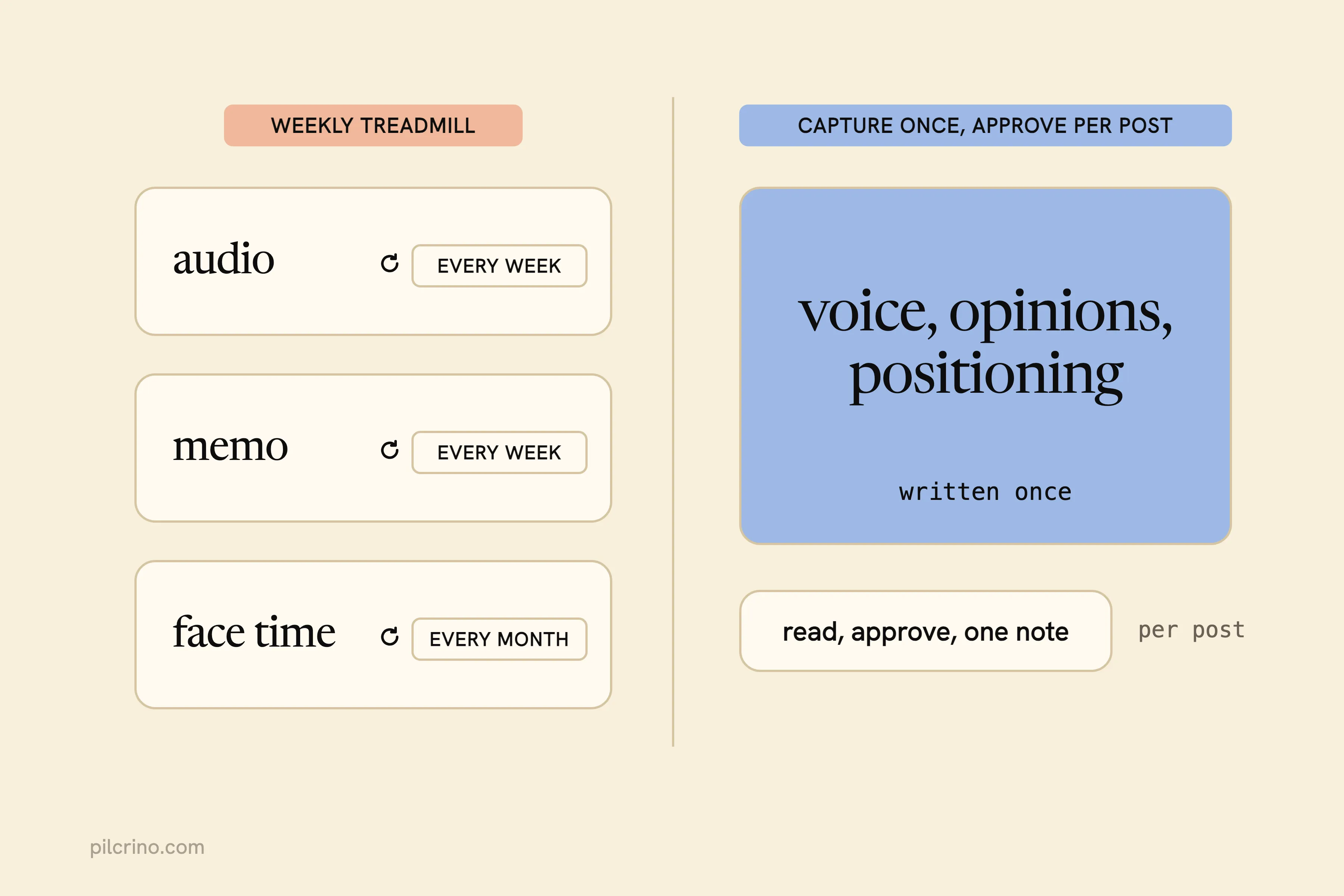
The ranking playbooks are open about the bill. The top result budgets about an hour a week: 30 to 60 minutes of recorded audio plus a review of each batch of drafts. A guide written by the head of a LinkedIn content agency puts it at about 90 minutes a week for two posts. A third promises under two hours a month, built from a weekly voice memo, a monthly review and a quarterly call.
Every one of them needs the founder again next week. None of them lets what you wrote down replace next week’s input.
The paid ways out still need you. One founder on X went looking for a “founder-led content strategist” to own their posts, and a reply named the catch: “nobody owns the content unless they are in the room when the decisions get made.” An agency has the same problem, and an early team often can’t pay for both. As one founder put it on r/SaaS: “We can afford one hire or one agency retainer, not both.”
The scarce input was never typing. A reply on X from @eddaunizeau called “start posting” the easy half and added: “What travels is a real opinion.”
Which parts of your input actually change from one post to the next?
Fewer than the playbooks assume. Your voice doesn’t change weekly, and neither does what you believe about your market. Both can be written down.
Step 1: Write Down How You Sound, Once
A voice file is a document that shows how you write, built from your own writing rather than from adjectives. “Confident but friendly” tells a drafter nothing. Three to five of your best existing pieces tell it almost everything: a post that landed, a long Slack answer to a customer, a sales email you were proud of.
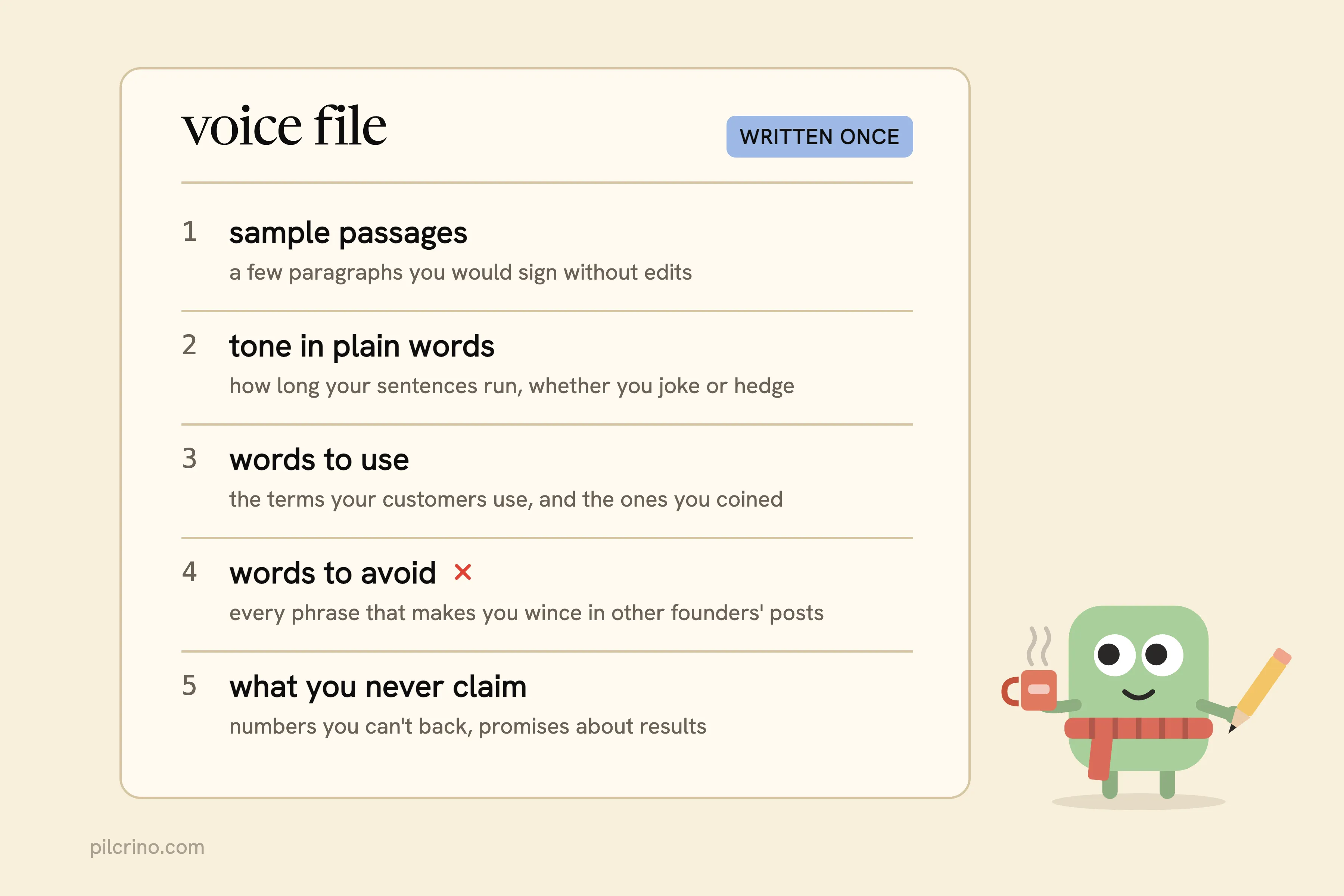
From those samples, write down what a stranger would need to sound like you:
- Sample passages: a few paragraphs, verbatim, that you would sign without edits.
- Tone in plain words: how long your sentences run, whether you joke, whether you hedge, how you sign off.
- Words to use: the terms your customers use, and the ones you coined.
- Words to avoid: a banned-phrase list, starting with every phrase that makes you wince in other founders’ posts.
- What you never claim: numbers you can’t back, promises about results, anything you’d have to walk back on a call.
The top-ranked playbook keeps something close to this: a card of verbatim examples from the founder’s best posts plus a do and don’t list. Then it still asks for fresh audio every week. The card already did the capture work. The weekly recording repeats it.
Without a file like this, a model writes like everyone, which is most of why AI blog posts sound generic. With it, drafts start from your sentences instead of the average of the internet.
Write it once. Revisit it when a draft sounds off, not on a calendar.
Step 2: Write Down What You Believe and What You Sell, Once
Your voice file covers how you say things. The second file covers what you say: the opinions and positioning that make a post argue for your product instead of for the whole category.
Keep it short. It should hold:
- Point of view: three or four positions you would defend on a sales call, stated as claims, not values.
- Audience and non-audience: who the product is for, and who should buy something else.
- Positioning order: what you lead with against the alternatives, and what comes second.
- Honesty rules: what you admit, such as the cases where a competitor or a free tool is the better pick.
- Call to action: the one thing a reader should do next.
This is the context a hire can’t get without sitting in your meetings. In that same X thread, the founder agreed in four words: “strategy needs founder context.” Writing it down is how that context gets into the room without you in it.
Does this file change? Yes, but slowly: a few times a year, when pricing moves or a new competitor shows up. Not per post.
That’s the whole trick. The two files carry everything about you that holds still, so your per-post time goes only to the part that doesn’t.
Step 3: Point It at the Blog, Not Only LinkedIn
When I searched this topic, none of the seven titles Google returned mentioned a blog. Nearly every founder-led content strategy for SaaS in those results is a LinkedIn plan.
Why the blog first?
A feed post has its moment and then scrolls away. A blog post that answers a real question stays findable, in search results and in the answers AI assistants give, and it keeps arguing for your product in the weeks your calendar belongs to a launch. Those are exactly the weeks founder-led content usually goes quiet.
Founder opinions also fit what Google says it looks for. Its guidance on helpful content suggests you judge a page by who created it, how, and why, and one of its self-check questions is whether the content shows first-hand expertise. A founder’s positions on their own market are first-hand by definition.
So the order is:
- Write the blog post first, from your two files.
- Cut a LinkedIn post from it: one argument, one example, a link back.
- Let the blog post keep working after the feed moves on.
If you’re still deciding whether blogging is still worth it for SaaS, that post makes the full case. This one assumes the answer is yes.
Step 4: Stay on Approval, Not Drafting
With two files in place, someone or something else drafts: a freelance writer, a hand-built Claude skill, or the full pipeline a Claude plan can run. You don’t write. You read.
Read each finished post once, the way it will publish, and do one of two things: approve it, or say what’s wrong. This is the one per-post job you can’t write down, because it’s judgment on this specific post.
Is it true? Would I say this? Is this the right week to say it?
What to check at approval:
- Claims about your product: features, limits, anything a customer could hold you to.
- Opinions: would you defend each one on a sales call?
- Anything you wouldn’t say out loud, to a customer or to a competitor’s founder.
- The call to action: does it ask for the thing you want right now?
Remember the reply about being “in the room when the decisions get made”? Approval is how you stay in the room for the decision that matters most: whether this post goes out under your name. You skip the drafting and keep the veto.
It’s the smallest job in the whole process, and the only one nobody else can do.
Step 5: Turn Each Piece of Feedback Into a Rule
AI drafting and new hires fail in the same way. Every draft starts from scratch, so you give the same note again and again.
A founder on r/founder described it with ChatGPT: “each time used ChatGPT to write another article I was starting from scratch. Even with creating projects with detailed instructions, it often conveniently remembered to forget or ignore the directions it was given.” The poster was selling a tool of their own, but the complaint is exactly the problem this step fixes.
So how do you stop giving the same note?
The fix is to treat every note as a rule, not a correction:
- When you reject or edit a post, write the note as a general rule. Not “cut the third paragraph”, but “a competitor is named at most twice” or “no rhetorical questions in the intro”.
- Add it to a rules list that every future draft reads before it starts.
- Prune the list. When a rule stops being true, delete it, or it will quietly fight your newer notes.
My own list grew this way. Posts on this blog kept opening with the same credibility line, so I said once that it shouldn’t appear in every post. That note is now a rule every later draft reads before it starts, this post included. So is a plainer one: writing a post never touches the rest of the site.
A note you give once costs one sentence. A note you give on every post is the weekly treadmill again, just in smaller pieces.
How Pilcrino Splits the Founder’s Work
Pilcrino, the app I’m building, is this split turned into software. Its setup wizard does the capture-once work: it reads your blog’s identity, audience, voice and authors into a workspace on your machine, and for an existing blog it pre-fills them from the posts you’ve already published. After that, your per-post work comes down to two things: feedback and approval.
Each finished post waits on a preview screen, where you read it as it will publish, images included. If it’s right, you approve it to go out now or on a date you schedule. If it isn’t, you send it back with a note in plain words, and Pilcrino revises it.
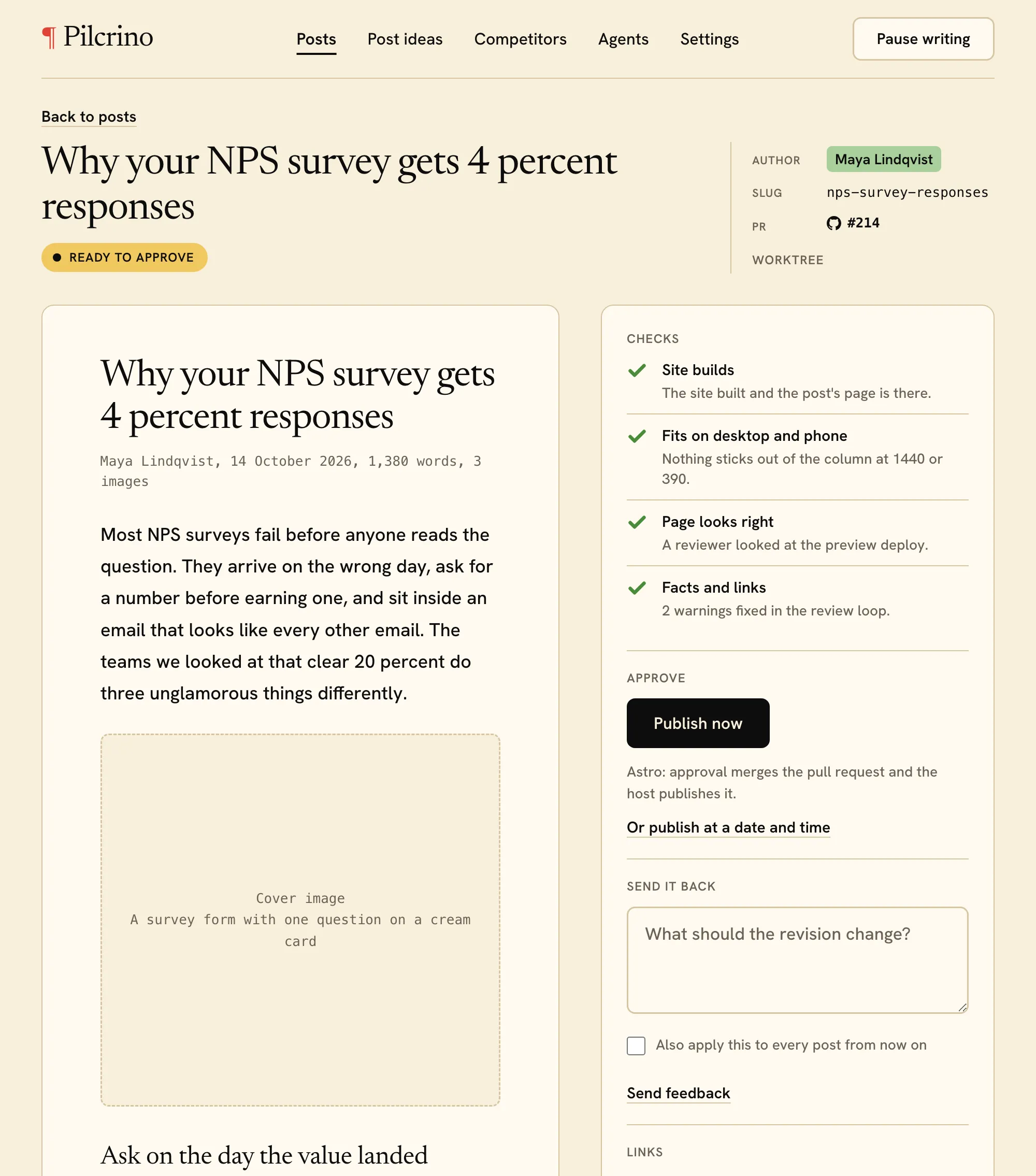
Under that note sits one tick box: “Also apply this to every post from now on”. Tick it, and Pilcrino keeps the note word for word as a rule every later post follows. You say what you mean once, and it sticks.
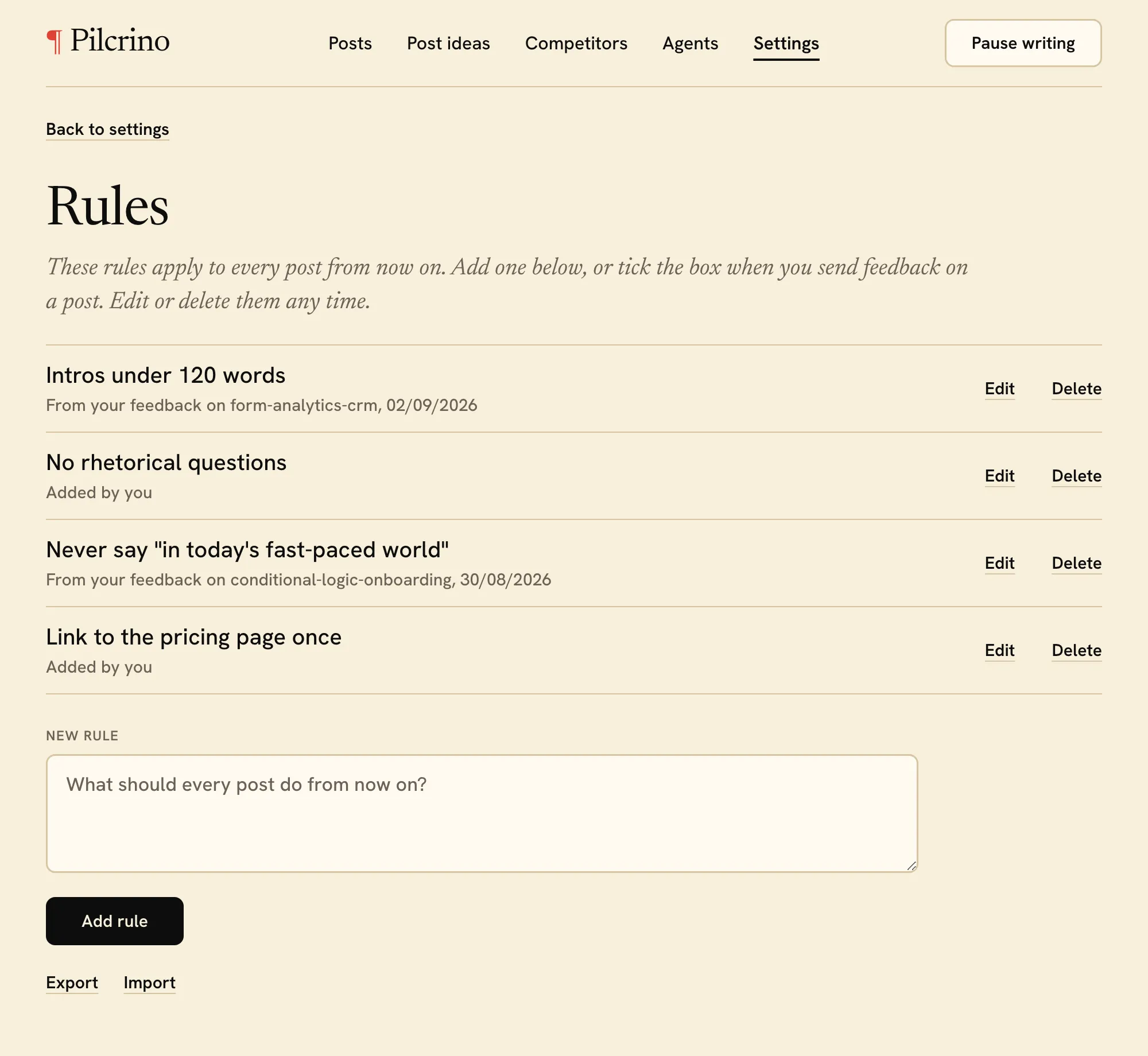
Every rule lives on a Rules screen under Settings, with a line saying where it came from: your feedback on a specific post, or added by you. You can add a rule there directly, edit or delete one when it stops being true, and export or import the whole list.
It runs on the Claude plan you already pay for, and your docs and drafts stay on your machine.
When This Does Not Work
This method has limits, and some of them are hard ones:
- You have no opinions yet, or can’t say them. A reply on X put the condition bluntly: founder-led content works “only if the founder actually knows how to communicate”. If there’s nothing to write down, there’s nothing to capture.
- Your positioning changes every month. Before product-market fit, the opinions file goes stale faster than you can update it, and approval turns into rewriting.
- You enjoy writing. Then write. This is for founders who don’t have the hours, not for the ones who like the work.
- You’d rather build the drafting side yourself. A hand-built Claude Code blog workflow covers that, and your two files carry over as they are.
It’s also slow either way. One founder-led LinkedIn account reported on r/b2bmarketing: “Took us about 6 months before we saw any meaningful traction.” Whatever system you pick has to survive months of low return, which is the real argument for keeping the per-post cost small.
Pilcrino writes posts in your voice, argued around your product, researched in your own browser and reviewed over several rounds, and it remembers your feedback. If that’s what you want, join the Pilcrino waitlist. The plugin is free; the app is $199 once, $129 for the first 50, with 12 months of updates and support.
Researched and drafted with Pilcrino. Approved by Slav.
FAQ
What is founder-led content for a SaaS company?
It’s content that carries the founder’s own opinions and voice, published under the founder’s name or on the company blog. The voice and the opinions are the point. Who types the words matters much less, as long as the founder’s positions come through and the founder signs off on what goes out.
How much founder time does founder-led content take?
Less than most playbooks budget, once the fixed parts are written down. The bigger job comes first: a voice file and an opinions file, written once and updated a few times a year. After that, the recurring cost is reading and approving each post, plus the occasional feedback note that becomes a rule for later posts.
Can a ghostwriter or AI write founder-led content?
Yes for drafting, no for the opinions. A ghostwriter or an AI model can produce a good draft only if it has your written voice and your written positions to work from. Either way, you still read and approve each post before it publishes, because that judgment is the part nobody else can supply.
Should founder-led content go on LinkedIn or the blog?
Write the blog post first, so it stays findable in search results and in AI answers long after a feed post has scrolled away. Then cut a LinkedIn post from it: one argument, one example, and a link back to the full post.