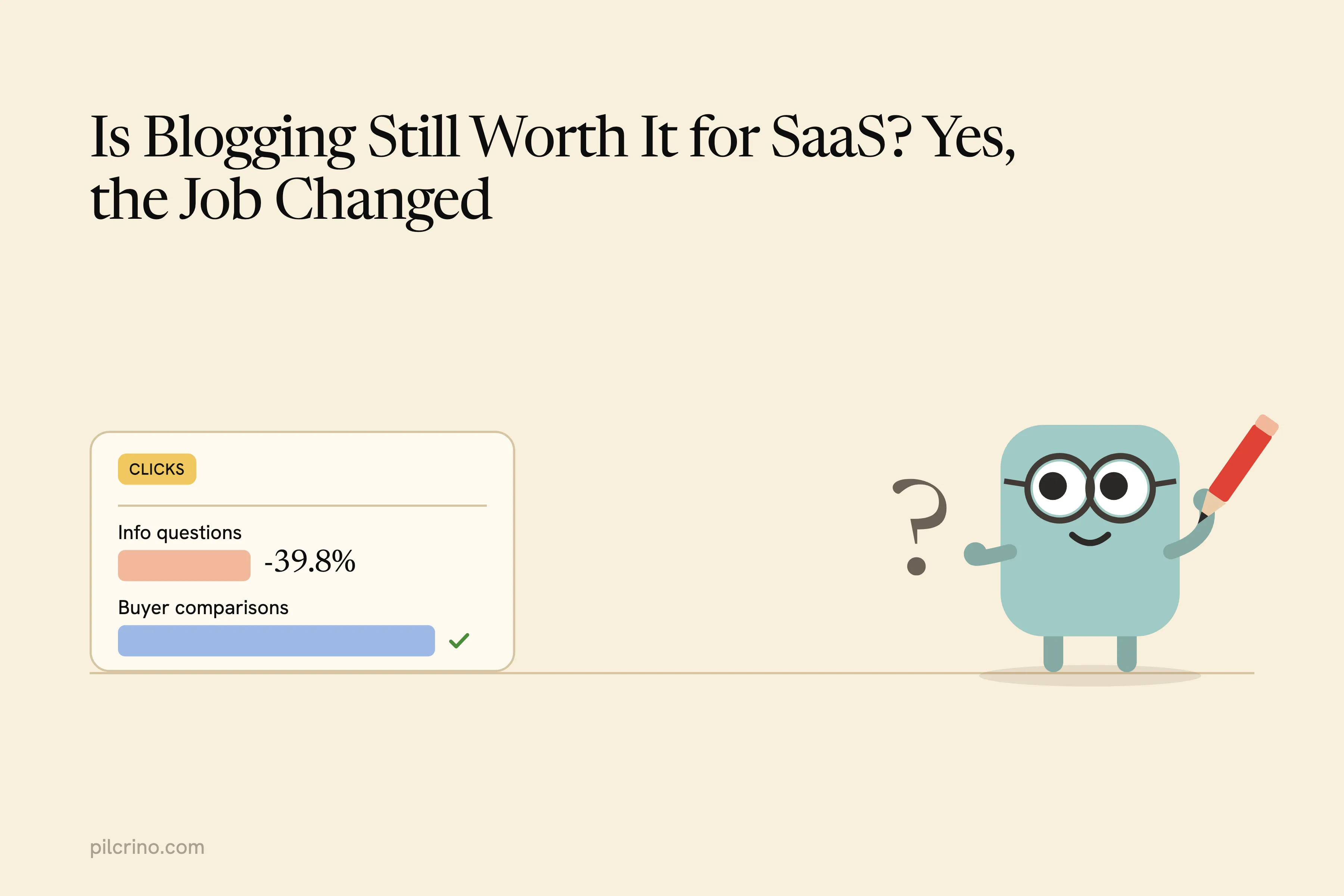
Is blogging still worth it for SaaS? Yes, as a long-term plan for most SaaS products, but the job changed. AI answers now take the clicks on “what is” and “how to” questions, so the posts that pay off are the ones that answer a buyer’s decision and give ChatGPT something about your product to cite.
I’ve run about 100 posts through my own writing pipeline on two live blogs, one on Astro and one on WordPress, and for this post I checked four studies on clicks and AI citations plus founder threads on Reddit and X.
If you already blog and want assistants to name you, I covered how to get ChatGPT to recommend your SaaS separately. This post is the step before that: whether to blog at all.
Below: where the clicks went, which SaaS posts still pay off, whether you need a blog if buyers ask ChatGPT, when not to blog at all, and a short checklist to decide this quarter.
Is Blogging Still Worth It for SaaS? The Short Answer
It depends less on blogging than on where your company is. Here’s the split I’d use.
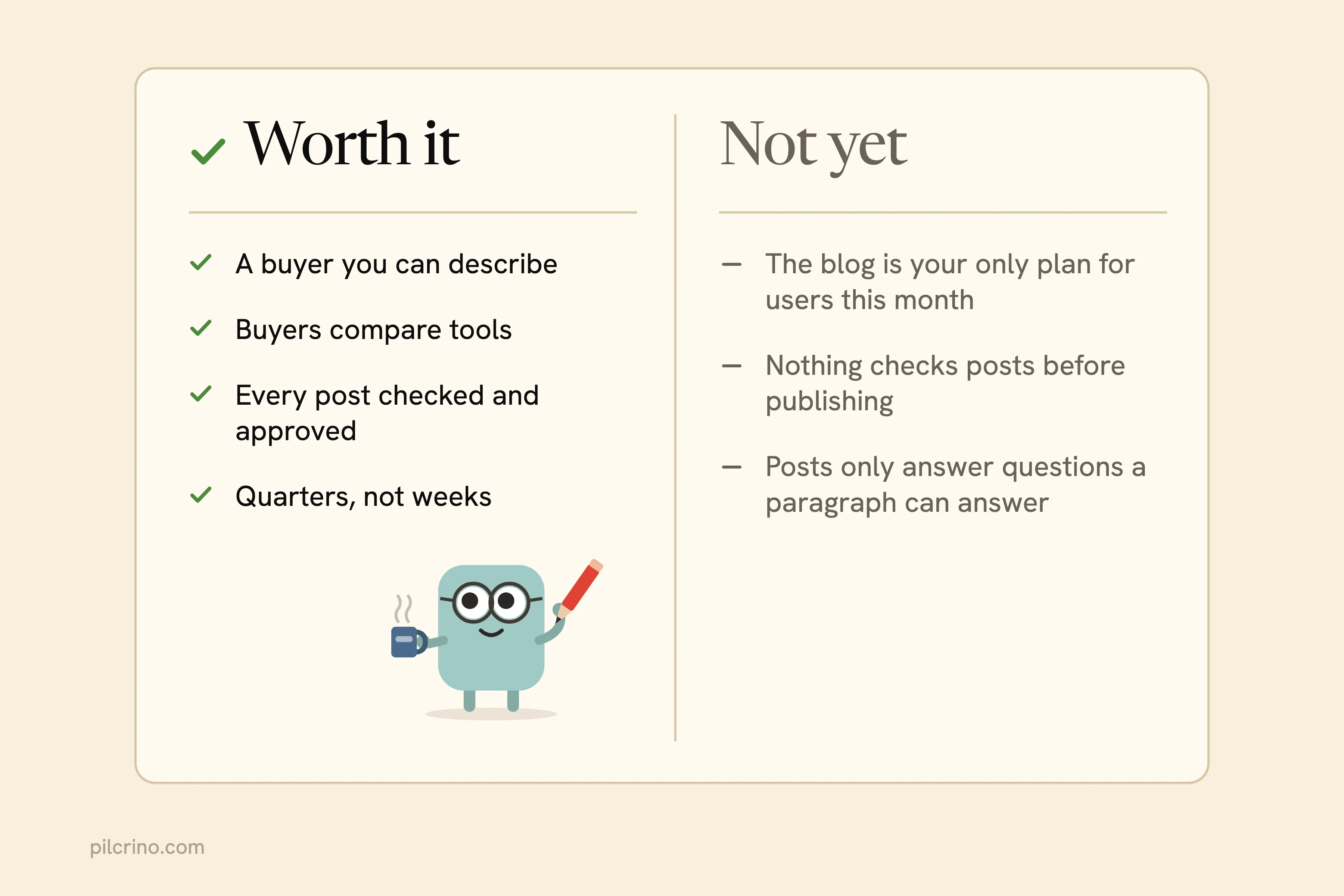
Worth it if:
- You can describe your buyer in one sentence.
- Your buyers compare tools before they pay.
- You can publish a few posts a month, and each one gets checked before it goes out. With a founder-led content strategy that doesn’t eat your week, that check is reading and approving, not writing.
- You think in quarters, not weeks.
Not worth it yet if:
- The blog is your only plan for getting users this month.
- Nothing checks your posts before they publish: no research, no fact check, no review, nobody approving.
Why those conditions?
Because the easy traffic is gone. In a randomized experiment, Google’s AI Overviews (the AI-written summary Google shows above the normal results) cut outbound organic clicks by 39.8% on the searches where they appeared. What’s left rewards posts written for a buyer’s decision, and those need a clear buyer, patience, and a real check before anything publishes.
And if you can’t describe your buyer yet? That limits what you can write, not whether to start. SEO takes a long time to pay off, so write a few posts on the questions you’re sure of now and add more as you learn the words buyers use.
The rest of this post backs each line.
Where the Clicks Went: Informational Questions
Zero-click search isn’t new. It means a Google search that ends without a click through to any website, and it was growing before AI got involved. What changed is how much of the answer Google now writes itself.
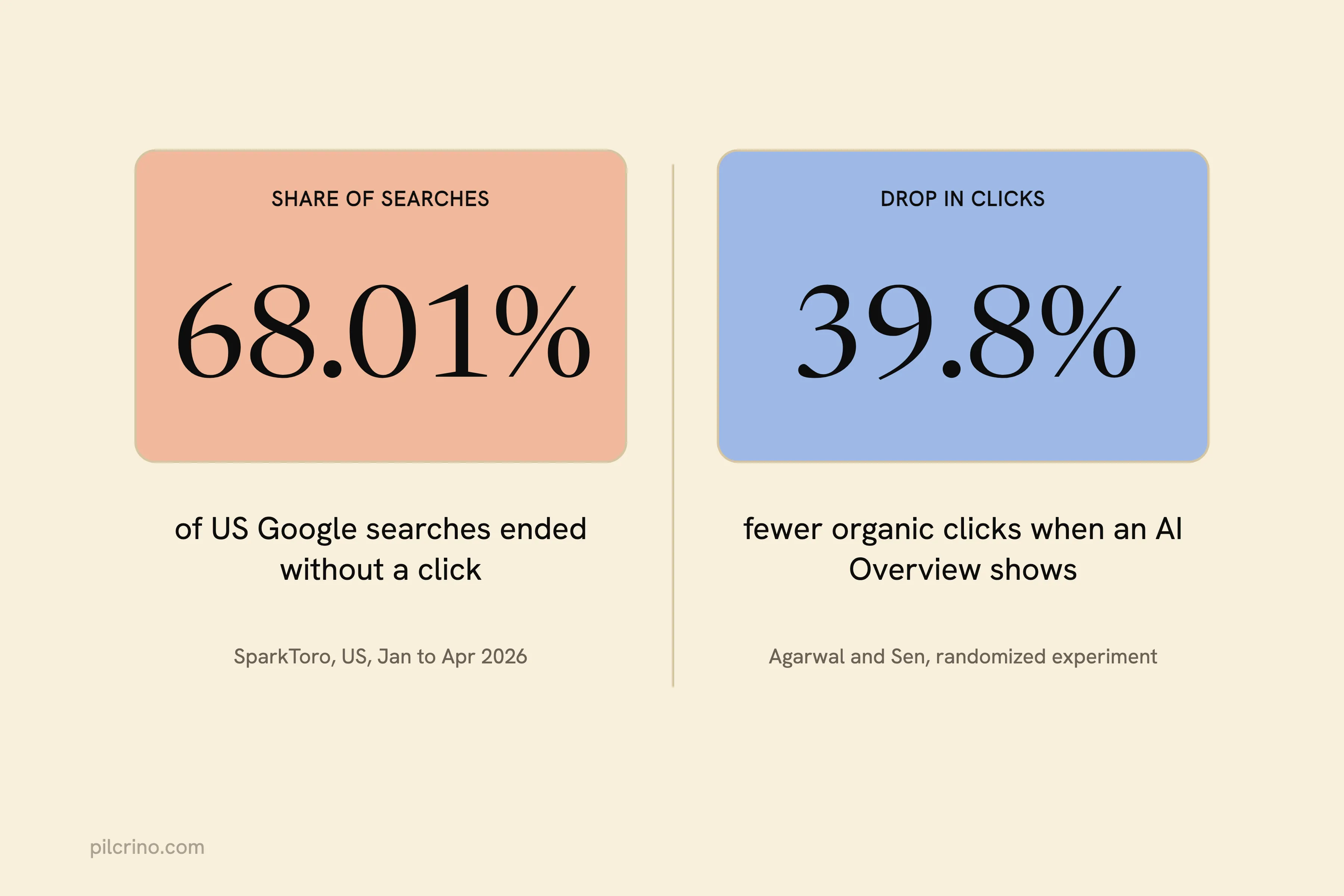
Rand Fishkin at SparkToro found that 68.01% of US Google searches ended without a click from January to April 2026, so only about 32% sent anyone to the open web. That’s Similarweb panel data from desktop and mobile browsers, not the Google app, and it covers those four months in the US. In the same window, AI Overviews appeared on 20%+ of searches.
A share of searches doesn’t show what AI Overviews cause. A controlled test does.
Saharsh Agarwal and Ananya Sen randomly showed people Google with or without AI Overviews and compared what they did. Their paper, posted to SSRN in April 2026, found that AI Overviews cut outbound organic clicks by 39.8% where they appeared, and zero-click searches rose 34.5%. Some things didn’t move:
- Clicks on sponsored results stayed the same.
- People who did click through engaged with the site just as much.
- Searchers reported no measurable gain in search quality.
So which clicks go?
The ones a summary can answer. A founder on r/SaaS, u/TargetPilotAi, watched click-through on “how-to” and “best tools for” keywords, in their words, “falling off a cliff” after AI Overviews arrived. The reply from u/patternpeeker in the same thread is the rule I’d keep: “if google can answer it in a paragraph, that traffic was always fragile.”
The SaaS Posts That Still Pay Off
The job moved to posts a buyer reads while choosing. The answer depends on your product, your competitors and the buyer’s situation, and that’s hard to squeeze into a paragraph.
The types I’d write first:
- Comparisons and alternatives pages for your category. The buyer is already choosing and wants the trade-offs.
- “How to do [job] with [type of tool]” posts where your product is the natural answer, with the real steps.
- Posts that answer one specific question with a specific answer, not a broad essay on why a problem matters.
- Original data or workflows only you have. A summary can’t pull those from anywhere else.
But didn’t “best tools for” clicks just fall off a cliff? For generic roundups, yes: a summary can compile a list of tools from other pages. A comparison that argues specific trade-offs from real use of your product and its alternatives can’t be compiled that way, and since category answers mostly cite other people’s pages (more on that in the next section), yours has to say something a roundup can’t.
u/Founder-Awesome put it plainly on r/SaaS: “blogging still works but the playbook shifted. the posts that move the needle now are ones answering a specific question with a specific answer”.
u/sriramkumar5 drew the same line in the AI Overviews thread. AI Overviews “kill generic ‘how-to’ clicks. They don’t kill: High-intent queries, Branded searches, Deep comparison content, Original data”.
That’s one practitioner’s read, not a study. It does match the mechanism Agarwal and Sen measured: clicks disappear where a summary is enough. For the study-based version, see which blog posts still get clicks with AI Overviews, by post type.
What do the losing posts have in common?
They’re generic. And generic is usually a workflow problem, not a model problem. I wrote about what’s behind AI blog posts that sound generic and how to fix the process that produces them.
Do You Need a Blog if Buyers Ask ChatGPT Instead of Google?
Yes, for questions that name you. For questions that only name your category, a blog alone isn’t enough.
Foundation Marketing and AirOps looked at 57.2 million citations across 50 brands in 7 verticals on 5 AI platforms, from December 2025 to February 2026. When a buyer asked about a brand by name, 77.6% of AI answers cited the brand’s own site at least once. When the question was about the category (“best tool for X”), only 2.2% of the links cited pointed to brand-owned sites.
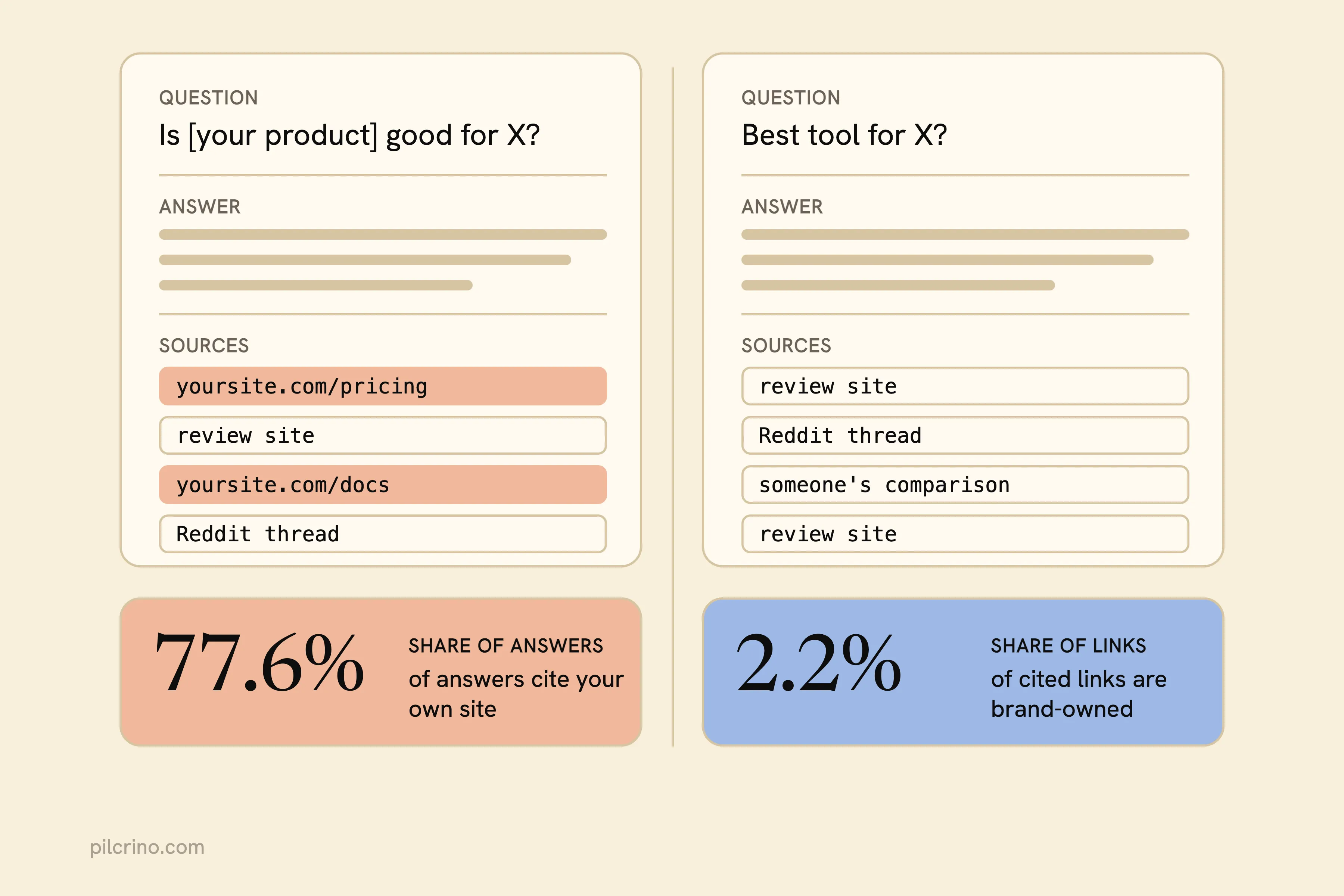
Those two numbers measure different things. One is a share of answers, the other a share of links, so they aren’t a single gap you can divide. The direction is still clear.
What does that mean for your blog?
- Once a buyer knows your name, your own posts and pages are what assistants quote about you. A blog that explains your product, its trade-offs and how it compares gives them something accurate to say.
- Before they know your name, your site rarely gets cited. Getting into category answers also takes mentions on pages you don’t own: review sites, Reddit threads, other people’s comparisons. The steps in my ChatGPT recommendation post cover that part.
Ranking still helps, but it’s no longer the whole story. In a July 2025 study, Ahrefs found about 76% of AI Overview citations came from pages in the top 10.
Its March 2026 update found that 37.9% of URLs cited in AI Overviews ranked in the top 10, with the rest spread across positions 11 to 100 and beyond. Ahrefs ties the drop to Google pulling sources from related searches, not only the one the person typed.
Marc Lou put the shift in founder terms on X. If he started a SaaS today: “I’d set AI visibility as my North Star metric and build everything backwards”.
So a SaaS blog has two jobs now. Win the searches that still click, and give assistants accurate pages to quote.
When Blogging Is Not Worth It for a SaaS
Sometimes the honest answer is no, or not yet. These are the cases where I’d skip the blog or keep it small.
- The blog is your plan for this month’s users. u/Free_Ninja7616 on r/NoCodeSaaS: “It usually takes a few months before you see steady traffic… If you’re early and need users fast, blogging alone probably won’t be enough.” Find your first customers where buyers already talk about the pain, like Reddit threads.
- Nothing checks your posts before they go out. Publishing AI drafts with no research, no fact check, no review and nobody approving is how a blog turns into noise. Reading every post by hand is the usual fix. A writing tool that runs its own research, fact and link checks and review passes covers much of the same ground, as long as someone still approves what publishes.
- Your posts would only answer questions a paragraph can answer. That’s exactly the traffic the 39.8% drop describes.
What about before product-market fit? I’d start earlier than that. The same commenter adds: “If you’re thinking long term, it can help.” Or as u/grand-yojimbo put it: “SEO discussions should always be had in years.”
If the payoff takes years, the clock is worth starting early. Don’t rely on the blog for your first customers, and don’t skip it either: write a small number of decision-stage posts now, so they’re compounding by the time buyers search for a tool like yours.
The strongest “no” I found came from TK Kader (@Tawheed) on X: “Blogging is dead. Google ADs are a waste of money. SEO is a money pit.” He says founders are “blogging into the void, hoping for a click 8 months from now.” He also sells an alternative built on social posts, an email list and paid ads, so weigh it with that in mind.
Is he wrong?
About generic posts written for clicks, he’s right. The posts from the section above are a different thing, and social posts still need something to link to. @SathyaHQ, who runs marketing at a B2B SaaS company, fits it in one line: “Blogging isn’t dead. Bad blogging is.”
How to Decide for Your SaaS This Quarter
You can run this in an afternoon.
- List the handful of questions buyers ask right before they choose a tool like yours: comparisons, alternatives, “how to do X”. If you can only list one or two, start there and keep talking to buyers.
- Google each one and note which show an AI Overview. Expect fewer clicks there, and write those posts to be quoted, not for traffic.
- Ask ChatGPT your category question and your brand question. Note whether you’re cited, named or absent. Branded answers usually draw on your own site; category answers mostly don’t. The routine for checking this on a schedule is in the ChatGPT post I linked at the top.
- Write a few posts argued around your product before you write many. Start with the questions from step 1.
- Measure signups from posts and whether assistants name you, not raw traffic. Review after a quarter, and judge the channel over a longer stretch than that. I’m doing that with this blog and published my day-90 bet for it.
What does running this cost?
No new subscription, and it helps to know what a content tool stack costs per month before adding one. You can write blog posts with the Claude plan you already pay for, and if you’d rather build the pipeline yourself, I documented a hand-built Claude Code blog workflow. That route works. The building and the upkeep are yours, though.
Step 1 is also the step I automated in Pilcrino: its content plan proposes topics from your product docs and competitors, built around what buyers search for and what AI assistants get asked.
Pilcrino Runs This Blog Workflow for You
If the checklist says “worth it”, you still need the workflow that produces those posts. Building your own means setting up and maintaining prompts, research, a review loop, fact checks, images and publishing. If you’d rather spend that time on your product, Pilcrino runs all of it on the Claude plan you already pay for:
- A content plan from your product and competitors.
- Research through your logged-in browser, including Reddit threads and X posts, cited with links.
- A writing pipeline in your voice: outline, draft, a review loop, and fact and link checks.
- Product-specific images in your blog’s palette and fonts.
- Publishing to Astro or WordPress, as a pull request or a WordPress draft.
- An approval gate: nothing publishes until you approve it.
The Pilcrino plugin is free today; the app is $199 once, $129 for the first 50, instead of a subscription, and on a waitlist now. Join the Pilcrino waitlist and get the posts from this checklist without building the workflow first.
Researched and drafted with Pilcrino. Approved by Slav.
FAQ
Is SEO dead for SaaS because of AI Overviews?
No. Clicks fell on questions a summary can answer: in Agarwal and Sen’s randomized experiment, outbound organic clicks dropped 39.8% on searches where an AI Overview appeared. Decision-stage searches, like comparisons and alternatives, are harder for a summary to settle, and ranking still feeds the pages AI answers cite. SEO for a SaaS now means choosing those searches on purpose.
How long does a SaaS blog take to work?
Think in quarters to years, not weeks. Early numbers are mostly noise: when one founder on r/SaaS shared 30 clicks from Google and 25 from Bing, 35 days after buying the domain, the top reply warned that numbers that early mean little. Another commenter’s rule is a good default: SEO discussions should be had in years.
Should an early-stage SaaS start a blog before launch?
Yes, as a long-term plan, not as your source of first customers. SEO takes a long time to pay off, so a few posts on the questions you’re already sure buyers ask will be compounding by the time you need them. Find your first customers where buyers already complain about the problem, like Reddit threads, and add posts as you learn the words buyers use.
Does ChatGPT cite blog posts from SaaS companies?
Yes, when the buyer names your brand. Foundation Marketing and AirOps found that 77.6% of AI answers to a branded question cite at least one page from the brand’s own site. On category questions, only 2.2% of cited links point to brand-owned sites, so you also need mentions on review sites, Reddit and other people’s comparisons.
What kind of blog posts should a SaaS write in 2026?
Posts a buyer reads while choosing: comparisons, alternatives pages, how to do the job your product does, and posts that answer one specific question with a specific answer, ideally with data or workflows only you have. Skip broad “what is” explainers that an AI Overview can summarize in a paragraph.