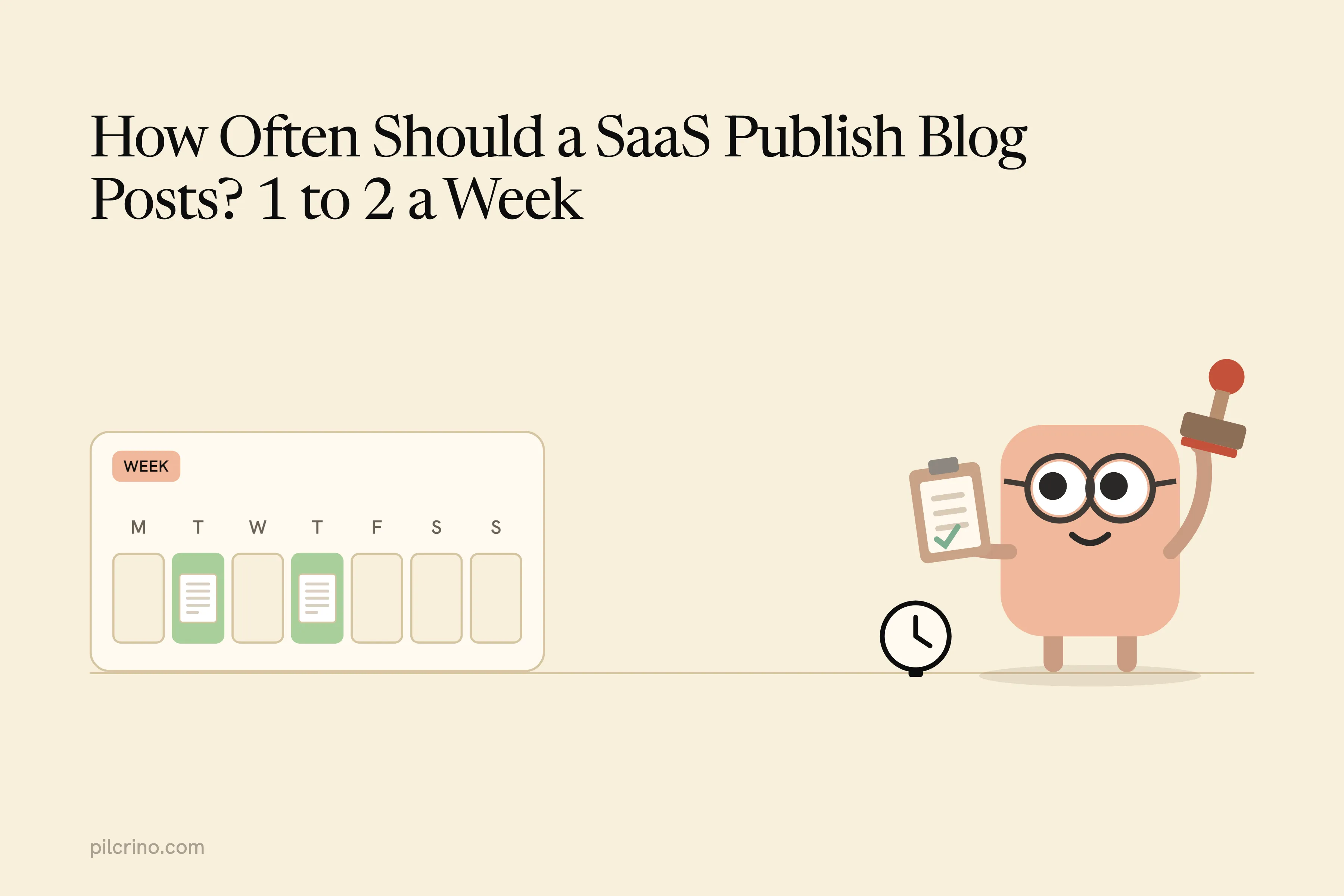
How often should a SaaS publish blog posts? For a small team, one to two a week that you can keep up for six months, and never more than you can read before they go live. HubSpot’s own guide says 6 to 8 posts a month for a blog under a year old and 2 to 4 for complicated topics, so the harder your subject, the lower in that range you sit.
I’m setting this blog’s own pace right now, and I build the pipeline that writes it. So the question I care about isn’t how many posts I can produce. It’s how many are worth shipping.
This assumes you’ve already decided whether a SaaS blog is still worth it and asks how often to feed it.
Below: what the frequency data can and can’t tell you, what extra posts buy, where Google draws the line on volume, how to hold a pace, and how to adjust it from Search Console.
What the Blogging Frequency Data Actually Shows
The numbers everyone quotes about blogging frequency are surveys and correlations. Nobody has run the experiment. Orbit Media’s 2026 survey of 1,042 bloggers found that 13.9% say their blog delivers strong results, an all-time low.
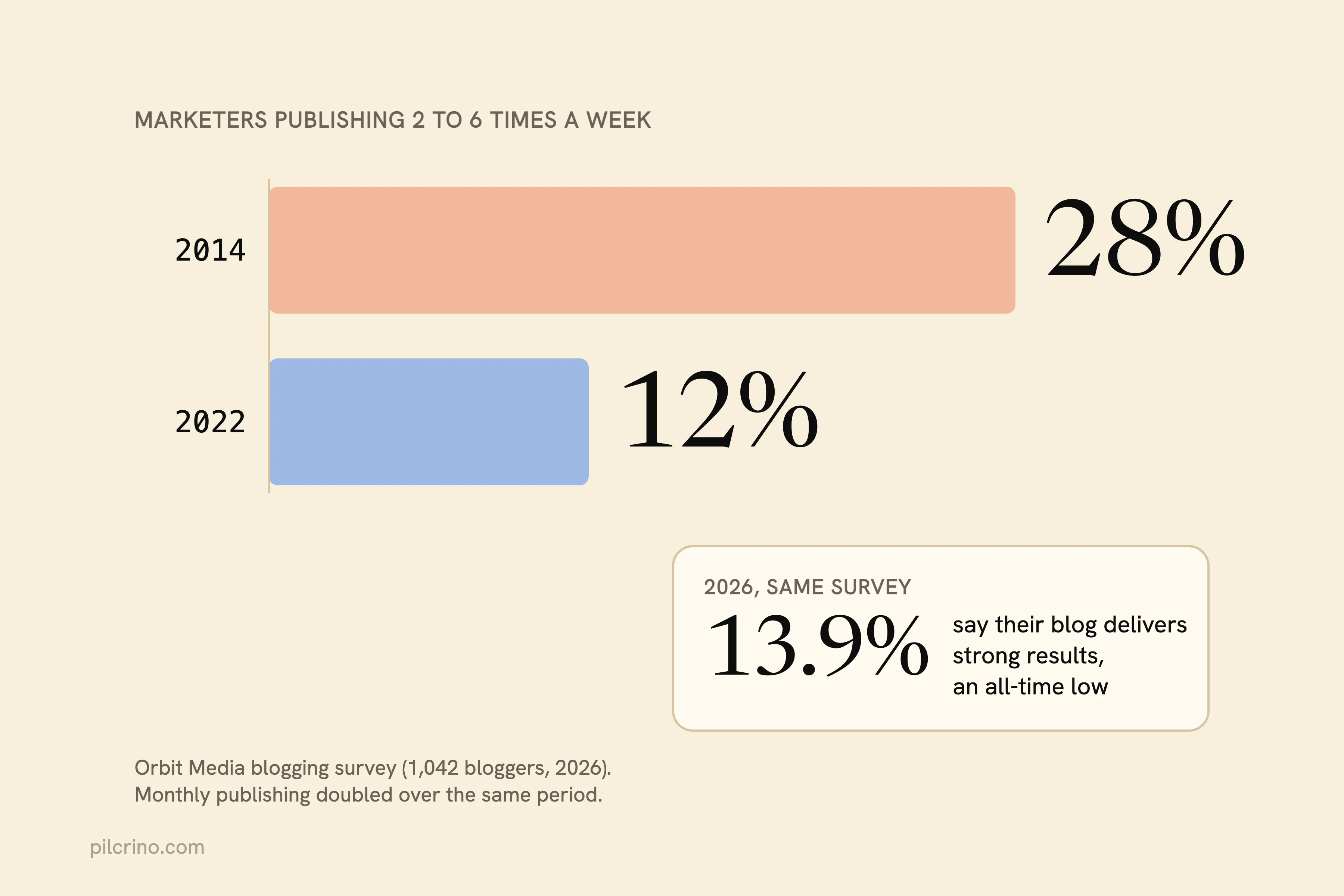
The same survey tracks how often people publish, and the trend runs against the “publish more” advice. Marketers publishing 2 to 6 times a week fell from 28% in 2014 to 12% by 2022, and monthly publishing doubled. Andy Crestodina, the survey’s author, sums it up: “The industry converged on a common strategy: fewer, bigger, better.”
HubSpot’s guide says 6 to 8 posts a month for a blog under a year old, 2 to 4 for complicated topics, and 5 to 10 if you have the budget. It also says the real answer “is it depends”, and the evidence it gives is an anecdote about one writer, not a dataset. The top Google results for this question go further and hand out stage tables (so many posts a week at so many total posts) with no data behind them at all.
So what can the surveys tell you?
- They can tell you what other marketers do, how that has shifted over a decade, and how they rate their own results.
- They can’t tell you that publishing more causes better results, what your site would do, or where any Google threshold sits.
That last gap matters most. Blogs that publish more may do better because they have bigger teams and budgets, not because of the count.
What More Posts Buy You, and What They Don’t
More posts do buy you something real:
- More questions answered. Each post can target one distinct thing your buyers search for.
- More pages for Google to find. Every post is another way into your site from a search.
- Faster feedback. More posts means more data points in Search Console each month, so you learn sooner which topics get shown.
What they don’t buy is ranking per post, trust, or being named by AI assistants. Eli Schwartz described, on X, a company that “publishes two posts a week, targets high-volume keywords, and follows every rule the agency gave them. Yet, traffic is flat.” The cadence was fine. The posts weren’t earning anything. One practitioner on r/SEO put the range bluntly: “For some clients, I publish 2 per month and it works. For others, I did 20.”
Writing capacity used to be the ceiling. It isn’t anymore. I’ve run about 100 posts through this pipeline on two live blogs, and a standard Claude plan with the default model mix gets through about three posts a day.
So what’s the limit now?
It’s how many you can read properly, and what each post adds that the pages already ranking don’t. That second question is about which post types still get clicks, and no publishing schedule answers it for you.
How Many Is Too Many? Where Google Draws the Line
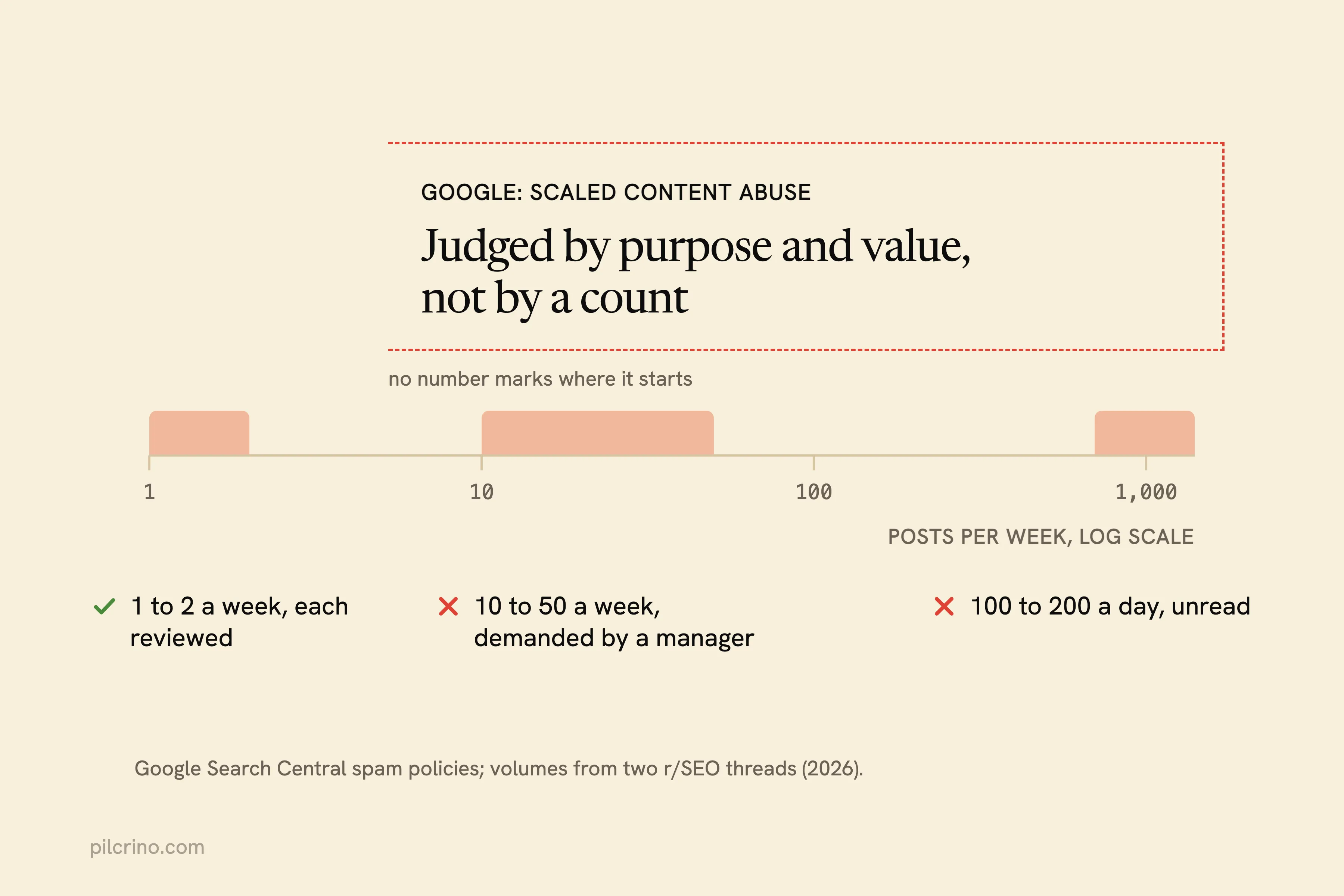
Google doesn’t name a number. What it names is scaled content abuse: “Scaled content abuse is when many pages are generated for the primary purpose of manipulating search rankings and not helping users.” The policy adds that this applies “no matter how it’s created”, and one of its examples is “Using generative AI tools or other similar tools to generate many pages without adding value for users”.
What does that definition turn on?
Purpose and value, not volume. I covered the policy itself in whether AI-written content hurts SEO; here the question is only how volume starts to look like it.
Google’s own self-check for search-first content asks two questions worth reading before you raise your pace: “Are you producing lots of content on many different topics in hopes that some of it might perform well in search results?” and “Are you using extensive automation to produce content on many topics?”
Here is the far end, in a real thread. Someone on r/SEO had a backlog of 2,500+ posts at 100 to 200 a day in mind, all of it “ready to publish” and set to run “until the entire backlog is live”. The top reply was “Do it and report back.” The second: “Sounds like Scaled Content Abuse, which violates Google’s Spam policies.” The thread never says what happened next.
What it looks like when it lands is in another r/SEO thread. The poster’s manager “demanded that I publish at least 10-50 articles a week”, and the site then got a manual action (a penalty applied by a Google reviewer, shown in Search Console) reading “Pages on this site appear to use aggressive spam techniques such as scaled content abuse…”. Lily Ray noted on X that Google still files these under a “major spam” manual action rather than a separate scaled content abuse label.
You’re publishing too many when you see any of these:
- More posts go live than you can read end to end before they do.
- Topics drift away from anything your product does.
- Posts repeat each other’s intent. As one r/localseo reply put it, “google doesnt cap you at a number, it caps you at whether each page solves a different intent”.
- You’re changing dates to look fresh. Google asks this one directly: “Are you changing the date of pages to make them seem fresh when the content has not substantially changed?”
When a Short Burst Makes Sense (and What I’m Testing)
Steady beats bursts, with one exception. If you have a finite list of core topics you know you need (your product’s main jobs, the comparisons buyers run, the pricing questions), publishing that list faster and then settling to a steady pace is a different thing from publishing everything you can generate.
That’s the plan for this blog. Five posts a week for the first six weeks, 30 posts in all, then a review against Search Console and waitlist sign-ups before I decide the ongoing pace. It’s a plan, not a result. I’ll know whether it was right after the review, not before.
What keeps a burst like that safe?
Two conditions:
- Every post still gets read and approved before it goes live.
- Each one targets a question none of the others answer.
Once you run out of distinct questions, the extra posts are the filler that makes AI blog posts sound generic.
The counterpoint deserves airtime. On r/SEO, one reply to a new blogger said: “If you can realistically publish 2–3 high-quality posts every week for the next 6–12 months, that’s a much better strategy than posting daily for a month and then disappearing.” Going quiet after the burst is the failure it has to avoid.
Hold the Pace With a Dated Queue
Most blogs don’t lose their cadence to a decision. They lose it on a busy Monday. The practical fix is a queue with a date on every post, so the pace gets decided once instead of every week.
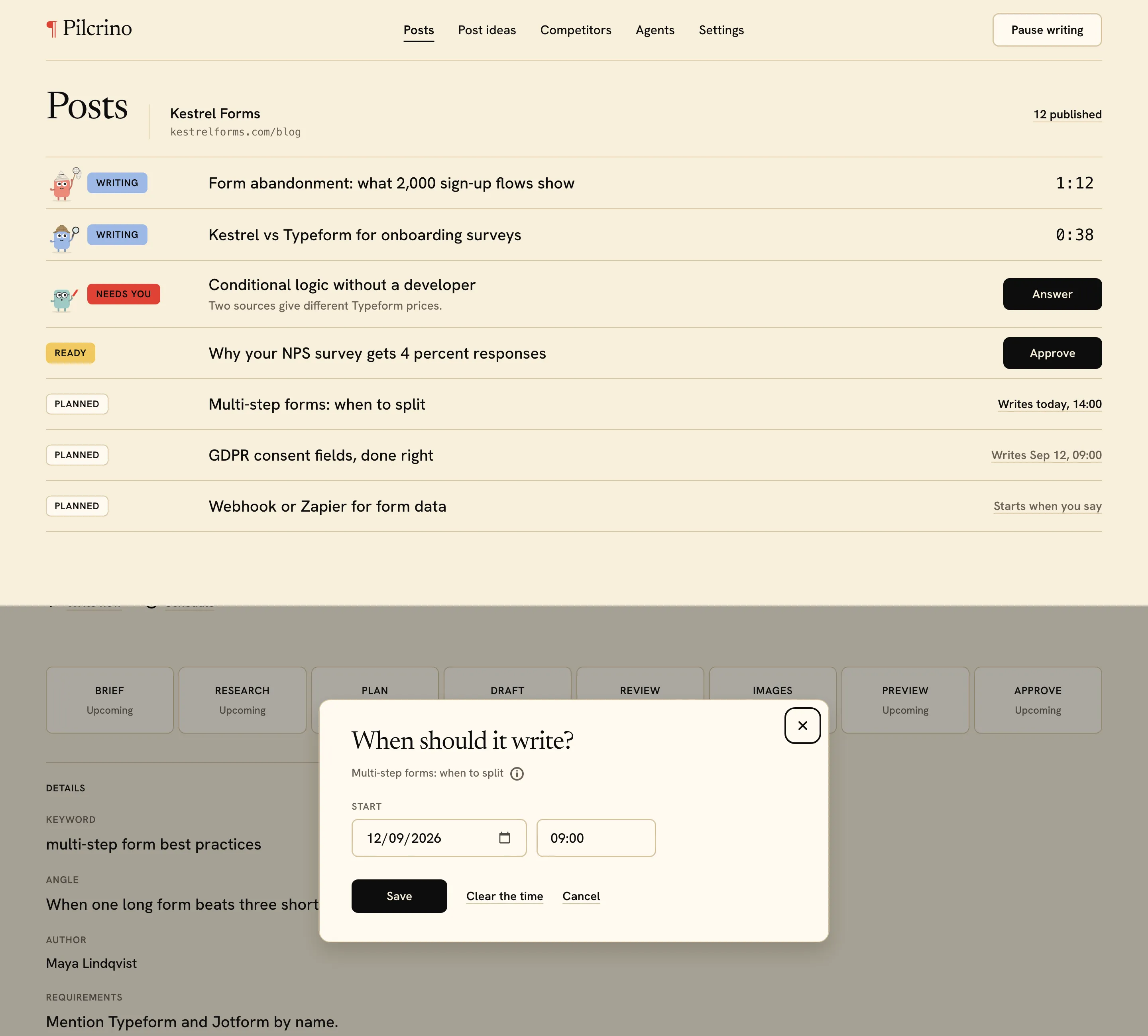
An illustrative queue from a sample workspace; Kestrel Forms is a fictional brand.
Pilcrino runs the queue side of this step:
- The content plan proposes topics from your product docs and competitors, and you edit the list and the order. That ordered list is the queue.
- The built-in preview shows every post as it will publish, with its images.
- The approval gate means nothing publishes until you approve it, now or at a scheduled date.
Getting a post written isn’t publishing it, though. The date a reader sees is the one you pick at approval, so the pace holds and the review step stays in it.
Do you need a tool for this?
Not at one post a week. A spreadsheet with dates and a calendar reminder does the same job. The queue earns its place once you want several posts a week without skipping the read-through. Pilcrino is on a waitlist for now.
How to Set and Adjust Your Cadence With Search Console
How often a SaaS should publish blog posts isn’t a number you set once; it moves as Search Console data comes in. These are my own rules of thumb, not Google guidance, and they assume you publish, wait, and look before you change anything.
- Pick a starting pace from your review time, not your writing time. Count the posts you can read end to end in a week. That number is your ceiling.
- Check each new post is indexed before adding more. Search Console’s URL Inspection tool and Page indexing report show whether Google has the page. As one r/solofirm reply put it: “Before increasing frequency, I’d make sure each post is being submitted and verified in Google Search Console.”
- Review in batches. After each batch (say every 4 to 6 weeks), look at impressions per post, meaning how often Google showed it, and at which queries each post shows up for. Read those before clicks, which come later.
- Speed up when posts get indexed, pick up impressions for the queries you meant, and you still have unanswered buyer questions on the list.
- Slow down when posts sit unindexed, several posts show up for the same queries (they’re competing with each other), or reviews start getting skipped.
Why slow down early?
Because mistakes compound with volume. A reply on r/localseo, about a site with 1,300 pages, says it better than I can: “I’d rather learn it at 30 pages than 1,300.”
Don’t expect those signals right away, either. For timing on a new blog, see what a new SaaS blog should expect in its first 90 days.
Pick a Pace You Can Read
Pick the pace you can review, not the one you can generate. Pilcrino keeps an ordered queue of posts in your voice, argued around your product, and nothing publishes until you approve it. The plugin is free; the app that keeps the queue is $199 once, $129 for the first 50, and on a waitlist for now: join the Pilcrino waitlist.
Researched and drafted with Pilcrino. Approved by Slav.
FAQ
Does Google penalize you for publishing too often?
No publishing number is penalized on its own. Google’s spam policy targets scaled content abuse: many pages generated to manipulate search rankings without helping the people reading them, no matter how they’re made. Publishing often is fine as long as every page answers something distinct and useful.
Is publishing daily better for SEO?
Not by itself. The surveys that show more posts doing better are correlation, and blogs that publish more often also tend to have bigger teams and budgets. Orbit Media’s data shows the industry moving the other way, toward fewer, bigger posts: marketers publishing 2 to 6 times a week fell from 28% in 2014 to 12% by 2022.
How many blog posts should a new SaaS blog start with?
HubSpot suggests 6 to 8 posts a month for a blog under a year old. A short burst to cover your core topics (your product’s main jobs, comparisons, pricing questions) is fine if every post is reviewed before it goes live and each targets a different question.
Should updating old posts count toward my cadence?
Yes, when the update substantially changes the post. Google’s own guidance warns against changing the date of pages to make them look fresh when the content hasn’t really changed, so a new date alone doesn’t count.