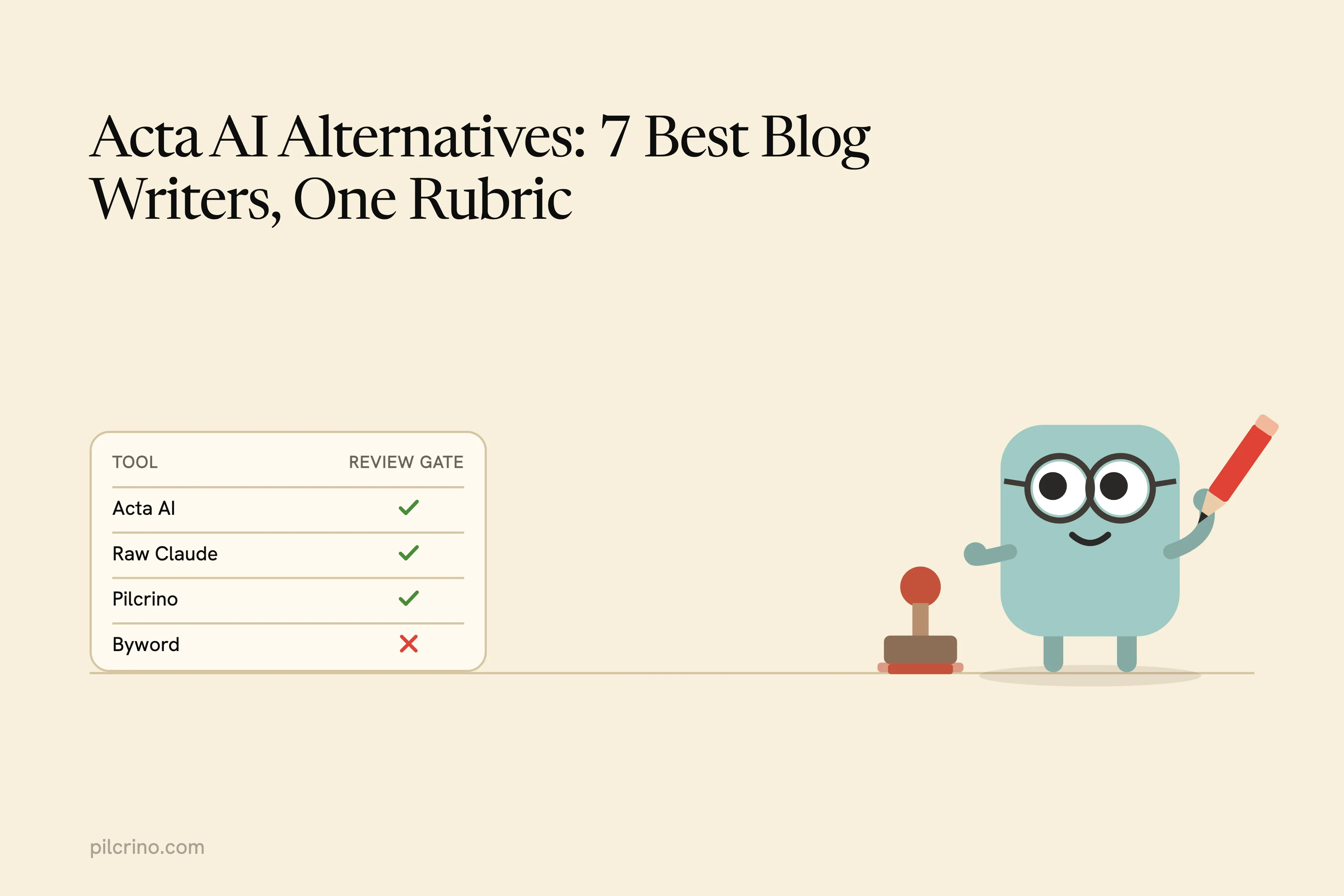
Acta AI, the blog writer at withacta.com (not acta.ai, the meeting-notes tool), ties a fact check to publishing. The best Acta AI alternatives keep a check before anything goes live, even when the check is you.
If you already pay for Claude, use raw Claude for a few posts a month or Daniel Agrici’s free Claude Code skills if you live in a terminal, and pick Junia AI, eesel AI, Byword or Koala Writer only if you want the vendor’s cloud and models.
I build Pilcrino, one of the seven options below, and I rate it by the same rubric as the rest.
Where these tools differ most is voice and who signs off, and voice is most of why AI blog posts sound generic.
Below: a short answer, the comparison tables, who should stay on Acta, how I compared the tools, a review of each with prices as of October 2026, and how to pick.
Key takeaways
- Raw Claude suits a few posts a month, Agrici’s free skills suit terminal users, and Pilcrino suits posts planned around your product, in your voice, researched through your logged-in browser; Junia, eesel, Byword and Koala suit a vendor’s cloud.
- Acta’s entry plan is $29 a month for 15 articles, and voice matching starts on Tribune at $79 for 40.
- “Publishing through Acta requires a current Editorial Review pass,” so only Acta wires a fact check into the publish button; the rest leave the gate to you, to a per-campaign or per-brand draft setting (Junia, Koala), or describe none (Byword).
- Raw Claude and Pilcrino run on the Claude plan you already pay for, Agrici’s skills run inside your Claude Code setup and bill however it bills, and the four paid tools meter their own models.
- On 2026-10-05, four of the six Google result pages I could read for this search were about acta.ai, a different product.
What are the best Acta AI alternatives?
The short version, one line per tool:
- Raw Claude if you want no new subscription and don’t mind running research, outline, draft and review by hand.
- Daniel Agrici’s Claude Code blog skills if you want a free pipeline in your terminal with a hard quality gate. They are free and MIT-licensed.
- Pilcrino if you want posts built around your product and written in your voice, with research from your logged-in browser (Google, Reddit, X) and citations.
- Junia AI if you want a hosted Autoblog that publishes on a schedule to many CMSs.
- eesel AI if your company already runs eesel for support.
- Byword if you produce content in high volume, including programmatic SEO.
- Koala Writer if you run affiliate or niche sites and want cheap words.
Which of these keeps Acta’s best idea, a check before anything goes live?
Fewer than you’d think. Only Acta ties a fact check to publishing. The rest leave approval to you, to a per-campaign setting, or don’t describe one.
Acta AI alternatives compared
Here are the eight criteria, split across two tables, with Acta as the baseline row. First, who approves, what feeds the voice and research, and what the cheapest plan costs:
| Tool | Who approves before it goes live | Voice | Research | Entry price |
|---|---|---|---|---|
| Acta AI (baseline) | Publishing needs a current Editorial Review pass | From a writing sample, Tribune ($79/mo) and up | Server-side web research (Tribune and up); Editorial Review checks primary sources | Scriptor $29/mo, 15 articles |
| Raw Claude | You, by hand | Samples you paste in | What you gather yourself | Your existing Claude plan |
| Agrici’s Claude Code skills | Blocks drafts under 90/100; you publish yourself | /blog style learn from 5 to 10 posts |
WebSearch site operators | $0 (MIT); Claude usage per your Claude Code setup |
| Pilcrino | You approve, then merge or publish; the app can merge on a date you pick | Read from your blog’s posts at setup | Google, Reddit and X through your logged-in browser, cited | Plugin free; app $199 once |
| Junia AI | Save as Drafts or publish on schedule, per campaign | Brand Voice from your style and samples | Server-side web, keyword and competitor data | Growth $34/mo, 10 articles |
| eesel AI | You export it to your CMS | Learned from your website URL | Ranking pages, Reddit, G2, Capterra, Trustpilot | $4/post, or credit plans from $299/mo (the site states both) |
| Byword | No approval gate described; auto-publish promoted | From uploaded content (Basic on Free, Full on paid) | SERP analysis, keyword data | Starter $99/mo, 25 articles |
| Koala Writer | Drafts or auto-publish, per brand | Brand DNA from your website or Google Maps | Deep Research agents (Professional and up) | Starter $25/mo, 45,000 words |
Which AI do you end up paying for?
The second table answers that: who pays for the AI, where your drafts sit, where posts go, and what the tool knows about your product:
| Tool | Which AI plan pays | Where drafts live | Publishes to | Product knowledge |
|---|---|---|---|---|
| Acta AI (baseline) | Inside the subscription (OpenAI and Anthropic) | Acta’s cloud | WordPress, Shopify; others by copy or export | Your notes, a conversation or a recording, plus an interview |
| Raw Claude | Your Claude plan | Wherever you save them | Nowhere; you paste it | What you paste in |
| Agrici’s Claude Code skills | Your Claude Code setup | Local files on your machine | No built-in publishing; WordPress via the WP MCP Ultimate plugin | /blog brand and /blog persona profiles |
| Pilcrino | Your Claude plan, no API key | On your machine | GitHub-built sites (pull request), WordPress (draft), a paste-in file for the rest | Posts planned around your product docs and competitors |
| Junia AI | Junia’s own models, metered | Junia’s cloud | WordPress, Shopify, Webflow, Wix, Blogger, Ghost, Medium, webhook, API | Site crawl plus Knowledge Base |
| eesel AI | eesel’s models, per post or credit | eesel’s cloud (EU or US) | Export as markdown, file or HTML | Site crawl, Notion, Confluence, Google Drive, uploads |
| Byword | Byword’s plans; your own keys only on Unlimited ($1,999/mo) | Byword’s cloud (GCP) | WordPress, Webflow, Shopify, Ghost, HubSpot, Medium | Custom Knowledge Base uploads |
| Koala Writer | Koala’s word meter, MCP included | Koala’s cloud | WordPress, Shopify, Webflow, Ghost, webhook, API | Brand DNA from Google Maps or a site crawl |
Every price comes from the vendor’s own pages, read on 2026-10-03 (Koala Writer on 2026-10-05).
What Acta AI does well, and who should stay on it
Acta starts from you, not from a keyword. It drafts from your notes, a conversation or a recording, then runs an experience interview so your own stories land in the post.
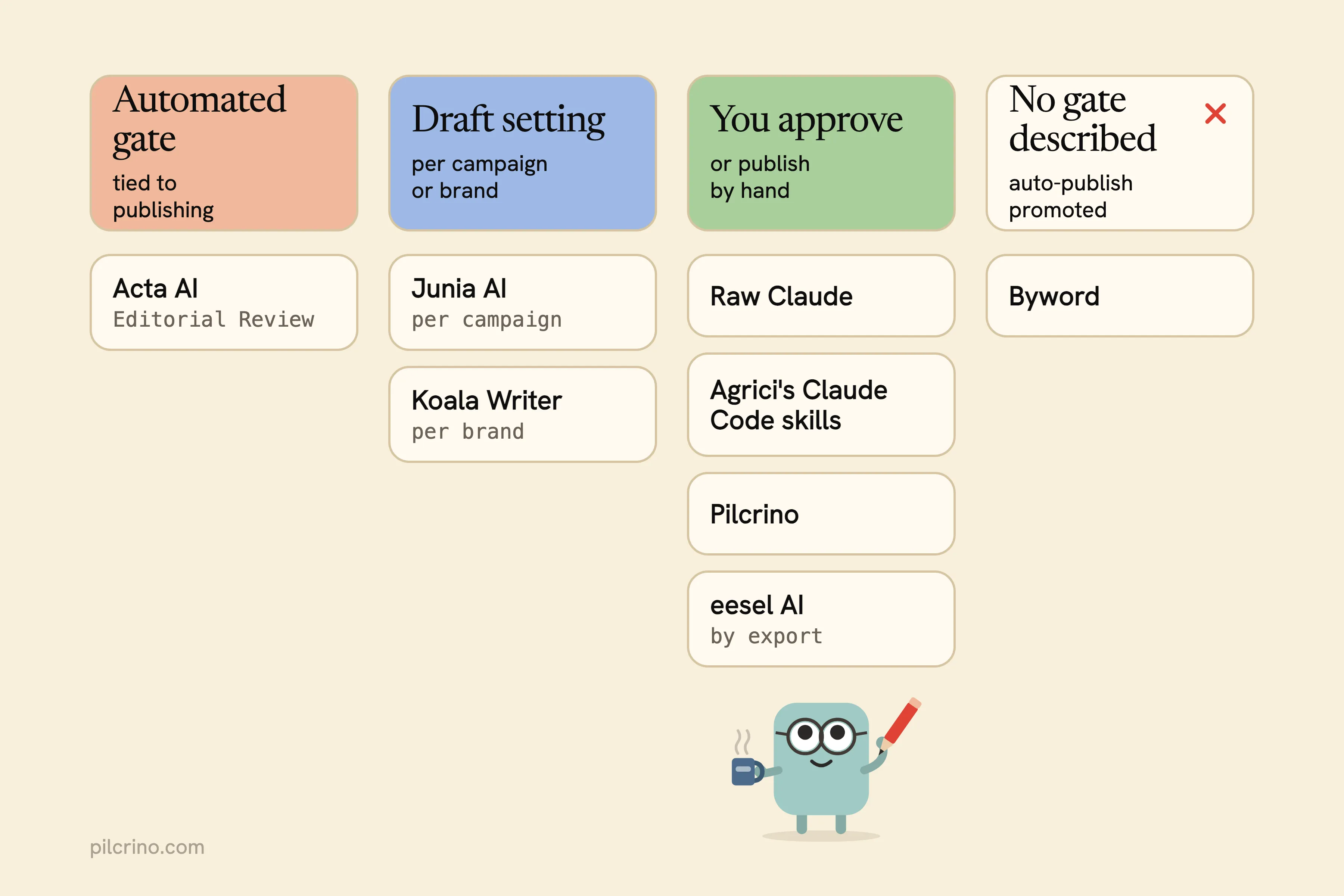
Only Acta ties an automated check to publishing. Junia AI and Koala Writer make review a draft setting per campaign or brand. With raw Claude, Agrici’s skills, Pilcrino and eesel AI (by export), you approve or publish by hand. Byword’s pages describe no gate.
The gate is the real credit. Editorial Review runs on every plan: it checks claims against primary sources, attempts one correction, re-reviews, and a pass stays current for 24 hours. And publishing through Acta requires a current Editorial Review pass.
Each post also gets an Acta Score on six dimensions, from readability to how likely AI assistants are to cite the post. Billing is monthly, and when you hit the cap, generation pauses instead of charging overage.
Has it always been pitched this way?
No. In April 2026 its founder called it “a multi-platform autoblogger” that publishes on a schedule. The October site leads with “Your expertise. Worth publishing.” and the review gate.
Stay on Acta if you run WordPress or Shopify, want a hosted tool, want a fact check wired to the publish button, and want monthly billing with no annual lock-in.
It is weaker for a founder writing about their own product:
- Voice matching starts on Tribune at $79 a month. Scriptor at $29 has no voice matching or web research, and carries a “Blog powered by Acta” credit.
- Your content and platform credentials sit in Acta’s database.
- The AI bill is inside the subscription, and your content goes to providers “including OpenAI and Anthropic”, so the Claude plan you already pay for doesn’t help.
- Direct publishing covers WordPress and Shopify. Anything else, Acta says, “copy or export your article and publish it yourself.”
How I compared them
I build Pilcrino, so weigh this accordingly. I applied eight criteria in this order:
- Who approves before a post goes live.
- Voice, and on which plan.
- Research sources and fact checking.
- Price model and entry price.
- Which AI plan pays.
- Where your docs and drafts live. I wrote more on who holds your docs separately.
- Where it publishes.
- Product knowledge: are posts planned around your product?
Each tool’s numbers come from its own pricing, feature and docs pages, read on 2026-10-03 (Koala Writer on 2026-10-05). I used no directory ratings, because there are none for Acta: the two directory listings that match Acta’s category and $29 price both show 0 reviews.
Why not just read the existing comparisons?
Because Google mostly doesn’t have any. On 2026-10-05 I read the six result pages for this search that loaded. Four described acta.ai, a meeting-notes product, and two matched the withacta.com blog writer, both with 0 reviews.
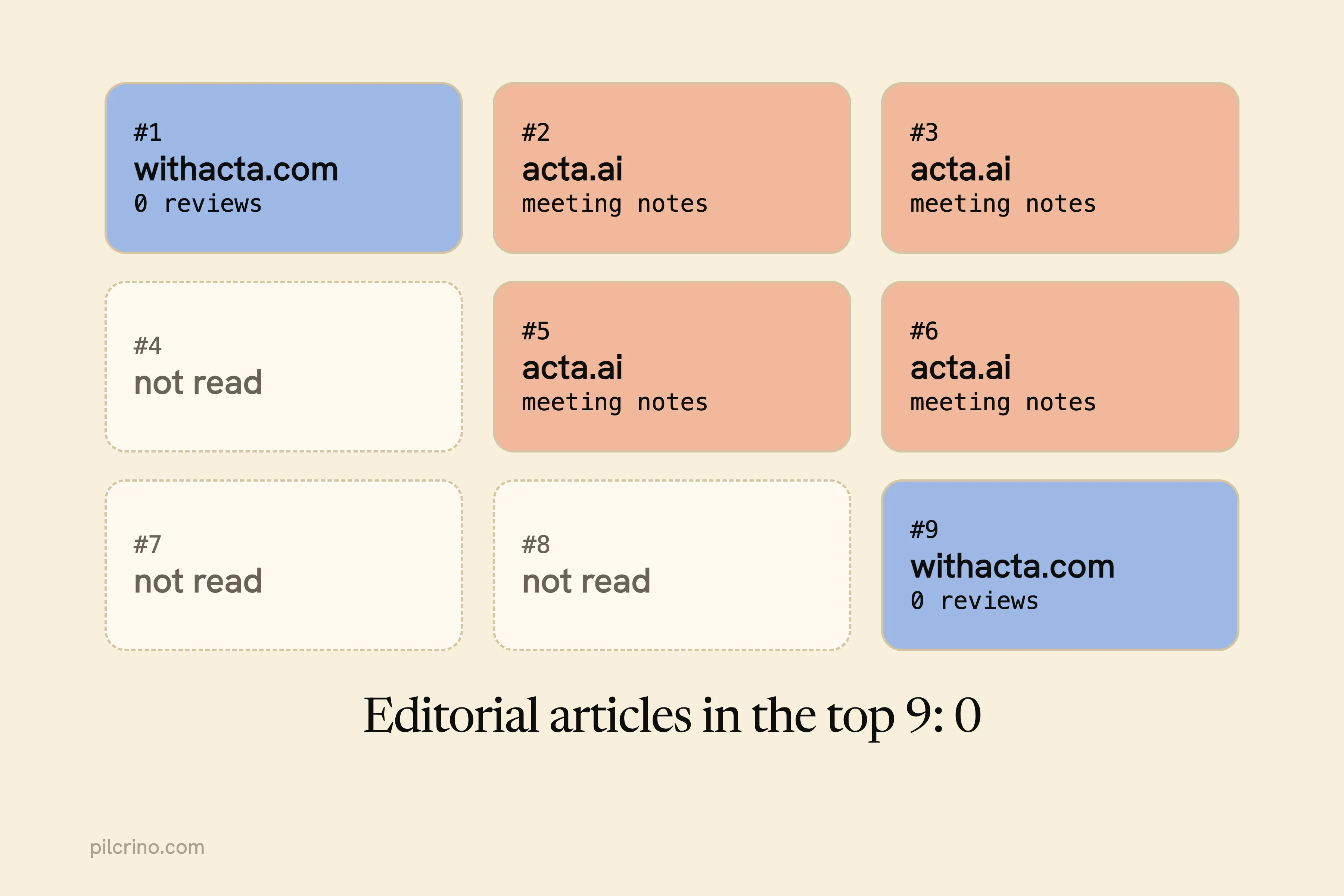
None of the top 9 results was an editorial article. Every one was a directory or a catalogue page, which is why this comparison builds its own table instead of quoting one.
The 7 best Acta AI alternatives, reviewed
Same order as the short list.
Raw Claude
If you pay for Claude, you already have the writer. What you don’t have is the process around it: research, outline, draft, review and publishing are all yours to run.
Voice is the hard part. After a week of trying, u/TimSimpson wrote in r/ClaudeAI that the output “reads like a summary of the thing I wanted to write, not the thing itself.” One commenter fed Claude “around 150 of my emails” and said it “works 95% just fine.”
Is that enough for you? For a few posts a month, often yes. I wrote up how I’d approach writing blog posts with Claude Pro for that route.
Best suited to: a founder who publishes a few posts a month and is happy to run every step by hand in the Claude plan they already pay for. Trade-off: no publishing, and no review gate unless you build one.
Daniel Agrici’s Claude Code blog skills
Daniel Agrici’s Claude Code blog skills are the strongest free option here. Version 2.2.0 ships 30 /blog commands, 5 agents and 12 templates, and the repo has 2.3k GitHub stars.
What stands out is the gate:
- A 5-gate contract scores each draft out of 100 and blocks anything under 90, for up to 3 iterations.
/blog style learnbuilds a voice profile from 5 to 10 of your posts.- The README’s rule: “the user is never the first reviewer.”
The trade-offs are practical. It runs in Claude Code and needs Python 3.11+. There’s no built-in publishing; WordPress goes through the separate WP MCP Ultimate plugin.
Reddit and X research run through WebSearch site operators, not your logged-in browser, and billing follows however your Claude Code setup bills. If you want to build your own version, here’s a Claude Code blog workflow to start from.
Best suited to: a terminal-comfortable writer who wants a free, open pipeline with a hard quality gate.
Pilcrino
Pilcrino is mine. It plans posts around your product docs and competitors, researches through your logged-in browser (Google, Reddit and X), cites what it finds, and writes in your voice on the Claude plan you already pay for, with no API key.
Every post goes through several review rounds: a plan review, a draft review loop, a humanizing pass, then fact and link checks. The images show your product: diagrams in your blog’s palette and fonts, screenshots of your product, and AI illustrations. A built-in preview and an approval gate come last.
Your docs, drafts and blog credentials stay on your machine. The writer is a free Claude Code plugin; the app that runs it for you is $199 once, not a subscription.
What does that cost you?
- It publishes to Astro (as a pull request) and WordPress (as a draft) only.
- It runs on your machine, so that machine has to be on while it writes.
Best suited to: a founder who wants posts argued around their own product, in their voice, researched through their own browser and cited.
Junia AI
Junia’s headline feature is Autoblog, which researches, writes and publishes on a schedule. It reaches more platforms than anything else here: WordPress, Shopify, Webflow, Wix, Blogger, Ghost, Medium, a webhook and an API.
The entry plan, Junia’s Growth plan at $34 a month, gives you 10 articles but no Autoblog. Autoblog needs a Scale plan at $59, $89 or $159 a month. The cheaper yearly prices are a limited-time 50% promo.
Each campaign picks “Save as Drafts” or publishing on schedule, and Junia’s docs advise “Start with drafts if you want to review the first few articles.”
It runs Junia’s own models in Junia’s cloud, and it markets a “Bypass AI Detection” toggle.
Best suited to: a team that wants a hosted Autoblog publishing on a schedule across many CMSs. Trade-off: Autoblog starts on Scale, and your plan buys Junia’s models, not Claude.
eesel AI
eesel’s main product is a customer-service AI agent. The blog writer is one more agent on that platform, and it learns your voice, colours and logo from your website URL. Its research reads what ranks plus Reddit threads, G2, Capterra and Trustpilot.
How much does it cost? The site gives two answers. The Blog Writer page says $4 per blog post, pay as you go, while the pricing page lists credit plans from $299 a month, where a post uses “more than one” credit.
Posts reach your CMS by export, as markdown, a file or HTML. Everything lives in eesel’s cloud, with EU or US data residency.
Best suited to: a company already on eesel for support that wants a blog writer quoting Reddit, G2, Capterra and Trustpilot. Trade-off: unclear pricing, and the blog writer is a side agent on a support platform.
Byword
Byword is built for volume. Byword starts at $99 a month for 25 articles on Starter, then $299 for 80 and $999 for 300. A free account gets 5 one-time articles, and credits never expire.
Its models are GPT-5.4, Claude Opus 4.6 and Gemini 3.1 Pro on Byword’s plans. Using your own Anthropic and Google API keys needs the Unlimited plan, a $1,999 a month platform fee plus roughly $0.10 per article paid to the AI providers. It publishes natively to WordPress, Webflow, Shopify, Ghost, HubSpot and Medium.
Byword’s pages describe no approval gate. Articles have a manual Publish button, but the integration pages promote “Zero manual publishing forever.”
Best suited to: content teams producing high volume with programmatic SEO. Trade-off: a high entry price, and a tool that leans toward publishing without review.
Koala Writer
Koala prices by the word, not the article. Starter is $25 a month for 45,000 words, and a free account gets 5,000 words with no card.
The catch is the meter. Koala meters words by model: GPT-6 Luna counts 1x, GPT-6 Sol and Claude Sonnet 5 count 2x, and Claude Opus 5.5 counts 3x. A 1,000-word Opus article uses 3,000 of Starter’s 45,000 words.
Can you drive it from your own Claude? Yes, through Koala’s MCP server with 62 tools, but “Generating an article through MCP uses your Koala AI word allowance.” Each brand can publish as drafts or auto-publish. I went deeper on this tool in Koala AI alternatives.
Best suited to: affiliate and niche sites that want cheap volume. Trade-off: the stronger the model, the faster the words run out, and everything lives in Koala’s cloud.
What happens before a Pilcrino post reaches you
Acta wires one automated fact check to publishing. Pilcrino runs several checks along the way.
Research comes first. Pilcrino reads Google results, Reddit threads and X posts through your logged-in browser, and the post cites them, the way this one links its Reddit quotes.
Then the review rounds. An agent reviews the plan before any writing starts. The draft goes through a review loop, a humanizing pass follows, and fact and link checks run on the result.
The images come from your product, not only from a prompt: diagrams rendered in your blog’s palette and fonts, screenshots of your product, and AI illustrations.
Last comes the preview screen. You read every post as it will publish, images included, after the checks have run.
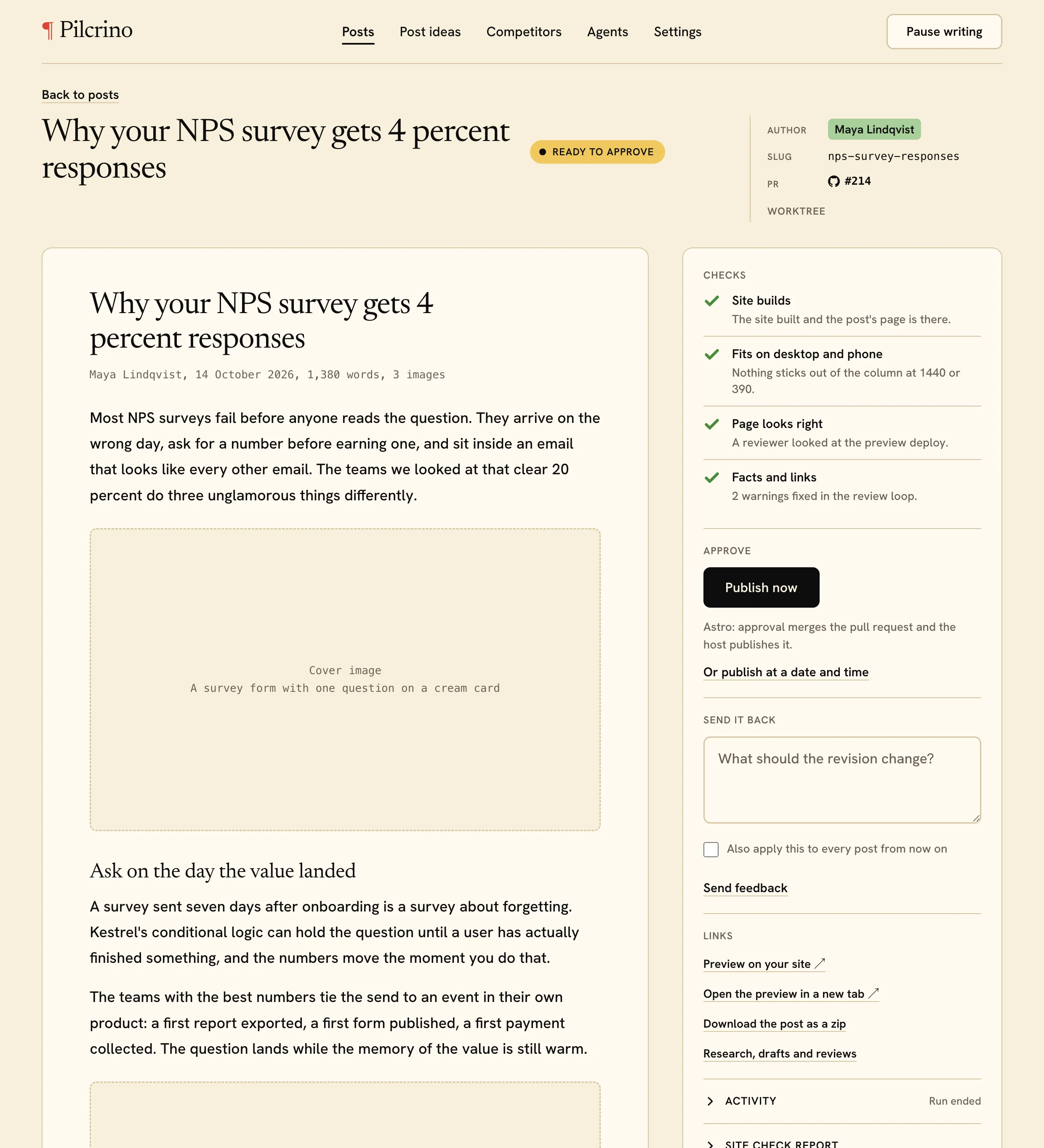
The screen above is the app with an example blog. The post on the left reads exactly as it will on the site. On the right, three checks ran first: the site build, a visual check on the preview deploy, and the fact and link checks. One item still needs a human, so it waits.
Astro posts arrive as a GitHub pull request (a proposed change you can read and merge) and WordPress posts as a draft. You approve now or pick a date.
Is an approval step free? No. It costs your time, and the queue can grow.
In a thread about one team’s automated pipeline, u/Deep_Ad1959 wrote that “8 opened, 1 published, 6 still sitting in review after two weeks is the number i’d watch.” The numbers come from the vendor that ran the pipeline and posted about it, not a benchmark, but it’s the right number to watch.
How to choose an Acta AI alternative
Pick by situation:
- A few posts a month, happy doing the steps: raw Claude.
- Terminal, free, open source: Daniel Agrici’s Claude Code skills.
- Posts planned around your product, in your voice, researched through your browser: Pilcrino.
- A hosted Autoblog across many CMSs: Junia AI.
- Already on eesel for support: eesel AI.
- Volume and programmatic SEO: Byword, or Koala Writer if words per dollar matter most.
- A fact check wired to the publish button, on WordPress or Shopify: stay on Acta.
Still unsure?
Start from what you already pay for. If that’s a Claude plan, raw Claude and Pilcrino add no new subscription, and Agrici’s skills are free to install. If you’d rather pay a vendor to run the whole thing, Acta is a fair choice: $29, $79 and $249 a month, monthly only, no overage fees.
Pilcrino plans posts around your product, writes them in your voice and researches them through your own browser, all on the Claude plan you already pay for. The plugin is free. The app is $199 once, $129 for the first 50, with 12 months of updates and support. If that’s what you want, join the Pilcrino waitlist.
Researched and drafted with Pilcrino. Approved by Slav.
FAQ
Is Acta AI the same as acta.ai?
No. Acta AI is the blog writer at withacta.com, built by a solo founder in Rome. acta.ai is a different company that makes a meeting-notes product. Search results mix the two up: on 2026-10-05, four of the six alternatives pages I could read in Google were about acta.ai.
Does Acta AI publish automatically?
It can publish on a schedule to WordPress or Shopify, and you pick a review queue, drafts or scheduled publishing for each site. Whichever you pick, publishing through Acta needs a current Editorial Review pass, which checks the post’s claims against primary sources and stays current for 24 hours.
How much does Acta AI cost?
Acta has three monthly plans: Scriptor at $29 for 15 articles, Tribune at $79 for 40 and Imperator at $249 for 120. There is no annual option and no free plan, but a 14-day Tribune trial includes 10 articles with no credit card. Prices are from Acta’s pricing page in October 2026.
Which Acta AI alternative runs on my Claude plan?
Raw Claude and Pilcrino run on the Claude plan you already pay for, and Daniel Agrici’s Claude Code skills run inside your Claude Code setup and bill however that setup bills. Junia AI, eesel AI, Byword and Koala Writer meter their own models, and Byword lets you bring your own API keys only on its Unlimited plan.
Is there a free Acta AI alternative?
Yes. Daniel Agrici’s Claude Code skills are free and MIT-licensed. Junia AI has a free plan, Byword gives 5 one-time articles, and Koala Writer gives 5,000 words. Acta itself has a 14-day trial but no free plan.